Top ContractPodAI (Now Leah) Competitors & Alternatives for Enterprise CLM in 2026
- Jun 06, 2026
- 15 min read
- Sirion
- Leah, formerly known as ContractPodAI, is part of a growing market of AI-powered CLM platforms competing for enterprise adoption.
Organizations evaluating ContractPodAI competitors increasingly compare platforms based on AI maturity, scalability, integrations, and operational visibility. - Modern enterprises need more than basic contract repositories and workflow automation.
Leading contract lifecycle management platforms now support AI-driven risk analysis, obligation tracking, analytics, and end-to-end contract operations. - Different ContractPodAi alternatives serve different enterprise priorities.
Some platforms focus on legal collaboration and ease of use, while others emphasize enterprise governance, procurement visibility, or AI-native automation. - Agentic AI and operational intelligence are becoming major differentiators in enterprise CLM.
Businesses increasingly prioritize platforms that can operationalize contract data across procurement, legal, finance, and compliance workflows. - Sirion stands out for enterprises seeking scalable, AI-native, end-to-end contract management.
Its Agentic AI CLM capabilities, advanced analytics, and enterprise-scale governance support complex global contracting environments.
Leah, formerly known as ContractPodAi, has become one of the more visible AI-powered contract management platforms in the enterprise CLM market. The company’s rebrand toward “Leah” reflects a broader industry shift toward AI-first legal and contracting experiences.
At the same time, enterprise expectations around contract lifecycle management have evolved significantly.
Organizations no longer evaluate CLM software based only on repositories, approvals, and e-signatures. Enterprises now expect AI-native capabilities, workflow orchestration, operational visibility, analytics, and integrations that connect contracts to procurement, finance, legal, and supplier ecosystems.
This shift has led many organizations to actively evaluate Leah competitors and broader Leah alternatives before committing to a long-term CLM strategy.
Some businesses prioritize usability and legal collaboration. Others focus on enterprise governance, procurement operations, AI-powered analytics, or large-scale contract centralization. Increasingly, buyers are also evaluating how well platforms support end-to-end performance tracking rather than isolated legal workflows.
Whether you are modernizing legal operations, scaling procurement governance, or evaluating ai powered contract management platforms, understanding the strengths and trade-offs across today’s CLM market is critical.
What Is ContractPodAI, Formerly Known as Leah
Leah is an AI-powered contract lifecycle management platform focused on legal operations, workflow automation, and enterprise contract management.
The platform combines contract creation, workflow management, repository capabilities, AI-assisted review, and analytics within a centralized legal technology environment. Its rebrand toward “Leah” reflects a stronger emphasis on AI-powered legal experiences and conversational interfaces.
Leah is often evaluated by organizations looking to:
- Modernize legal workflows
- Centralize contracts and legal documents
- Improve collaboration across business teams
- Automate approvals and reviews
- Introduce AI-assisted contract analysis
At the same time, some enterprises evaluating long-term CLM strategy explore Leah competitors due to evolving operational requirements around scalability, AI maturity, integrations, analytics depth, procurement visibility, and end-to-end contract management.
Exploring Leah’s Features and What They Mean for CLM Buyers
Contract Creation and Automation
Leah supports template-based drafting, automated workflows, and AI-assisted contract creation to help legal teams accelerate document generation.
Where buyers may want more:
Some enterprises seek deeper workflow orchestration, procurement integration, and AI-native operational intelligence beyond legal drafting automation alone.
Workflow and Approval Management
The platform offers configurable approval routing and collaboration workflows to streamline contract reviews and stakeholder coordination.
Where buyers may want more:
Organizations with highly complex global governance models may require broader enterprise-scale workflow customization and operational visibility.
Analytics and Reporting
Leah includes reporting dashboards and AI-assisted contract analysis capabilities to help teams surface risks and monitor contract activity.
Where buyers may want more:
Some enterprises evaluate alternatives offering deeper analytics, portfolio-wide operational insights, obligation tracking, and performance intelligence tied directly to commercial outcomes.
Third-Party Integrations
The platform integrates with several enterprise systems and legal technology environments to improve workflow connectivity.
Where buyers may want more:
Enterprises operating large ERP, procurement, supplier management, and finance ecosystems may prioritize broader integration depth and connected operational data flows.
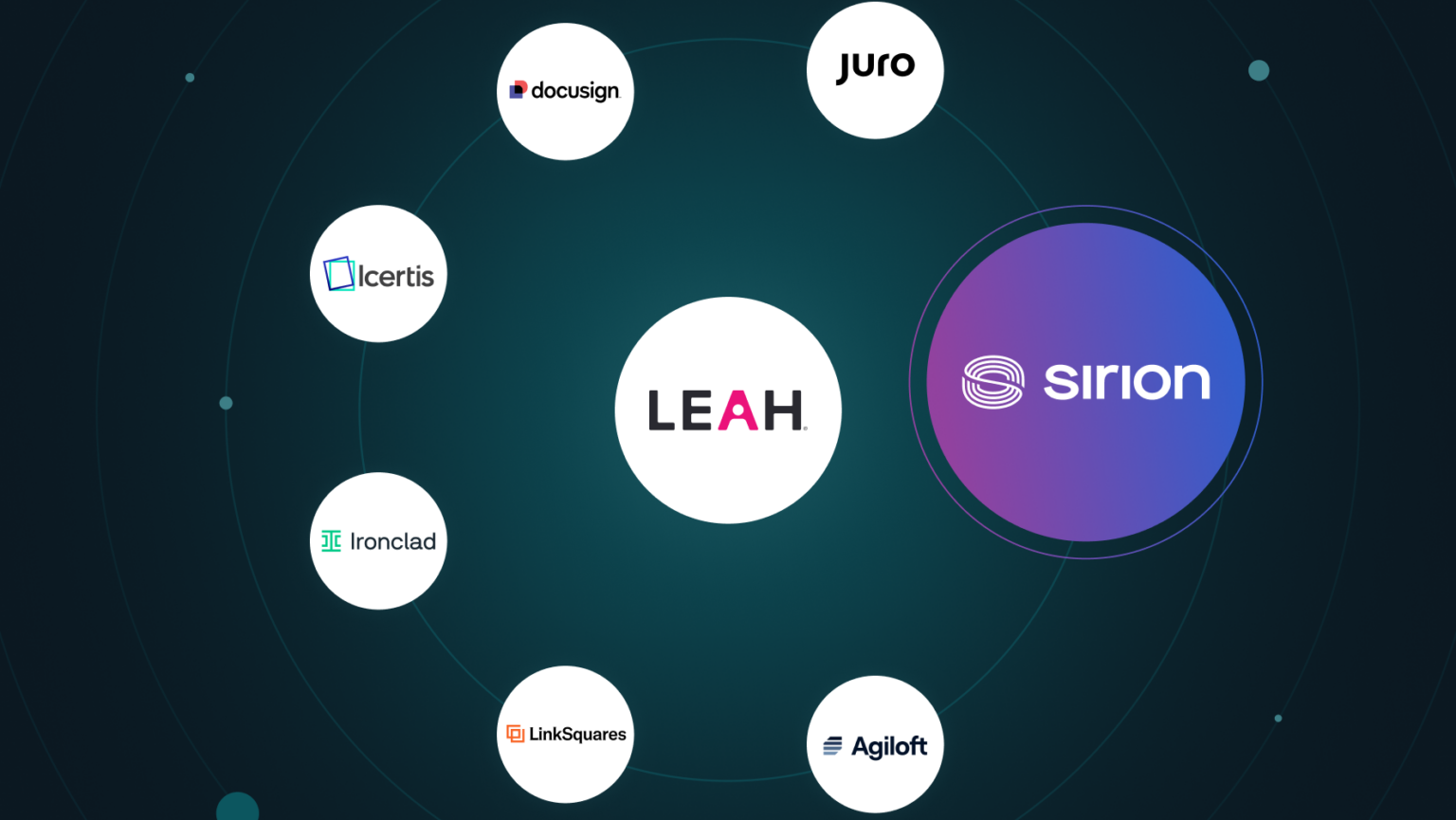
Top 7 Leah Competitors Redefining CLM in 2026
Platform | Brief About the Platform | Best For | Pricing |
Sirion | Enterprise-level CLM platform built with Agentic AI to support complex contracting and end-to-end performance tracking. | Large enterprises with complex CLM needs | Custom pricing |
Icertis | Contract intelligence platform designed to help enterprises manage large and complex contract portfolios. | Enterprises and regulated industries | Custom pricing |
Ironclad | Digital contracting platform focused on legal workflows, business collaboration, and faster contract execution. | Legal teams and business users | Custom pricing |
Agiloft | Flexible CLM platform known for configurable workflows and contract process automation. | Teams needing high customization | Custom pricing |
DocuSign CLM | CLM solution connected with DocuSign’s eSignature and agreement management ecosystem. | Teams already using DocuSign | Custom pricing |
Juro | AI-enabled contract automation platform for creating, approving, signing, and managing contracts in one workspace. | Fast-growing legal and business teams | Custom pricing |
LinkSquares | AI-powered contract management platform focused on contract visibility, search, and legal operations insights. | Mid-market and enterprise legal teams | Custom pricing |
Sirion – Best for Large Enterprises Seeking End-to-End Agentic AI-Powered CLM Solution
Sirion is an AI-native enterprise CLM platform designed for organizations managing complex contracting environments across procurement, legal, finance, supplier governance, and compliance operations.
Unlike platforms focused primarily on legal workflow automation, Sirion combines Agentic AI CLM capabilities, operational analytics, workflow orchestration, and enterprise-scale governance across the entire contract lifecycle.
Key Features of Sirion
- AI-native contract analysis and risk detection
- Pre- and post-signature obligation tracking
- Guided contract drafting
- Advanced analytics and operational insights
- Deep enterprise integrations
Pros
- AI-driven insights
- End-to-end CLM solution
- Enterprise-scale governance
- Strong procurement and supplier visibility
Explore the Best Alternative to ContractPodAI for Enterprise CLM and compare capabilities, scalability, and AI innovation across leading enterprise platforms.
Cons
- Primarily designed for large enterprises
- Enterprise implementation may require planning
What Users Are Saying About Sirion
· “User friendly tool that will transform your contract management processes.” – Gartner Peer Insights · “Effective Support and Responsive Communication Highlight Sirion Implementation Experience.” – Gartner Peer Insights · “Comprehensive CLM That Brings Legal, Procurement, and Business onto One Platform” – G2 Review · “Outstanding End-to-End CLM Automation with Powerful AI and Workflow Design” – G2 Review |
Icertis – Suitable for Enterprises Managing Complex Contract Portfolios
Icertis is widely recognized for enterprise contract governance, compliance management, and contract intelligence across highly regulated industries.
Key Features of Icertis
- Enterprise contract governance
- Compliance management
- AI-assisted contract intelligence
- Advanced workflow automation
- Large-scale repository management
Pros
- Strong governance controls
- Mature enterprise workflows
- Extensive compliance capabilities
Cons
- Longer implementation cycles
- Administrative complexity
What Users Are Saying About Icertis
“Implementation Requires Significant Planning and Coordination Among Team Members” – Gartner Peer Insights “Training was easy, tool not there yet for advanced capabilities and top-tier support” – Gartner Peer Insights “Highly Complex Tool which may not be a straight-forward solution for Procurement Function” – G2 Reviews “Icertis is useful, but it’s not without its shortcomings” – G2 Reviews |
Ironclad – Suitable Legal Teams Streamlining Digital Contract Workflows
Ironclad is known for collaborative legal workflows, intuitive interfaces, and streamlined digital contracting experiences.
Key Features of Ironclad
- Workflow automation
- Collaborative redlining
- Approval routing
- E-signature integrations
- Legal workflow visibility
Pros
- Modern interface
- Strong legal collaboration
- Faster onboarding experience
Cons
- Limited advanced analytics
- Less emphasis on operational intelligence
What Users Are Saying About Ironclad
Agiloft – Suitable for Teams Needing Highly Configurable CLM Workflows
Agiloft is recognized for its highly configurable no-code architecture and governance-heavy workflow customization.
Key Features of Agiloft
- No-code customization
- Workflow automation
- Compliance management
- AI-assisted workflows
- Advanced reporting
Pros
- Highly flexible workflows
- Strong governance controls
- Extensive customization capabilities
Cons
- Longer onboarding timelines
- Can require technical administration expertise
What Users Are Saying About Agiloft
“In-Depth Look at Feature-Rich Product Marred by Slow Support” – Gartner Peer Insights “Customization and Maintenance Require Advanced Skills Amid Declining Support Experiences” – Gartner Peer Insights “Powerful and Flexible Platform, but there are Hurdles to overcome” – G2 Reviews “Centralized Contract Storage, Needs User-Friendly Improvements” – G2 Reviews |
Explore the Best Simple Contract Management Software Alternatives to Agiloft and compare leading solutions designed to simplify contracting while supporting enterprise-scale requirements.
DocuSign CLM – Suitable for Teams Using DocuSign’s Agreement Ecosystem
DocuSign CLM extends the company’s widely adopted e-signature platform into broader contract lifecycle management.
Key Features of DocuSign CLM
- Native e-signature integration
- Workflow automation
- Repository management
- Approval routing
- Broad integrations
Pros
- Strong brand familiarity
- Seamless signature workflows
- Extensive integration ecosystem
Cons
- Less customizable for highly complex workflows
- Advanced analytics may require additional tooling
What Users Are Saying About DocuSign CLM
· “Centralised Contract Management Streamlines Workflows But Presents Integration Challenges” – Gartner Peer Insights · “Technical Issues and Expensive Plans Limit Utility of Intuitive Tool” – Gartner Peer Insights · “Signature module is amazing, core CLM UI is not great” – G2 Review · “It allows many functionalities, but it is difficult to learn them in order to master it” – G2 Review |
Juro – Suitable for Growing Teams Seeking Collaborative Contract Automation
Juro focuses on browser-native contract collaboration and lightweight workflow automation for growing teams.
Key Features of Juro
- Browser-native editing
- AI-assisted drafting
- Contract collaboration
- Workflow approvals
- Integrated signing
Pros
- User-friendly experience
- Fast deployment
- Strong collaboration tools
Cons
- Less suited for highly complex enterprise governance
- Limited deep operational analytics
What Users Are Saying About Juro
“Simple and smooth when uncomplicated and when clients are happy to use it.” – G2 Reviews “Juro is a fine platform to manage contract templates but a lot that could be improved” – G2 Reviews |
LinkSquares – Suitable for Legal Teams Focused on Contract Visibility and Analytics
LinkSquares is an AI-powered contract management platform focused heavily on repository intelligence, analytics, and searchability.
Key Features of LinkSquares
- AI-powered search and analytics
- Repository intelligence
- Contract visibility
- Legal operations insights
- Reporting dashboards
Pros
- Strong contract visibility
- Fast search capabilities
- Helpful analytics for legal teams
Cons
- Less emphasis on deep operational workflows
- More limited procurement functionality
What Users Are Saying About LinkSquares
· “Template Creation and Search Features Improve Efficiency Although Challenges Are Present” – Gartner Peer Insights · “Web Interface Performs Smoothly but Setup and Administration Require Significant Effort” – Gartner Peer Insights · “Effective Contract Management, But Needs Better Support” – G2 Reviews · “LS is a very good tool overall, if one has enough time to organize documents” – G2 Reviews
|
Why Enterprises Are Re-Evaluating Leah and Exploring Alternatives
Many enterprises evaluating Leah alternatives are reassessing how well traditional CLM environments support evolving operational and AI requirements.
Common reasons include:
- Shift Away from Core CLM Focus
Some organizations believe the platform’s broader legal technology positioning can dilute focus on deep enterprise contract lifecycle management requirements. - Complex Onboarding and Bulk Ingestion
Large-scale migration and legacy contract ingestion may require significant operational effort for enterprises managing massive portfolios. - Limited Ecosystem Integrations
Organizations with highly interconnected procurement, ERP, and finance environments may require broader integration flexibility. - Narrower AI Capabilities
Enterprises increasingly seek AI-native operational intelligence beyond legal review and drafting assistance. - Scalability Concerns
Global enterprises often require more advanced governance, analytics, and workflow orchestration across multiple business functions. - Limited Reporting & Analytics
Some organizations prioritize deeper portfolio analytics, obligation visibility, and operational performance intelligence.
Explore the Best CLM Software for Large Enterprises and see how leading platforms support complex contracting, governance, and scalability requirements.
Choosing the Right CLM Platform for Your Enterprise
Identify Your Core Pain Points
Organizations should first determine whether their biggest challenges involve legal workflows, procurement visibility, compliance, analytics, or operational coordination.
Define Essential Features
Different enterprises prioritize different capabilities such as AI review, workflow automation, contract centralization, obligation tracking, or analytics.
Ensure Integration Capabilities
A CLM platform should connect seamlessly with ERP, CRM, procurement, finance, and legal systems.
Evaluate Security & Customization
Global enterprises often require granular permissions, governance frameworks, and configurable workflows.
Compare Pricing and Deployment Models
Enterprises should evaluate not only licensing costs, but also implementation timelines, support, scalability, and operational ROI.
Head-to-Head Comparison: Sirion vs Leah
Category | Sirion | Leah |
Brand & AI Positioning | Agentic AI CLM with purpose-built AI agents for enterprise contracting | AI-powered legal and contract management platform |
AI Performance & Speed | AI-native analytics, risk detection, workflow orchestration, operational intelligence | AI-assisted drafting and legal review workflows |
Contract Migration | Supports large-scale intelligent ingestion and data mapping | Bulk ingestion may require additional operational effort |
Enterprise Scale | Built for large global enterprises and procurement-heavy operations | Strong legal operations focus |
Analytics & Visibility | Deep operational analytics and obligation visibility | Standard reporting and dashboard capabilities |
Integrations | Extensive ERP, procurement, CRM, and finance integrations | Broad integrations with some ecosystem limitations |
Governance | Enterprise-grade workflow orchestration and governance controls | Strong legal workflow automation |
User Experience | Centralized administration with AI-driven operational workflows | Modern legal user interface and collaboration tools |
Why Sirion Is the Strongest Long-Term Alternative to Leah for Global Enterprises
Enterprises increasingly choose Sirion when they require deeper operational intelligence and scalable AI-native contract lifecycle management.
Key advantages include:
- Agentic AI-Powered Automation
Purpose-built AI agents support contract analysis, workflow orchestration, issue detection, and operational intelligence. - End-to-End Contract Management
Sirion supports workflows spanning drafting, negotiation, obligations, analytics, renewals, and supplier governance. - Enterprise-Scale Capabilities
Designed specifically for global enterprises managing complex procurement, compliance, and operational ecosystems. - Advanced Analytics & Insights
Provides portfolio-wide visibility into risks, obligations, supplier performance, and contract outcomes. - Customizability & Governance
Supports configurable workflows, enterprise permissions, compliance controls, and policy standardization. - Collaboration Across Teams
Connects procurement, legal, finance, sales, and supplier teams within unified workflows and centralized contract intelligence.

Experience AI-Native CLM in Action
See how Sirion transforms contracting with automation, compliance, and faster time-to-contract.
The Verdict on Leah Competitors
The market for Leah competitors has evolved rapidly as enterprises demand more from modern contract lifecycle management platforms.
Organizations increasingly expect AI-powered automation, operational visibility, analytics, workflow orchestration, and connected enterprise intelligence rather than simple repositories and approval workflows.
Leah continues to serve organizations seeking AI-powered legal workflow modernization and contract management capabilities. However, some enterprises evaluating long-term scalability, operational intelligence, and end-to-end contract management continue exploring broader Leah alternatives.
Platforms such as Sirion, Icertis, Ironclad, Agiloft, DocuSign CLM, Juro, and LinkSquares each serve different organizational priorities depending on governance complexity, AI strategy, collaboration requirements, and operational scale.
For large global enterprises pursuing long-term digital transformation, AI-native operational visibility and enterprise-scale contract intelligence are becoming increasingly important differentiators in CLM selection.
Frequently Asked Questions (FAQs)
Why is end-to-end contract management important for global enterprises?
Global enterprises manage contracts across multiple departments, regions, suppliers, and regulatory environments. End-to-end contract management improves visibility, standardizes governance, reduces operational silos, and helps organizations track obligations, compliance, renewals, and performance throughout the entire lifecycle.
What are the common challenges companies face when migrating contracts to a new CLM?
Common migration challenges include inconsistent metadata, fragmented repositories, poor document quality, duplicate contracts, integration complexity, and insufficient governance. Large enterprises also frequently struggle with bulk ingestion, workflow standardization, and aligning legacy contracts with new operational frameworks.
What are the benefits of multi-department collaboration within a CLM system?
Multi-department collaboration improves operational alignment across legal, procurement, finance, compliance, and sales teams. Centralized workflows reduce approval delays, improve contract visibility, strengthen accountability, and ensure contractual obligations are consistently managed across the organization.
How does CLM software reduce manual errors and improve contract accuracy?
CLM software standardizes templates, automates workflows, centralizes approvals, and uses AI-powered analysis to reduce drafting inconsistencies, missing clauses, and approval bottlenecks. Automated governance also improves version control and compliance consistency across contract portfolios.
What metrics should organizations track to measure CLM performance?
Organizations commonly track contract cycle time, approval bottlenecks, renewal rates, obligation compliance, risk exposure, contract value leakage, supplier performance, negotiation turnaround time, and workflow efficiency to measure CLM effectiveness and operational impact.
Sirion is the world’s leading AI-native CLM platform, pioneering the application of Agentic AI to help enterprises transform the way they store, create, and manage contracts. The platform’s extraction, conversational search, and AI-enhanced negotiation capabilities have revolutionized contracting across enterprise teams – from legal and procurement to sales and finance.