














Avoid failed implementations and bolt-on AI. Choose a platform built to perform – not just promise.
Extraction is limited to a small number of fields OOTB
Extract thousands of fields across metadata, clauses, obligations, service levels and more
Flat repository, no parent-child hierarchy
Hierarchical, folder-structure, fully searchable repository
Manually built, rule-based playbooks
Playbook creation via conversational prompts
Redlines clauses in isolation, no issue-level granularity
Issue-level drill down for precise confident negotiations
Limited extraction restricts reporting capabilities
Full BI engine. Ability to create custom records
Integrations are complex and lack enterprise depth
Deep OOTB integration with SAP, Oracle, Salesforce, and more
Configuration changes mostly need vendor or IT support
Fully self-serve, no-code configuration across the platform
Dated, everyday actions feel complex
Modern, consumer-grade experience with conversational contracting
Empower business users to configure workflows, templates, clause libraries, and AI models – without depending on IT or vendor teams. Leverage AgentOS to design, deploy, and orchestrate custom agents that work together and connect with enterprise data to automate complex workflows.
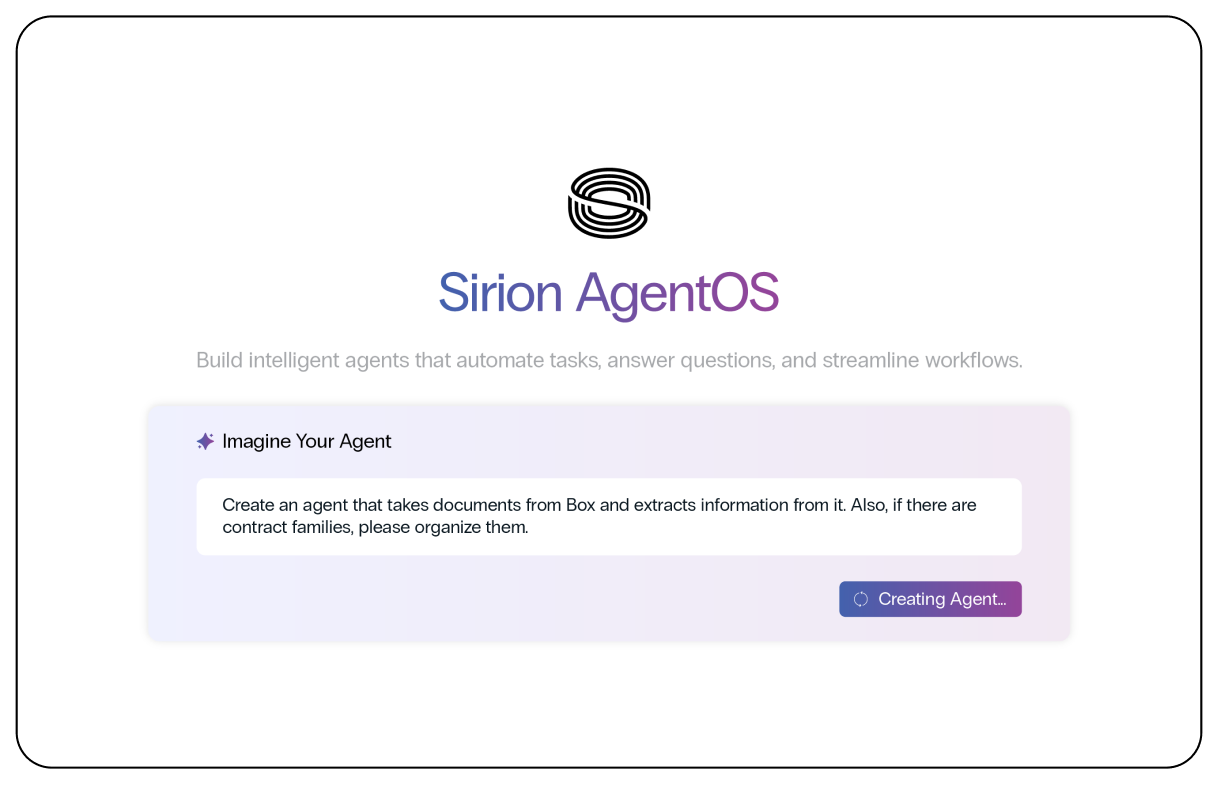
Specialized Agents embed intelligence into drafting, negotiation, extraction, and post-signature performance to automate outcomes across the contract lifecycle.
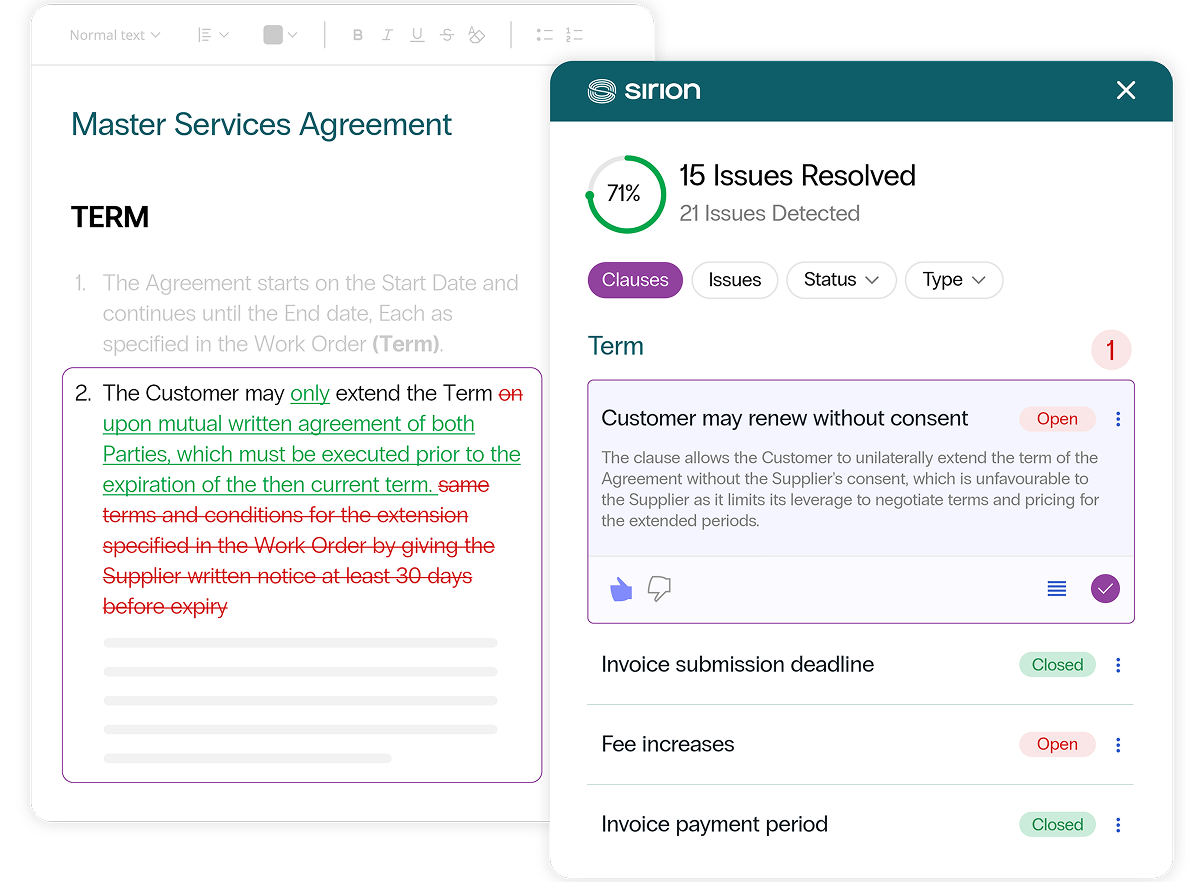
Empower teams to work with contracts in the tools they trust and use every day. Use OOTB integrations for platforms like Salesforce, SAP, and Microsoft – or leverage robust B2B APIs to connect with any third-party application seamlessly.
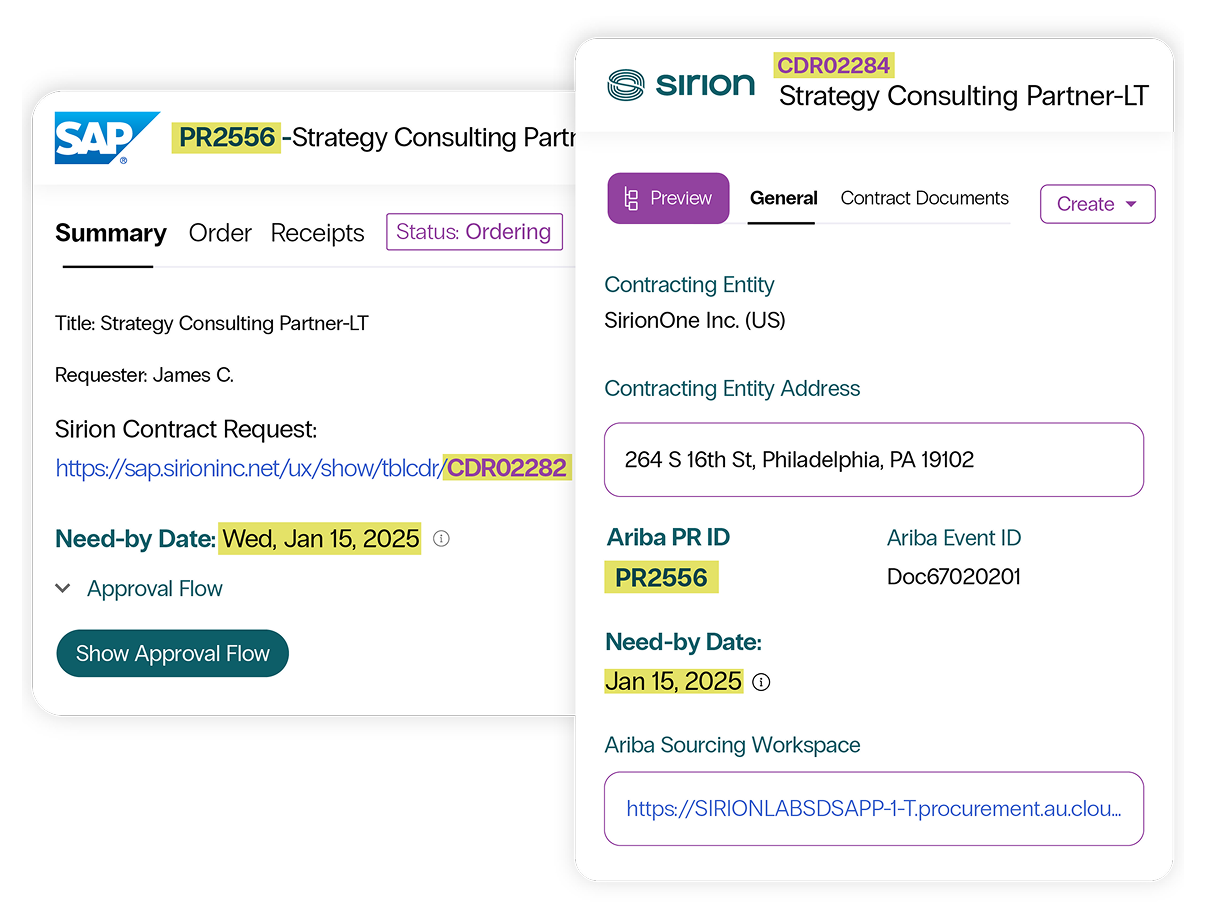
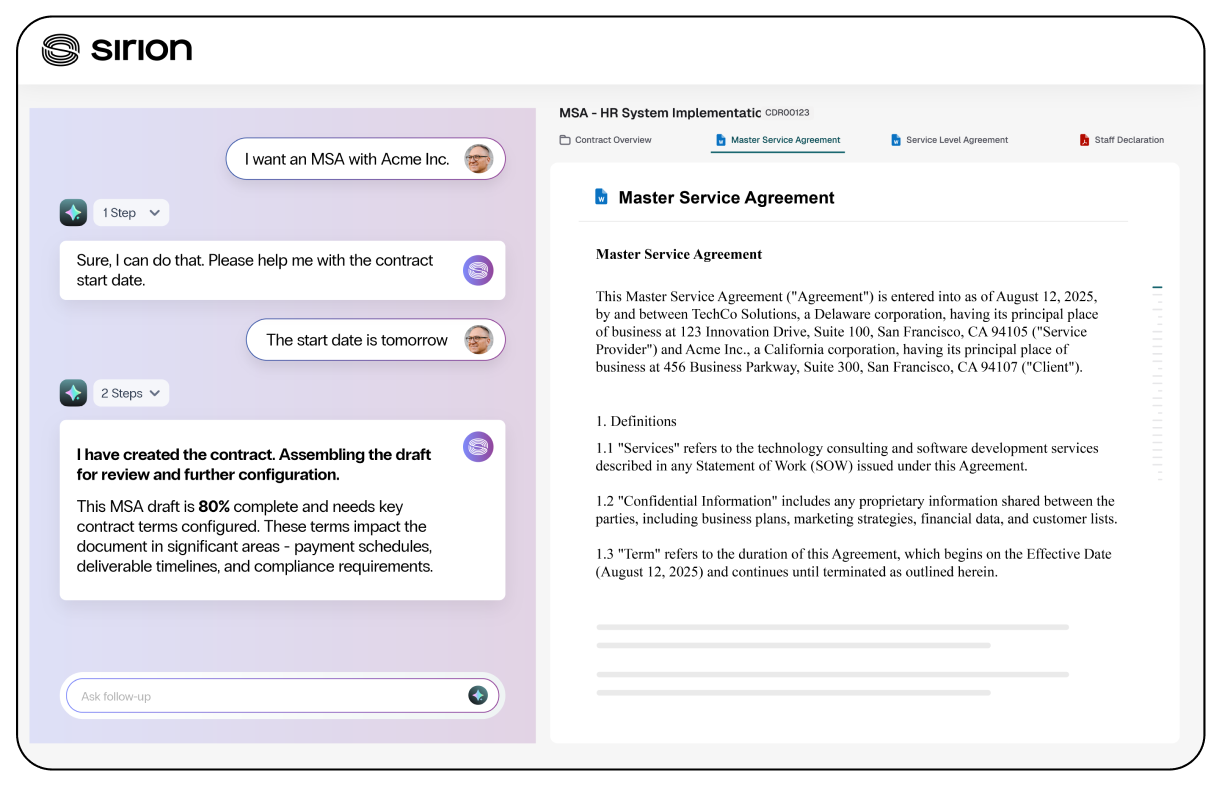
An intuitive interface, conversational capabilities, and clear lifecycle visibility accelerate user adoption across legal, procurement, and business teams – reducing friction from day one.

The Gartner Peer Insights Customers’ Choice badge is a trademark and service mark of Gartner, Inc., and/or its affiliates, and is used herein with permission. All rights reserved.
„Im Rahmen unseres Vertragsdigitalisierungsprogramms wollten wir uns nicht darauf beschränken, unsere Verträge einfach in die Cloud zu stellen. Wir wollten vollständige Transparenz und Kontrolle über die Leistungen und Verpflichtungen in unseren Verträgen. Wir haben mit Sirion die perfekte Lösung gefunden.“
„Alle unsere Verträge werden in Sirion, einer zweckmäßigen CLM-Lösung, erstellt und gepflegt. Heute verwalten wir über Sirion alle unsere regulatorischen Anforderungen, passen uns intelligent an Veränderungen im Bankwesen an und nutzen umfassende Erkenntnisse für die Berichterstattung in Echtzeit.“
„Einige der größten Highlights der Zusammenarbeit mit Sirion bestanden für mich darin, zu beobachten, wie sich die Technologie im Laufe der Zeit verändert hat. Und wie sie jedes Mal besser wird, wenn neue Funktionen veröffentlicht werden.“
„KI verändert die Vertragsgestaltung grundlegend, von der Erstellung von Verträgen mit minimalem menschlichen Input über die Überprüfung und das Markieren und Nachverfolgen im großen Maßstab. Anwälte können dadurch deutlich schneller und effektiver verhandeln. Es ist aufregend, Teil dieser Reise zu sein, während die Vision näher an die Realität rückt, und die agentische CLM-Plattform von Sirion ist ein wichtiger Schritt nach vorn.“
„Mit Sirion haben wir unsere Verträge zentralisiert, aber was noch wichtiger ist: Wir haben die Art und Weise, wie wir mit Vertragsdaten arbeiten, verändert. Die KI-gestützte Extraktion und die Berichterstattung in Echtzeit haben unseren Rechts- und Vertriebsteams schnellere und präzisere Erkenntnisse geliefert. Wir arbeiten jetzt mit größerem Vertrauen in unsere Daten, einer stärkeren Compliance-Kontrolle und einem deutlich geringeren manuellen Aufwand.“
Not at all. Most organizations start by migrating their repository or extraction layer first, then expand into authoring, negotiation, and performance. Sirion’s modular design and open integrations make the transition low-risk and phased.
No. Sirion can ingest and enrich existing templates, clause libraries, and metadata — turning your legacy assets into dynamic, searchable, and AI-driven building blocks for faster authoring and negotiation.
Far less. Sirion’s interface and conversational agents make adoption easier for business users, while no-code configuration empowers business teams to make changes themselves without heavy IT intervention.
Sirion’s AgentOS lies at its core, enabling generative AI-driven automation across the platform. Icertis continues to add separate copilots instead of embedding AI into its foundation.
Sirion is known for its responsive, high-touch customer support and dedicated customer success teams that stay engaged beyond deployment. Icertis support is often slower to respond and more ticket-driven, which can delay issue resolution in large deployments.
Both platforms support enterprise integrations. Sirion offers open, configurable integrations that are easier to deploy and extend, while Icertis integrations are typically more vendor-managed and tightly coupled to specific ecosystems.
For enterprises focused on faster deployment, lower maintenance and complete lifecycle intelligence, Sirion is the more future-proof choice. But for enterprises that are already deeply tied to Icertis and are comfortable with vendor-managed configurations, Icertis may suffice.