
Construction projects are contract-heavy by nature. From owner agreements and subcontractor contracts to change orders, RFQs, and compliance documents, every phase of a construction project is governed by contracts. Yet many construction teams still rely on spreadsheets, email threads, and shared folders to manage these critical documents—creating blind spots that lead to delays, disputes, and cost overruns.
Construction contract management software addresses this gap by bringing structure, visibility, and control to how contracts are created, reviewed, executed, and managed across the project lifecycle. Unlike generic document tools, purpose-built software is designed to handle the complexity of construction workflows, multiple stakeholders, frequent amendments, and strict compliance requirements, without slowing projects down.
What Is Construction Contract Management Software?
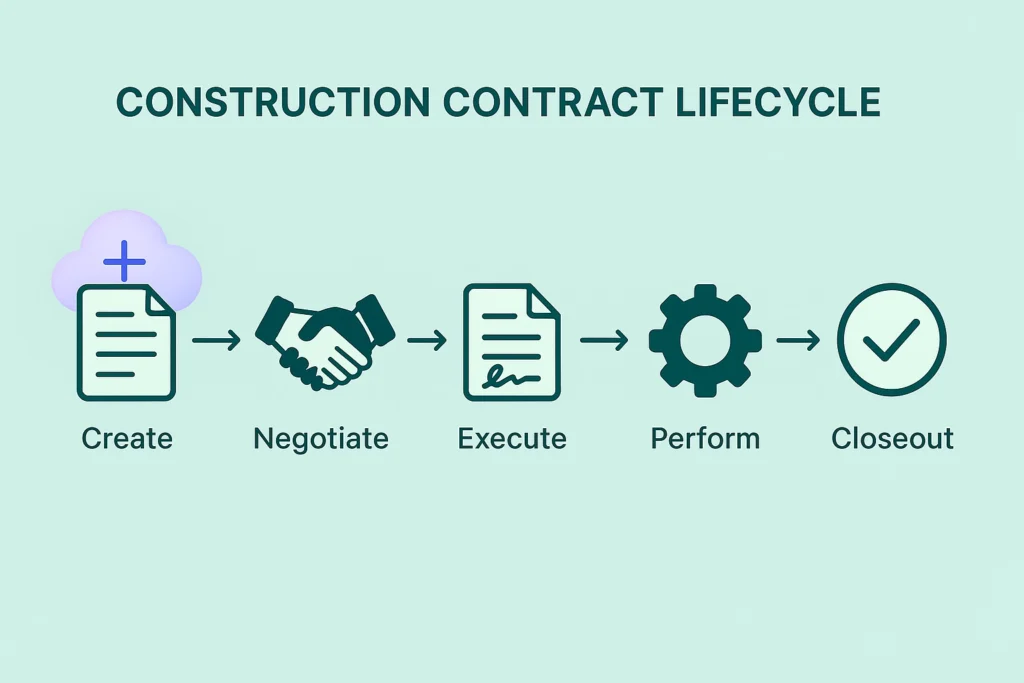
Construction contract management software is a specialized system used to manage construction contracts from creation through execution, performance, and closure. It centralizes all contract-related documents, workflows, approvals, and obligations in a single platform.
Beyond storage, the software improves visibility, control, and coordination across owners, contractors, subcontractors, legal teams, and finance. It ensures that everyone works from the latest contract version, understands their responsibilities, and stays aligned as projects evolve.
Common Challenges in Manual Construction Contract Management
Managing construction contracts manually introduces risk at every stage of a project. Common challenges include:
- Lack of Standardization & Manual Processes: Contracts are created using inconsistent templates, clauses, and approval paths, increasing legal and commercial risk.
- Poor Communication & Collaboration: Multiple stakeholders operate across sites, vendors, and departments, leading to fragmented communication and version confusion.
- Disorganized Documentation: Contracts, change orders, and amendments are scattered across emails, drives, and local systems, making retrieval difficult during disputes or audits.
- Missed Renewals and Expirations: Critical dates for renewals, extensions, or milestones are tracked manually, often resulting in missed deadlines and unplanned exposure.
- Lack of Visibility & Reporting: Teams lack real-time insight into contract status, obligations, financial exposure, and project risk, limiting proactive decision-making.
Why Is Construction Contract Management Software Important?
Construction contract management software directly addresses these challenges by embedding structure and automation into contracting processes.
1. Streamlined Workflow
The software automates contract reviews, approvals, and notifications, reducing manual follow-ups and delays. Requests move through predefined workflows, ensuring the right stakeholders are involved at the right time without bottlenecks.
2. Risk Mitigation
By tracking obligations, deadlines, and compliance requirements, the software helps teams identify risks early. This reduces disputes, penalties, and project delays caused by overlooked clauses or missed commitments.
3. Efficiency
Automating routine tasks such as drafting, approvals, and status tracking reduces administrative effort. Real-time data enables faster, better-informed decisions that keep construction projects moving forward.
4. Better Cost & Budget Control
Construction contract management software links contracts to financial data, helping teams track actual spend against budgets, monitor change order impact, and manage subcontractor costs more effectively.
5. Enhanced Compliance & Accountability
With clear audit trails and role-based access, the software ensures adherence to contractual and regulatory requirements. Every change, approval, and decision is documented, fostering transparency and accountability across stakeholders.


Key Features of an Effective Construction Contract Management Software
1. Document Management
A centralized repository stores contracts, change orders, submittals, RFQs, and purchase orders, ensuring teams always access the latest, approved documents.
2. Workflow Automation
Automated approval workflows, review cycles, and revision tracking reduce manual coordination and ensure consistency across projects and contract types.
3. Risk Identification & Analysis
AI-driven analysis helps flag risky clauses, deviations, and inconsistencies early, before they escalate into disputes or cost overruns.
4. Financial Tracking & Cost Monitoring
The system tracks contract values, payments, change orders, and financial exposure, giving finance and project teams real-time visibility into cost performance.
5. Digital Signatures & E-Signing
Built-in or integrated e-signature capabilities accelerate contract execution and eliminate delays caused by physical signatures.
6. Reporting, Alerts & Notifications
Automated alerts track key dates, compliance status, pending RFQs, and approvals, ensuring nothing critical slips through the cracks.
Construction Contract Software vs. General Project Management Tools
Because construction projects already rely on project management software, many wonder if a separate contract management system is even necessary. The truth is, while the two overlap in purpose, they serve very different functions:
- Contracts = Accountability: They define obligations, costs, risks, and legal protections.
- Project Management = Coordination: They focus on scheduling, task assignment, and resource allocation.
Both tools complement each other, but only contract management software provides the legal and financial guardrails that keep projects protected.
Industry Use Cases of Construction Contract Software
Contract management in the construction industry is not one-size-fits-all. Contractors across different segments adopt construction contract software in ways that reflect their project scale, regulatory environment, and operational complexity:
- Residential Builders: Small contractors benefit from mobile-friendly tools for change orders and approvals on the go.
- Commercial Construction Firms: Large projects demand deep financial tracking and multi-party collaboration.
- Infrastructure and Government Projects: Heavy compliance requirements make audit trails, certifications, and clause management critical.
No matter the project scale, the right platform aligns stakeholders and safeguards profitability.
Choosing the Right Software for Your Construction Needs
Choosing construction contracts software should start with a clear understanding of your business and project needs and not vendor features. Construction teams manage different contract volumes, project types, and stakeholder structures, so the right solution is one that aligns with existing workflows while closing process gaps that cause delays, risk, or cost overruns.
1. Assess Your Needs
Identify where contract processes break down today. Common pain points include slow approvals, poor change order tracking, limited contract visibility, and manual compliance tracking. Consider company size, project complexity, contract types, and geographic spread to ensure the software fits how your teams operate.
2. Prioritize Core Features
Focus on essential capabilities that directly impact project execution- job costing, financial tracking, scheduling alignment, document management, structured communication, and reporting. Prioritizing core features helps avoid over-investing in tools that don’t support day-to-day construction workflows.
3. Evaluate Integration Capabilities
The software should integrate with existing accounting, ERP, CRM, and project management systems. Seamless data flow reduces manual rework, improves reporting accuracy, and prevents information silos across teams.
4. Consider Scalability
Select a CLM platform that grows with your business as project volume and contract complexity increase. Scalable software reduces reliance on disconnected point solutions and supports long-term process standardization.
5. Review User Experience
Ease of use drives adoption. Look for intuitive workflows, role-based access, and minimal training requirements so project, legal, and finance teams can collaborate without friction.
6. Check Vendor Support & Training
Evaluate the vendor’s onboarding process, training resources, and ongoing support. Strong support ensures teams can fully adopt the platform and adapt as requirements evolve.
7. Test Through Demos & Trials
Validate the software using real construction workflows before committing. Testing approvals, change orders, and reporting in practical scenarios confirms the solution delivers value in real-world conditions.
AI and Analytics in Construction Contract Software
As construction projects grow in complexity, simply tracking contracts is no longer enough. Modern contract management solutions are embedding AI and advanced analytics to provide insights that go beyond document storage:
- Clause risk detection: Identify non-standard or high-risk terms instantly.
- Predictive insights: Spot early warning signs of cost overruns or project delays.
- Performance benchmarking: Compare subcontractor and supplier performance across multiple projects.
With AI-driven insights, contractors move from reactive to proactive management—unlocking higher efficiency and lower risk.
Putting Your Software to Work
Selecting the right platform is only half the job—the real value comes when it’s embedded in your day-to-day operations. A successful rollout is less about technology and more about adoption. Your teams need to see that this tool doesn’t add work; it takes work off their plate.
Start with a phased approach: pilot the system on one project, refine workflows, and then scale across teams. Provide role-based training so each stakeholder understands how the software simplifies their tasks—whether that’s tracking RFIs in the field or managing compliance deadlines in the back office.
To ensure you’ve set yourself up for success, use this quick checklist as a guide:
Construction Contract Software Implementation Checklist
- Centralized repository set up with clean, current contract data
- Clear workflows for approvals, change orders, and RFIs
- Integrations tested with accounting/ERP/project management systems
- Automated alerts activated for compliance and key dates
- Mobile access enabled for field teams
- Training delivered by role, with quick-reference guides provided
- Reporting dashboards aligned with leadership’s KPIs
With these essentials in place, your platform becomes more than a system—it becomes the backbone of predictable, profitable project delivery.

Sirion: The Ideal Construction Contract Management Software
When evaluating solutions, many contractors ask: what does an ideal platform look like? The answer lies in a system that not only digitizes documents but intelligently manages the entire construction contract lifecycle—from drafting to closeout.
Why Sirion Fits the Bill
Sirion is an AI-native contract lifecycle management (CLM) software trusted by leading enterprises across industries. For construction firms, it delivers:
- End-to-end lifecycle management: From contract creation and negotiation to performance monitoring and renewal.
- AI-powered risk detection: Automated identification of high-risk clauses and non-standard terms.
- Compliance and obligation tracking: Ensure permits, insurance, and safety requirements never slip through the cracks.
- Workflow automation: Streamline approvals, change orders, and RFIs with zero manual bottlenecks.
- Financial integration: Align contracts with ERP and accounting systems (SAP, Oracle, QuickBooks) for full budget and payment visibility.
- Analytics and reporting: Real-time dashboards surface insights into cost overruns, supplier performance, and value leakage.