How to Solve the Build-vs-Buy Dilemma for Contract Management

- Last Updated: Jul 15, 2026
- 15 min read
- Sirion
Choosing between building an in-house contract lifecycle management (CLM) system or buying a commercial solution is one of the most consequential decisions for legal, procurement, and IT leaders. The right choice can determine not just your technology architecture but also your time-to-value, compliance posture, and operational agility.
This article outlines a structured approach to resolving the build-vs-buy dilemma for contract management—bringing together frameworks, key evaluation criteria, and practical next steps to help leaders make an informed, defensible decision grounded in measurable business outcomes.
Define Your Primary Objective for Contract Management
The first step is establishing clarity around what your CLM initiative is meant to achieve. Every modern enterprise pursues one of three overarching goals—growth, scale, or optimization.
Use the Growth–Scale–Optimize (GSO) framework to anchor your decision:
- Growth: Expanding revenue potential or entering new markets through faster contract execution
- Scale: Handling higher contract volumes without proportional increases in resources
- Optimize: Improving efficiency, visibility, and compliance in existing processes
Once the objective is clear, define success metrics—time to deployment, ROI, compliance rates, or reduced contract cycle time. This ensures decisions are tied to measurable outcomes rather than broad aspirations.
Identify Core Capabilities: Commodity vs Differentiator
Not every CLM capability drives competitive advantage. Begin by classifying features as commodity or differentiator.
Capability | Commodity or Differentiator | Strategic Importance |
E-signature | Commodity | High |
Clause library | Commodity | Medium |
AI metadata extraction | Differentiator | High |
Risk scoring analytics | Differentiator | High |
Wardley mapping can further help visualize capability maturity—from innovation (build potential) to standardized utility (best bought off the shelf).
Evaluate Total Cost of Ownership and Time-to-Value
Financial comparison goes far beyond upfront cost. A true TCO model should include:
- Internal development hours and infrastructure
- Integration and customization costs
- Ongoing maintenance and upgrades
- User training and support
- Opportunity cost from delayed deployment
Commercial CLM systems typically deploy in 3–9 months, while in-house builds often require 12–24 months before delivering ROI.
Factor | Build | Buy |
Upfront cost | High | Moderate |
Ongoing cost | Continuous | Subscription |
Time-to-value | 12–24 months | 3–9 months |
Scalability | Limited | Vendor-managed |
Compliance | Custom | Built-in |
Assess Internal Expertise, Maintenance, and Security Requirements
Be realistic about internal capabilities. Building a CLM means owning uptime, maintenance, and security.
Key considerations:
- Does the team have CLM architecture or AI expertise?
- Who owns ongoing maintenance and upgrades?
- Are security controls aligned with regulatory expectations?
Vendor platforms typically provide these guardrails at scale, whereas custom builds require dedicated security and DevOps investment.
Conduct Constraint Mapping for Compliance and Risk
Constraint mapping identifies legal, technical, or operational limitations that may influence your decision.
Key checks include:
- Data residency requirements
- Third-party audit certifications
- Integration with identity and access systems
- Support for SLAs and multi-tenant environments
A structured compliance matrix ensures feasibility is evaluated early.
Validate Options with Proof of Concept on Real Contracts
Proof of concept (POC) testing converts evaluation into evidence. Use your own contract data to assess:
- Accuracy of metadata extraction
- Effectiveness of obligation tracking
- Ease of integration
- Usability of dashboards
The option that delivers better accuracy, speed, and adoption typically reveals the stronger long-term fit.
Develop a Recommendation Plan with Clear Ownership and Exit Strategy
Formalize the decision using a weighted scoring model across cost, compliance, scalability, and time-to-value.
Also define:
- Ownership and approval checkpoints
- Change management plan
- Exit strategy (data portability, migration readiness)
Revisit assumptions periodically to ensure long-term alignment.
When to Choose Building a Custom Contract Management System
Building is justified when contract management is a core differentiator.
Best-suited scenarios include:
- Proprietary workflows
- Strict regulatory or security requirements
- Deep integration with niche internal systems
- Strong internal technical maturity
However, expect longer timelines and ongoing maintenance overhead.
When to Choose Buying a Commercial Contract Management Solution
Buying is ideal when speed, compliance, and scalability are priorities.
Benefits include:
- Faster deployment (3–9 months)
- Built-in compliance and certifications
- Prebuilt integrations
- AI capabilities that improve over time
This approach allows teams to focus on value creation rather than infrastructure.
The Hybrid Approach: Combining Build and Buy
A hybrid strategy combines speed with flexibility—deploy a commercial platform, then extend where needed.
Approach | Speed | Control | Cost Over Time | Ideal Use Case |
Build | Slow | Full | High | Proprietary workflows |
Buy | Fast | Moderate | Predictable | Standardized needs |
Hybrid | Medium | Balanced | Moderate | Custom extensions |
A “buy-first, build-later” approach often delivers early ROI while preserving long-term flexibility.
Build vs Buy CLM: Key Decision Factors at a Glance
- Time-to-value requirements
- Internal technical capability
- Compliance and security needs
- Total cost of ownership
- Scalability and future flexibility
Build vs Buy: A Practical Decision Rule
- Choose build when contract management is a strategic differentiator and internal capability exists
- Choose buy when speed, compliance, and scalability are critical
- Choose hybrid when you need both rapid deployment and selective customization
How Sirion Supports Build, Buy, and Hybrid CLM Strategies
For enterprises navigating this decision, the goal is not just choosing a model—but ensuring long-term value realization across the contract lifecycle.
Sirion’s AI-native CLM platform combines configurable workflows, contract intelligence, and post-signature performance tracking in a unified system. With enterprise-grade security, built-in integrations, and advanced analytics, it enables organizations to accelerate time-to-value while maintaining flexibility for customization where needed.
This allows enterprises to adopt a buy-first approach, extend capabilities selectively, and avoid the trade-offs typically associated with build vs buy decisions.
Frequently Asked Questions (FAQs)
How do I evaluate total cost of ownership for build vs buy decisions
What are the main risks of building an in-house CLM system?
When is buying CLM software more beneficial than building?
How can organizations balance customization with cost and time?
What role does AI play in the build vs buy decision?

Sirion is the world’s leading AI-native CLM platform, pioneering the application of Agentic AI to help enterprises transform the way they store, create, and manage contracts. The platform’s extraction, conversational search, and AI-enhanced negotiation capabilities have revolutionized contracting across enterprise teams – from legal and procurement to sales and finance.
Zusätzliche Ressourcen
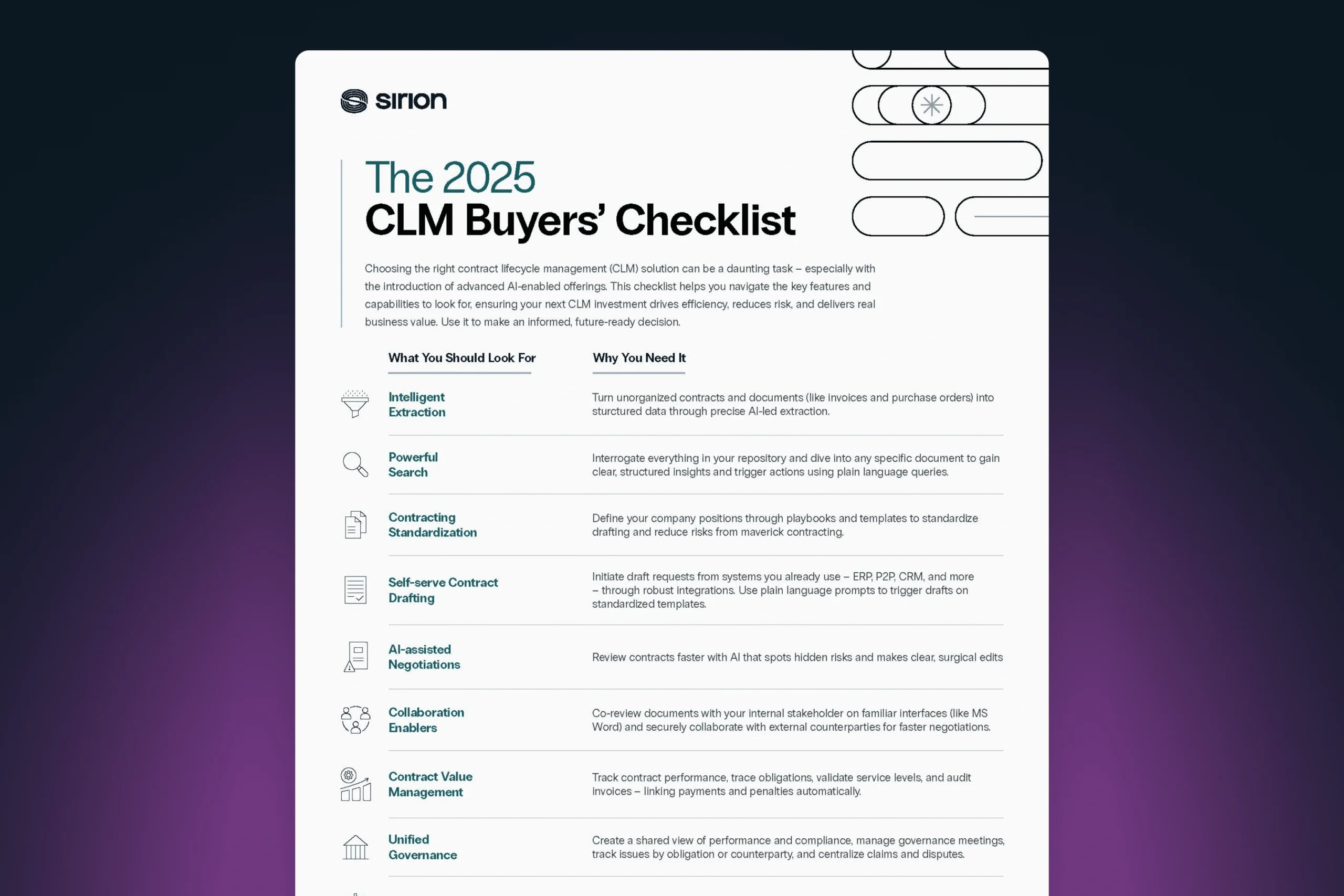
The 2026 CLM Buyers‘ Checklist