Is Your CLM Ready to Be a Contract System of Record?
- 27. Mai 2026
- 15 min read
- Arpita Chakravorty
In a recent post, we argued that AI in CLM depends on operational contract data: structured, modeled, and synchronized across the enterprise. That argument leads to a natural question: what does it take to get there, in terms of enterprise architecture, the systems, integrations, and data infrastructure that a contract system of record has to live inside?
Most enterprise CLM deployments look ready. Contracts are centralized. Integrations exist. An AI layer is either live or in evaluation. On paper, the architecture checks out. But readiness for a contract system of record isn’t assessed on paper. It’s assessed on what the enterprise can actually do — without manual intervention, without human verification loops, without the workarounds that have been absorbed so deeply into the process that nobody notices them anymore.
Where the gap usually lives
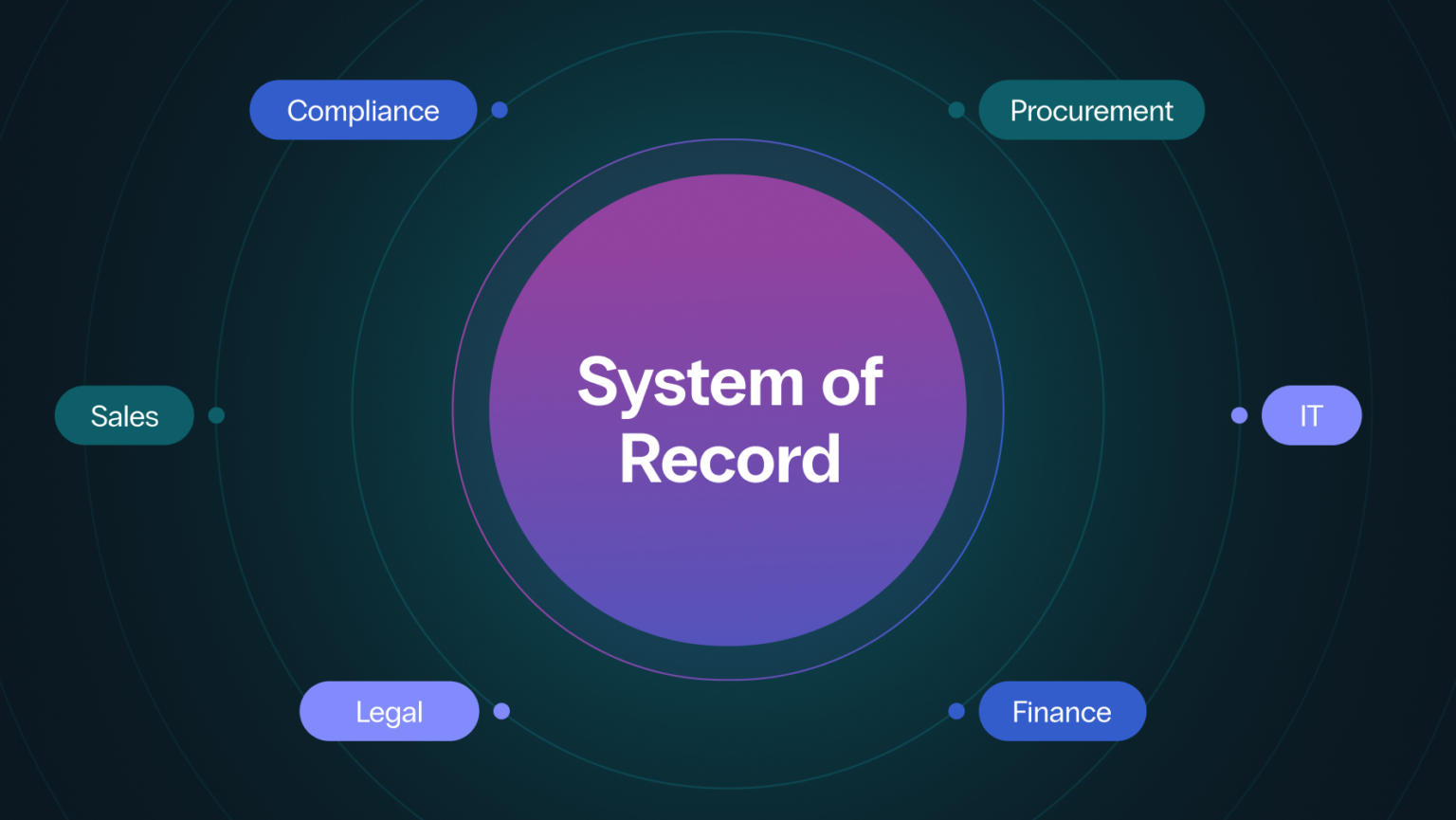
The distance between a structured repository and a contract system of record is architectural. And it shows up consistently across the same six dimensions:
- Always-current data. Integrations are shallow, one-way, or batch-based. Contract data goes stale the moment activity moves outside the CLM. In fact, only 9% have bidirectional data flow where contract data stays in sync with the enterprise tech stack.
The test: When a pricing amendment is executed in the CLM, does ERP reflect the updated commitment automatically?
- Structured intelligence. The system stores files and basic metadata. Search remains stuck at the document level.
The test: Can your AI layer trace its output back to the specific clause, amendment, and counterparty version it reasoned over or is the data too fragmented?
- Embedded control. Governance lives in email threads and tribal knowledge. Decisions are recorded after the fact, not enforced at the point of action.
The test: The last time a non-standard clause was accepted in a negotiation, where was that deviation recorded
- Enterprise connectivity. The CLM can ingest data for visibility, but cannot push updates back, trigger downstream actions, or maintain synchronized state across systems.
The test: When a renewal triggers, does CRM know before the account manager does?
- End-to-end lifecycle. The platform is strong pre-signature but breaks down post-signature, where obligations, invoices, and performance data move elsewhere.
The test: When something goes wrong post-signature, does the contract data help you act?
None of these gaps are visible from inside the CLM. They only surface when someone asks the enterprise to act on contract data, and the action requires a human to translate what the system produced.
The more telling signal: most enterprises that complete the Sirion SOR Readiness Assessment don’t discover a wholesale failure. They discover two or three precise architectural conditions that haven’t been met.
What the assessment reveals
The Sirion SOR Readiness Assessment is a structured 30-minute conversation—a guided examination of what your enterprise can actually do with its contract data today.
Most enterprises that complete it discover two things. The gaps are more specific than expected. And the path to closing them is more realistic than it seemed before someone mapped it properly.
If your team is evaluating AI capabilities in CLM, preparing for a platform review, or trying to understand why operational contract data remains elusive despite a structured repository, the assessment maps the specific gap between where you are and where a contract system of record begins.
Book your 30-minute SOR Readiness Assessment — a structured conversation with a Sirion specialist that maps your current CLM architecture against the conditions that define contract system of record readiness. Book Your Assessment
Want to know more about what a true contract system of record looks like? Check out our paper: Contracts as Intelligence Infrastructure: Why the Al Enterprise Needs a Contract System of Record
Zusätzliche Ressourcen
 3 min read