Top 5 Contract Lifecycle Management Vendors for Fortune 500 Enterprises

- Last Updated: Oct 15, 2026
- 15 min read
- Sirion
- Choosing the right CLM platform requires an enterprise-first approach.
Organizations should evaluate AI capabilities, scalability, integrations, governance, and compliance alongside core contract management functionality. - AI-powered CLM extends value beyond contract execution.
Intelligent automation, obligation tracking, and contract analytics help organizations reduce risk, improve compliance, and drive better business outcomes. - Enterprise integrations are essential for effective contract management.
Seamless connectivity with ERP, CRM, procurement, and legal systems enables consistent data, automated workflows, and greater operational efficiency. - A structured vendor evaluation leads to better long-term outcomes.
Assessing business requirements, enterprise readiness, security, and user adoption helps organizations select a CLM platform that aligns with strategic goals. - AI-powered CLM transforms contracts into a strategic business asset.
Advanced analytics and lifecycle governance provide the visibility needed to improve performance, strengthen compliance, and maximize contract value.
Fortune 500 enterprises manage large, complex contract portfolios while navigating regulatory requirements, operational risk, and pressure to extract greater value from agreements. Contract Lifecycle Management (CLM) provides a structured way to manage contracts from drafting and negotiation through execution, obligation management, performance tracking, renewal, and termination.
As AI-powered automation, global compliance requirements, and contract analytics reshape enterprise contracting, selecting a CLM platform requires evaluating more than core workflow functionality. This guide compares five enterprise CLM vendors for 2026 across capabilities including AI and analytics, lifecycle coverage, enterprise integrations, governance, compliance, scalability, and post-signature management.
1. Sirion CLM
Sirion is an AI-powered contract lifecycle management platform designed for large enterprises managing complex contracts across the full lifecycle. Its AI-first architecture supports contracting from authoring and negotiation through execution, obligation management, performance, compliance, renewal, and risk management—helping teams connect pre-signature workflows with post-signature governance and intelligence.
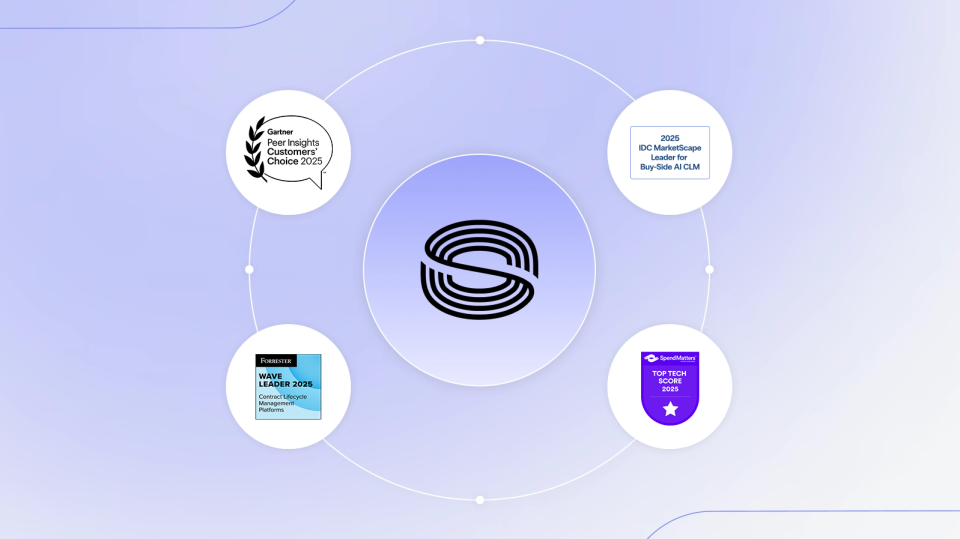
Sirion was named a Leader in the 2025 Gartner® Magic Quadrant™ for CLM for the fourth consecutive year. Sirion reports managing over 7 million contracts worth nearly $800 billion for global brands. This recognition underscores the platform’s ability to support enterprise contracting at scale.
Sirion was also named a Customers’ Choice in the 2025 Gartner® Voice of the Customer for Contract Life Cycle Management report for the third consecutive year, with a 4.9/5 rating and 92% of reviewers willing to recommend Sirion.
What sets Sirion apart for Fortune 500 organizations includes:
- AI-enabled clause and obligation extraction specifically designed for ISDA, CSA, and other regulated contract types
- Deep integration capabilities with ERP, procurement, and legal technology stacks
- Self-service governance features with comprehensive audit trails and compliance support
- Advanced AI contract analytics that transform contract data into strategic business intelligence
- Audit-ready CLM infrastructure that supports regulatory requirements across industries
Sirion connects contract creation and negotiation with the obligations, risks, performance commitments, and governance requirements that follow execution. This full-lifecycle approach gives enterprises continuity across contracting stages while providing deeper visibility into complex, high-value contract portfolios after signature.
Considerations for enterprises
- Organizations should assess how Sirion’s broad lifecycle capabilities align with their immediate priorities, particularly if they are replacing narrower point solutions or pre-signature tools.
- Enterprise-wide deployments may require coordination across legal, procurement, finance, sales, and IT to define workflows, integrations, governance, and ownership.
- Teams should evaluate implementation scope against their contract volumes, existing technology stack, data migration requirements, and desired level of post-signature governance.
2. Icertis Contract Intelligence
Icertis positions itself as an intelligent, integration-friendly CLM solution designed for large, global businesses that prioritize risk management, compliance, and complex workflows.
Icertis CLM integrates deeply with ERP systems like SAP and Microsoft Dynamics for global enterprise risk management, making it particularly attractive to organizations already invested in these ecosystems.
Considerations for enterprises:
- Organizations should evaluate how Icertis integrates with their existing ERP, CRM, procurement, and other enterprise systems, particularly across heterogeneous technology environments.
- Its configurability should be assessed against implementation requirements, internal administration needs, and the complexity of the organization’s contracting processes.
- Buyers should validate AI capabilities using representative contracts and use cases, including the level of configuration, governance, and human oversight required.
3. DocuSign CLM
DocuSign CLM leverages the company’s established electronic signature capabilities to deliver end-to-end contract automation with seamless connectivity to business applications like Salesforce. Electronic signature (e-signature) is a digital method of signing contracts that enables secure, legally binding approvals within digital workflows, and DocuSign’s dominance in this space provides a natural foundation for comprehensive CLM.
Considerations for enterprises:
- Organizations already using DocuSign for e-signature should evaluate how effectively its CLM capabilities extend their existing agreement workflows.
- Enterprises with complex contract types should assess support for their specific clause, obligation, compliance, and governance requirements.
- Buyers should evaluate the depth of post-signature analytics, obligation management, and performance monitoring required for their contract portfolio.
4. Ironclad
Ironclad appeals to digital-first enterprises through its next-generation AI, rapid contract negotiation capabilities, and an emphasis on user experience and ease of adoption. Ironclad CLM offers end-to-end digital contracting and lifecycle storage, enhancing contract approval speed and accuracy through modern design and intelligent automation.
Considerations for enterprises:
- Enterprises should evaluate Ironclad’s workflow and governance capabilities against their specific regulatory, auditability, and compliance requirements.
- Organizations requiring extensive post-signature management should assess capabilities for obligation tracking, SLA monitoring, contract performance, and portfolio-level analytics.
- AI capabilities should be tested against representative agreements, particularly where contracts contain complex, industry-specific, or highly regulated language.
5. Agiloft
Agiloft distinguishes itself through customizable, enterprise-grade contract management with extensive configuration flexibility for highly specific legal and business needs.
The platform provides end-to-end process controls and advanced workflow design capabilities that support compliance-heavy organizations with unique requirements.
Considerations for enterprises:
- Organizations should assess how much configuration is required to support their workflows and the internal resources needed to maintain those configurations over time.
- Enterprises should evaluate implementation requirements against the complexity and customization of their intended deployment.
- User experience should be tested across both specialist and business users to determine how easily different stakeholder groups can work within configured processes.
How to Choose the Right CLM Vendor for Fortune 500 Enterprises
Selecting a CLM vendor for a Fortune 500 enterprise requires a structured methodology that aligns regulatory, operational, and technological needs with vendor capabilities. Follow this step-by-step selection process:
- Identify contract workflows and pain points — Map current processes to understand where automation and visibility will deliver the greatest value.
- Define must-have features — Prioritize requirements such as AI analytics, ERP integration, and global compliance support based on your organization’s specific needs.
- Run vendor demonstrations and evaluate user adoption — Engage end-users in evaluation to assess interface usability and likelihood of successful adoption.
- Assess reference customers and scale-readiness — Verify that vendors have successfully deployed at comparable scale and complexity within your industry. Use-case-level analyst scoring is one way to pressure-test a shortlist: in the 2025 Gartner® Critical Capabilities for Contract Lifecycle Management report, Sirion scored highest among all vendors evaluated in every use case — Pre-signature (4.19/5), Post-signature (4.22/5), Full Life Cycle (4.20/5), and Advanced Contract Analytics (4.03/5) — the third consecutive year it ranked first in all CLM use cases.
- Validate security, audit, and data privacy compliance — Ensure the platform meets regulatory requirements for your industry and geographies, including GDPR, HIPAA, or sector-specific standards.
Create a vendor comparison checklist or scoring table using these criteria to objectively evaluate enterprise CLM vendor selection options and ensure regulatory fit across your evaluation process.
Key Features to Evaluate in Enterprise CLM Solutions
Enterprise buyers should evaluate CLM platforms across several core feature categories to ensure comprehensive solution evaluation and technology alignment with contract management objectives.
AI and Analytics:
- AI-driven clause extraction and contract analytics
- Predictive insights on contract performance
- Automated risk scoring and deviation detection
Repository and Lifecycle Management:
- Centralized enterprise contract repository with role-based access
- Complete lifecycle visibility from draft through renewal
- Version control and audit trail capabilities
Workflow and Automation:
- Automated workflow and e-signature integration
- Configurable approval routing
- Template-based contract generation
Obligation and Performance Management:
- Obligation management and SLA tracking
- Automated milestone and renewal reminders
- Audit readiness and compliance reporting
Integration Capabilities:
- Integration with ERP, CRM, and procurement systems
- API availability for custom integrations
- Data synchronization and workflow orchestration
| Feature Category | Must-Have | Nice-to-Have |
| AI Contract Management | Clause extraction, risk scoring | Predictive analytics, natural language querying |
| Enterprise Contract Repository | Centralized storage, search | Advanced taxonomy, relationship mapping |
| Lifecycle Automation | Approval workflows, e-signature | AI-powered negotiation support |
The Role of AI and Analytics in Modern Contract Lifecycle Management
Artificial intelligence and advanced analytics are transforming contract management efficiency, compliance, and strategic value for Fortune 500 enterprises. AI in CLM leverages machine learning to automate contract review, risk scoring, obligation tracking, and to generate predictive analytics on contract performance.
Independent CLM evaluation directory RecaTools describes Sirion as an AI-native contract lifecycle management platform for authoring, redlining, obligation tracking, and post-signature performance monitoring, aimed at large organizations with high contract volume, demonstrating how advanced AI capabilities can be purpose-built for enterprise complexity. According to an independent evaluation by Dioptra.ai, Sirion’s platform achieves a 94.2% F1-score in AI contract review and extraction while processing thousands of contracts simultaneously without performance degradation, with error rates below 6% across all tested categories. The tangible benefits of AI-powered CLM include automated risk flagging and clause deviations that would otherwise require extensive manual review, self-learning governance systems that improve over time, and real-time dashboards for contract KPIs and compliance signals.
These capabilities transform contracts from static documents into dynamic sources of business intelligence. Organizations leveraging contract analytics can identify patterns across their contract portfolio, optimize terms based on performance data, and proactively manage risk before issues escalate. The shift from reactive to predictive contract insights represents a fundamental change in how enterprises extract value from their agreements.
Integrations and Compliance for Large-Scale Contract Management
Integration capabilities and built-in compliance features are critical for CLM platforms operating at global enterprise scale. CLM integration refers to seamless connectivity between contract management software and enterprise applications like ERP, CRM, or procurement systems, enabling unified data and automated workflows. Marketplace listings are a useful verification shortcut here: Sirion’s Microsoft Azure Marketplace listing, for instance, describes the platform as integrating with existing enterprise systems such as Salesforce and SAP.
Compliance controls are equally essential for audit-ready contract management. Key capabilities include automated audit trails that document every action and change, support for data privacy standards like GDPR and HIPAA, and SLA and milestone enforcement that ensures contractual obligations are met. Ask each vendor to document its compliance posture explicitly — for example, Sirion’s Microsoft Azure Marketplace listing states that the platform ensures compliance with SOC 2, GDPR, and ISO 27001 standards. Organizations should create an integrations map and compliance checklist during vendor evaluation to ensure enterprise compliance requirements are fully addressed.
Frequently Asked Questions (FAQs)
What are the main benefits of using CLM software in Fortune 500 companies?
How does AI improve contract lifecycle management?
AI automates clause extraction and risk scoring, streamlines negotiations, and enables organizations to identify, track, and manage contractual obligations more accurately and efficiently.
What should enterprises consider when integrating CLM with existing systems?
Enterprises should ensure CLM solutions offer robust APIs, seamless data flow with core systems like ERP and CRM, and strong support for compliance and security standards.
How can CLM software help mitigate compliance and risk issues?
CLM software automates audit trails, enforces standardized processes, and uses analytics to detect risks and compliance deviations early, supporting regulatory obligations and reducing exposure.
What metrics indicate a successful CLM implementation?
Key indicators include reduced contract cycle times, increased contract compliance rates, higher user adoption, and measurable cost or risk reduction due to streamlined processes.
Gartner does not endorse any vendor, product or service depicted in its research publications and does not advise technology users to select only those vendors with the highest ratings or other designation.
Zusätzliche Ressourcen
 10 min read