- Last Updated: Aug 19, 2026
- 15 min read
- Sirion
- Different contract types support different stages of the oil and gas value chain.
From exploration rights to transportation and marketing, each agreement serves a distinct commercial and operational purpose. - Risk allocation varies across contract models.
Some contracts transfer exploration risk to operators, while others emphasize collaboration, shared investment, or service delivery. - Oil and gas contracts rarely operate independently.
Upstream, midstream, and downstream agreements are closely connected, making coordinated contract management essential. - Effective governance improves commercial outcomes.
Well-managed contracts help organizations reduce risk, improve compliance, and maximize operational efficiency. - AI-native CLM platforms strengthen contract management.
Solutions such as Sirion improve visibility, automate obligations, and support end-to-end governance across complex energy portfolios.
The oil and gas industry depends on a diverse network of contracts to govern every stage of the energy value chain—from exploration and drilling to production, transportation, processing, and commercialization. Each agreement defines the commercial relationship between governments, operators, contractors, suppliers, and infrastructure providers while allocating responsibilities, risks, and financial rewards.
The types of oil and gas contracts used on a project vary depending on factors such as resource ownership, investment risk, operational complexity, and regulatory requirements. Some agreements determine who has the right to explore and produce hydrocarbons, while others govern drilling services, transportation infrastructure, joint operations, or revenue sharing.
Understanding these contracts is essential because they directly influence project economics, operational control, regulatory compliance, and long-term profitability. In this guide, we’ll examine the major types of contracts in the oil and gas industry, explain where each is used, and explore how modern contract lifecycle management (CLM) platforms help organizations manage increasingly complex energy agreements.
Explore Oil and Gas Contract Management to understand how energy companies manage complex agreements, track obligations, and reduce contractual risk across operations.
8 Major Types of Oil and Gas Contracts
Different contracts are designed to address specific commercial, operational, and regulatory requirements throughout the oil and gas lifecycle. The table below summarizes the most common contract types, the level of commercial risk they involve, and where they are typically used.
Contract Type | Risk Level | When It Is Best Used |
Concessions & Leases | High | Stable regulatory environments where operators receive long-term exploration and production rights |
Production Sharing Contracts (PSCs/PSAs) | Medium-High | Resource-rich countries seeking production-based revenue while retaining resource ownership |
Risk Service Contracts | Medium | Governments that wish to retain ownership while outsourcing exploration and production activities |
Joint Operating Agreements (JOAs) | Shared | Large exploration or development projects involving multiple investors and operators |
Farm-in & Farm-out Agreements | Variable | Exploration projects requiring investment, risk sharing, or ownership restructuring |
Gas Processing & Marketing Agreements | Medium | Midstream operations involving gas treatment, processing, pricing, and commercialization |
Drilling & Service Contracts | Medium-High | Upstream drilling and field development requiring specialized contractors and equipment |
Transportation & Storage Agreements | Low-Medium | Pipeline, terminal, and storage infrastructure supporting hydrocarbon movement and distribution |
Concessions and Leases
Concession and lease agreements grant an oil and gas company the exclusive right to explore, develop, and produce hydrocarbons within a defined geographic area for a specified period. In exchange, the operator typically pays royalties, taxes, lease fees, and other fiscal obligations established by the host government.
These agreements are common in mature regulatory environments such as the United States, Canada, and the United Kingdom, where legal frameworks provide long-term investment certainty. Because operators generally exercise significant operational control, concession agreements offer flexibility but also place substantial exploration, financial, and operational risk on the company.
Project economics under concession models depend heavily on factors such as royalty rates, taxation, production volumes, commodity prices, and the duration of exploration and production rights.
Production Sharing Contracts (PSCs or PSAs)
A Production Sharing Contract (PSC)—also referred to as a Production Sharing Agreement (PSA)—is a contractual arrangement in which the government retains ownership of petroleum resources while granting a contractor the right to explore and produce oil or gas.
The contractor finances exploration, drilling, and field development using its own capital. Once production begins, eligible costs are recovered through cost oil, after which the remaining production (profit oil) is shared between the contractor and the government according to pre-agreed contractual terms.
PSCs are widely used in resource-rich developing countries because they attract foreign investment while preserving national resource sovereignty. Their commercial success depends on carefully negotiated fiscal terms, production-sharing formulas, and cost recovery provisions that balance investor returns with government revenue.
Risk Service Contracts
Risk service contracts allow governments to retain complete ownership of oil and gas resources while engaging private companies to perform exploration, development, or production activities.
Unlike production sharing models, contractors do not receive a share of hydrocarbon production. Instead, they are compensated through predetermined service fees or performance-based payments for successfully completing agreed operational activities.
This structure enables governments to maintain greater strategic control over petroleum resources while leveraging the technical expertise and operational capabilities of experienced energy companies. Risk service contracts are particularly attractive in countries seeking operational support without transferring commercial ownership of production.
Joint Operating Agreements (JOAs)
A Joint Operating Agreement (JOA) governs how multiple companies collaborate to develop and operate a shared oil and gas asset. Rather than one company bearing the entire financial and operational burden, participating organizations contribute capital, technical expertise, and resources according to their ownership interests.
JOAs establish the governance framework for the project by defining the responsibilities of the designated operator, voting procedures, budget approvals, cost-sharing arrangements, liability allocation, and decision-making processes.
These agreements are commonly used for offshore developments, deep-water exploration, and other capital-intensive projects where sharing investment and operational risk improves commercial feasibility.
Farm-in and Farm-out Agreements
Farm-in and farm-out agreements enable companies to transfer all or part of their working interest in an exploration or production asset to another organization.
Under a farm-in arrangement, the incoming company acquires an ownership interest by funding exploration, drilling, or development activities. Conversely, the existing operator reduces its financial exposure while retaining a portion of the asset.
These agreements provide flexibility for portfolio management, allowing companies to optimize capital allocation, diversify exploration risk, access specialized expertise, or accelerate project development without completely exiting valuable assets.
Gas Processing & Marketing Agreements
Gas processing and marketing agreements govern how natural gas is processed, treated, transported, priced, and ultimately sold to downstream customers.
These contracts establish responsibilities for processing raw gas, removing impurities, determining product specifications, allocating processing costs, and defining pricing mechanisms. They also specify custody transfer points, delivery obligations, and market access arrangements that influence how revenue is generated.
Because natural gas often passes through multiple processing and transportation stages before reaching end users, these agreements play a critical role in ensuring commercial certainty across the midstream value chain.
Drilling & Service Contracts
Drilling and service contracts define the commercial relationship between oil and gas operators and specialized contractors responsible for drilling wells or providing field services.
Depending on project requirements, these agreements may cover drilling operations, well completion, hydraulic fracturing, directional drilling, equipment rental, maintenance, inspection, or engineering services.
Commercial structures vary widely and may include day-rate pricing, lump-sum contracts, performance-based incentives, or integrated service agreements. Clearly defined performance metrics and service levels help ensure projects remain on schedule, within budget, and compliant with operational standards.
Transportation & Storage Agreements
Transportation and storage agreements govern access to pipelines, terminals, storage facilities, and other infrastructure required to move hydrocarbons from production sites to refineries, export terminals, or end markets.
These agreements define transportation capacity, scheduling priorities, tariff structures, storage rights, delivery obligations, quality specifications, and operational responsibilities between infrastructure operators and shippers.
Reliable transportation and storage contracts are essential for maintaining supply chain efficiency, preventing production bottlenecks, and ensuring hydrocarbons reach commercial markets safely and economically.
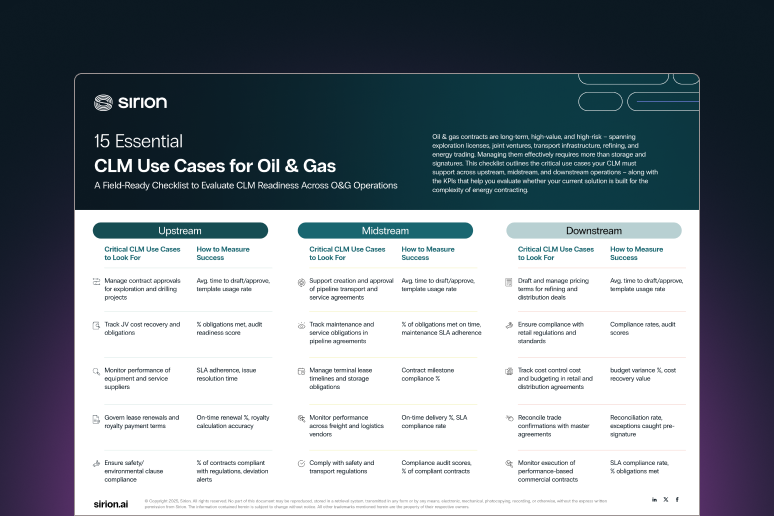
Explore CLM Use Cases for Oil & Gas to learn how CLM supports complex contracting, obligation tracking, compliance, and risk management across energy operations.
Hidden Dependencies Between Upstream, Midstream, and Downstream Contracts
Oil and gas contracts rarely operate in isolation. Every agreement across the energy value chain influences the performance of others, creating a network of commercial and operational dependencies that organizations must actively manage. A delay in exploration can affect pipeline commitments, while changes in production forecasts can alter processing schedules, transportation capacity, and downstream supply agreements.
Understanding these interdependencies is essential because even a well-structured individual contract may fail to deliver its intended value if connected agreements are not aligned.
Upstream Output Drives Midstream Planning
Exploration and production contracts determine when hydrocarbons become available for transportation and processing. Pipeline operators, storage providers, and gas processing facilities rely on production forecasts established during upstream projects to plan infrastructure utilization and capacity allocation.
If drilling schedules slip, production volumes fall below expectations, or development activities are delayed, midstream operators may experience underutilized assets, scheduling disruptions, or contractual penalties for unused transportation capacity.
Midstream Performance Shapes Downstream Commitments
Midstream agreements ensure that oil and gas reach refineries, distributors, export terminals, and end customers safely and efficiently. Delays in transportation, storage constraints, or processing bottlenecks can directly affect downstream supply contracts, resulting in missed delivery obligations, pricing adjustments, or reduced customer satisfaction.
For example, insufficient pipeline capacity can delay refinery feedstock deliveries, while processing disruptions may affect the quality specifications promised under downstream sales agreements.
Commercial Assumptions Must Remain Aligned
Oil and gas contracts often rely on shared assumptions regarding production volumes, commodity prices, infrastructure availability, and project timelines. When these assumptions diverge across related agreements, commercial inefficiencies can emerge.
Common challenges include:
- Production exceeding available transportation capacity.
- Pipeline commitments based on outdated production forecasts.
- Pricing mechanisms that no longer reflect market conditions.
- Storage agreements that fail to accommodate changing production profiles.
- Delivery schedules that conflict with refinery or export requirements.
These mismatches can increase operating costs, delay revenue recognition, and create unnecessary commercial disputes.
Contract Coordination Across the Value Chain
Successful energy companies manage contracts as an interconnected portfolio rather than as independent legal documents. Coordinated planning across upstream, midstream, and downstream agreements improves operational resilience and helps organizations respond more effectively to changing market conditions.
A connected contract strategy enables organizations to:
- Align production schedules with transportation capacity.
- Synchronize processing and marketing commitments.
- Identify commercial risks before they affect operations.
- Improve forecasting across interconnected projects.
- Strengthen collaboration between commercial, legal, operations, and finance teams.
As projects become larger and supply chains more integrated, managing these contractual relationships holistically becomes a competitive advantage rather than simply an administrative exercise.
How Contract Lifecycle Management (CLM) Is Transforming Oil and Gas Agreements
Managing oil and gas contracts has become increasingly challenging as projects span multiple jurisdictions, involve numerous stakeholders, and generate thousands of contractual obligations over several decades. Traditional document repositories and spreadsheet-based tracking often make it difficult to monitor commitments, manage renewals, or identify commercial risks across large contract portfolios.
Modern contract lifecycle management (CLM) platforms address these challenges by centralizing contracts within a single system that supports every stage of the agreement lifecycle—from drafting and approvals to execution, obligation management, amendments, renewals, and reporting.
For oil and gas organizations, CLM platforms help:
- Centralize exploration, production, transportation, service, and commercial agreements.
- Standardize contract templates and approval workflows across global operations.
- Track obligations, milestones, reporting deadlines, and renewal dates automatically.
- Improve collaboration between legal, commercial, procurement, finance, and operations teams.
- Reduce compliance risk through version control and comprehensive audit trails.
- Surface commercial insights using AI-powered search and analytics.
As contract portfolios grow, AI has become a key differentiator. AI-native CLM platforms enable organizations to move beyond document storage by transforming contracts into structured, searchable business data.
Sirion’s AI-native CLM platform, powered by AgentOS, extends traditional contract management with intelligent automation and real-time contract intelligence. Organizations can automatically identify obligations, monitor contract performance, detect commercial risks, search complex agreements using natural language, and connect contractual commitments with operational outcomes. This enables legal and business teams to proactively manage compliance, reduce value leakage, and improve decision-making across the entire oil and gas contract portfolio.
Explore Oil and Gas Contract Management Software to learn how CLM helps energy companies manage complex agreements, automate contract workflows, and strengthen compliance and obligation tracking.
Conclusion
The various types of oil and gas contracts each serve a distinct purpose across the energy value chain, from granting exploration rights and governing production to managing transportation, processing, and commercialization. Together, these agreements establish how risks, responsibilities, ownership, and revenues are allocated among governments, operators, contractors, and infrastructure providers.
As projects become more complex and contract portfolios continue to expand, organizations must look beyond individual agreements and manage them as interconnected business assets. Modern AI-native contract lifecycle management platforms help achieve this by improving visibility, strengthening governance, and providing real-time insight into contractual obligations across the entire lifecycle. By combining well-structured contracts with intelligent contract management, energy companies can reduce risk, improve compliance, and maximize long-term commercial value.
Frequently Asked Questions (FAQs)
What factors determine the choice of an oil and gas contract?
Are oil and gas contracts fixed or negotiable?
Most oil and gas contracts are negotiated before execution to reflect the commercial objectives and risk appetite of the parties involved. While core legal provisions remain binding, amendments may be negotiated during the project lifecycle to address regulatory changes, commercial developments, or operational requirements.
How do oil and gas contracts manage financial risk?
Can oil and gas contracts change during a project?
How does CLM improve risk management in oil and gas agreements?
Why is CLM important in managing oil and gas contract complexity?

Arpita has spent close to a decade creating content in the B2B tech space, with the past few years focused on contract lifecycle management. She’s interested in simplifying complex tech and business topics through clear, thoughtful writing.
Zusätzliche Ressourcen
 6 min read
Energy Contract Management: The Hidden Risk Draining Your Bottom Line

6 Warning Signs Your Oil & Gas Margins Are Under Threat