What Is a Contract Management System and Why Does It Matter?

- Nov 25, 2025
- 15 min read
- Arpita Chakravorty
Imagine your business is juggling dozens—maybe hundreds or thousands—of contracts. These agreements govern everything from vendor relationships and employee terms to service-level commitments and software licenses. Now, picture trying to keep all those contracts organized, easily accessible, compliant with changing regulations, and actively monitored for performance—without a clear system. How much risk, inefficiency, or lost value might that cause? This is where a contract management system comes in.
Whether you’re a purchasing manager at a manufacturing firm, a legal professional in healthcare, or a project lead in finance, understanding what a contract management system (CLM system) is can transform how your organization handles contracts and commercial relationships. Below, we break down CLM from the ground up—what it is, how it works across the contract lifecycle, key features you can expect, and why it’s a critical tool for modern businesses.
What is a Contract Management System?
At its simplest, a contract management system is a software solution designed to manage every stage of a contract’s life—from creation and negotiation through execution, performance monitoring, renewal, and eventual termination or extension. Sometimes called contract lifecycle management (CLM) software, these systems provide a centralized platform to:
- Store contracts securely and logically
- Automate workflows and approvals
- Standardize contract creation using templates and clause libraries
- Track obligations, deadlines, and compliance risks
- Analyze contract data for insights into risk and performance
The core idea is creating a “single source of truth” for all contracts within an organization. Instead of scattered Word documents, emails, or paper files, a CLM system gives teams transparency over what commitments exist, what’s been delivered, and what needs attention.
This definition holds true across industries—healthcare, telecom, retail, manufacturing, financial services—each managing contracts relevant to their unique operations but sharing common underlying needs for accuracy, compliance, and speed.
For a clearer view of why organizations are shifting to digital contracting, refer to our guide on the Benefits of Contract Management Software.
How a CLM System Helps at Every Stage of a Contract
Contracts don’t just appear out of nowhere and vanish after signing. They move through a series of stages, and good management means understanding each phase to reduce risk and improve outcomes. Here’s a broadly accepted view of the contract lifecycle that CLM systems help manage:
Contracts progress through a defined set of stages — from the initial idea of an agreement to renewal or closure. A modern contract management system helps orchestrate this entire journey seamlessly, ensuring control, visibility, and compliance at every step.
- Initiation
This stage begins with identifying the need for a new contract — such as engaging a vendor, renewing a service, or onboarding a customer. Teams outline objectives, scope, and key commercial terms. - Authoring
Contracts are drafted using standardized templates and clause libraries to ensure legal consistency and faster turnaround. Automated authoring tools reduce manual effort and maintain compliance. - Negotiation and Review
Both parties collaborate on terms, make redlines, and review edits. Version control and audit trails in CLM system ensure transparency and prevent miscommunication. - Approval
Before execution, contracts route through internal approval workflows — legal, finance, or executive — based on predefined rules. Automated reminders prevent bottlenecks. - Execution
Once approved, contracts move to the signing stage. With integrated e-signature tools, organizations can finalize agreements quickly and securely, without paper-based delays. - Obligation & Performance Management
Post-signature, the CLM system tracks obligations, deliverables, and KPIs to ensure all parties fulfill their commitments. This stage often ties into invoice validation, SLA tracking, and vendor performance monitoring. - Compliance & Risk Management
CLM systems help enforce regulatory compliance by mapping contractual terms to policies and legal standards. Alerts notify teams of potential non-compliance or risk exposures. - Monitoring & Reporting
Analytics dashboards provide visibility into contract performance, cycle times, and risk hotspots. Regular reporting supports informed decision-making and continuous improvement. - Renewal & Termination
As contracts near expiration, the CLM system triggers automated renewal alerts. Teams can proactively renegotiate, extend, or close agreements, ensuring no unwanted auto-renewals or missed opportunities.
For anyone new to contract management, having this lifecycle visualization clarifies how CLM system orchestrate complex processes and maintain business continuity.
Key Features of Contract Management Systems Explained
While specific CLM systems offer varying capabilities, certain features are foundational and widely common across solutions:
1. Contract Templates and Clause Libraries
Templates and pre-approved clauses standardize contract language, reducing drafting time and legal risks. For instance, an NDA template can be customized quickly per deal, maintaining compliance without reinventing the wheel.
2. Automated Workflows and Approvals
Automating contract routing and approval steps eliminates bottlenecks and ensures proper stakeholders review contracts on time. Alerts and task assignments keep processes moving smoothly.
3. Electronic Signature Integration
Digital signing capabilities accelerate execution while maintaining legality and audit records. E-signatures reduce delays associated with physical documents and promote faster deal closure.
If you want a breakdown of the core functions every CLM should offer, check out our guide on the Features of Contract Management System.
4. Centralized Contract Repository
A secure, searchable digital storage simplifies retrieval and ensures only authorized users access sensitive agreements. Metadata tagging allows quick filtering, whether by contract type, renewal date, or party.
5. Obligation and Renewal Tracking
Systematic monitoring of contract milestones prevents missed deadlines or auto-renewals. Notifications can be set for key dates such as payment schedules or compliance checks.
6. Advanced Analytics and Reporting
Data-driven insights reveal patterns in contract performance, risk hotspots, and cycle times. For example, visualization dashboards might highlight late deliveries or cost leakage across supplier agreements.
Many systems also offer integration with ERP, procurement, or CRM solutions, enabling seamless data sharing and comprehensive commercial oversight.
Why Use a Contract Management System? Key Problems It Solves
Most organizations start by managing contracts via shared drives, emails, or physical files, which often leads to:
- Contract Visibility Gaps: Untracked or lost contracts cause missed renewals or unmanaged risks.
- Time-Consuming Manual Processes: Drafting, approvals, and renewals take longer, delaying business execution.
- Compliance Risks: Overlooking regulatory obligations can result in penalties or damaged reputation.
- Limited Performance Tracking: Lack of oversight into whether contractual obligations are met, leading to value leakage.
- Inefficient Collaboration: Siloed working creates errors and misaligned expectations between departments.
A CLM system addresses these with better control, workflow automation, and data transparency. Organizations report shorter contract cycle times, improved compliance rates, and enhanced contract value realization.
How a CLM System Works with Other Business Systems?
A common question from beginners is how CLM system compares to or integrates with other enterprise systems like CRM or ERP:
- CRM (Customer Relationship Management) focuses on managing leads, customer interactions, and sales pipelines. It generally stops short of detailed contract governance.
- ERP (Enterprise Resource Planning) supports core business processes like finance, procurement, and operations but often lacks specialized contract lifecycle tracking.
- CLM sits at the intersection, managing contracts as strategic business assets—linking negotiation, compliance, obligations, and performance data.
Integration across these systems creates an end-to-end flow of commercial information, from opportunity through execution to ongoing management.
Types of Contracts CLM Systems Handle Across Industries
To put concepts into context, here are some typical contract types handled:
- Healthcare: Patient service agreements, supplier contracts, insurance reimbursements.
- Manufacturing: Vendor purchase orders, quality agreements, maintenance contracts.
- Financial Services: Client agreements, investment contracts, compliance documentation.
- Technology: Software license agreements, service-level agreements, distribution contracts.
- Retail: Franchise agreements, lease contracts, vendor supply agreements.
Regardless of industry, the underlying purpose remains consistent—to control contractual risk, speed up operations, and improve governance.
How to Evaluate and Implement a Contract Management System
Choosing the right CLM system involves balancing functionality, ease-of-use, integration potential, and scalability. Consider these factors:
- Does the system cover the full contract lifecycle from draft to renewal?
- Are contract templates, clause libraries, and workflow automation included?
- Can it integrate smoothly with your existing ERP, CRM, or procurement platforms?
- What compliance features and audit trails does it provide?
- Does the platform support electronic signatures?
- How user-friendly is the interface across departments?
- What analytics and reporting capabilities are offered?
- Is vendor support and customization sufficient for your needs?
Starting implementation with a clear project plan—piloting with key contract types, training users, and setting KPIs—helps ensure success.
While there are many contract management systems in the market, few deliver true intelligence and autonomy across the entire lifecycle. This is where Sirion stands apart.
If you want a step-by-step framework for implementation, check out our guide on How to Implement a Contract Management System.
Sirion: The AI-Native Contract Lifecycle Management Platform
Sirion redefines what a contract management system can do by combining deep legal intelligence with autonomous workflows. As one of the world’s most trusted AI-native CLM platforms, Sirion transforms static documents into dynamic sources of business intelligence.
Here’s what sets Sirion apart:
- AI-Powered Data Extraction and Insight:
Sirion’s proprietary AI models — trained on over ten million enterprise contracts — automatically extract key clauses, metadata, and obligations with unmatched accuracy. This creates a living repository where every term is searchable and auditable. - Autonomous Risk Detection and Compliance:
Sirion’s Issue Detection Agent continuously monitors contract portfolios to flag potential risks and deviations in real time. It ensures compliance not just at signing, but throughout the contract’s active lifecycle. - Conversational Contract Intelligence:
Through AskSirion, users can query their entire contract repository in natural language — getting instant answers about obligations, renewal dates, SLAs, and risks without manual searching. - Integrated Workflows Across Systems:
Sirion connects seamlessly with ERP, CRM, and procurement platforms (such as SAP, Oracle, Salesforce, and Workday) — synchronizing data so changes in one system automatically reflect across all connected workflows. - Faster Time-to-Contracting:
With automated clause libraries, redlining, and approval workflows, Sirion accelerates contracting cycles while maintaining legal rigor — ensuring teams negotiate smarter and close deals faster. - Post-Signature Performance Management:
Sirion bridges the gap between contract intent and real-world performance. It tracks deliverables, KPIs, and obligations to prevent value leakage and improve supplier and customer relationships.
In essence, Sirion elevates contract management from document storage to AI-driven contract intelligence — empowering enterprises to manage risk, extract value, and operate with speed and control across buy-side and sell-side contracts alike.
Bringing Clarity to Contract Management: Next Steps
Understanding what a contract management system is and how it functions across industries prepares you to improve your organization’s contract processes. Take next steps by:
- Mapping your current contract workflows and pain points.
- Exploring beginner-friendly templates and clause libraries.
- Considering how CLM system integrates with your existing technology stack.
- Creating an evaluation checklist tailored to your contract volume and risk profile.
- Engaging stakeholders from legal, procurement, finance, and operations for a cross-functional view.
Contract management is more than paperwork—it’s a strategic enabler of compliance, efficiency, and business value. Building knowledge now sets the stage for smoother, smarter contract governance.
Frequently Asked Questions About Contract Management Systems
Is contract management software only for legal teams?
No. While legal involvement is critical, CMS benefits many departments—procurement, sales, finance, and operations—all relying on contracts for execution and compliance.
Can I use a CLM system for simple contracts like NDAs or purchase orders?
Absolutely. Many organizations start with straightforward templates (NDAs, MSAs) before expanding CMS use to complex agreements, scaling with business needs.
How do CLM systems keep contracts secure?
Most providers offer role-based access controls, encryption, audit trails, and compliance with data protection standards (e.g., GDPR), ensuring contracts are both accessible and protected.
What does integration with ERP or CRM systems look like?
CMS platforms typically share critical contract data (dates, obligations, pricing) with ERP/CRM solutions for unified commercial management, avoiding information silos.
Are cloud-based CLM systems safe for highly regulated industries?
Leading cloud vendors comply with stringent security and regulatory requirements to serve sectors like healthcare, finance, and telecom. Always verify certifications and compliance in your evaluation.
How quickly can organizations implement a CLM?
Implementation timelines vary by contract complexity and user readiness but pilot phases can often run in a few weeks to months, with full rollouts taking longer depending on scale.
Does CLM support contract analytics with AI?
Many platforms now use AI to extract metadata, detect risks, and offer insights on contract performance, providing predictive analytics to guide decision-making.
Additional Resources
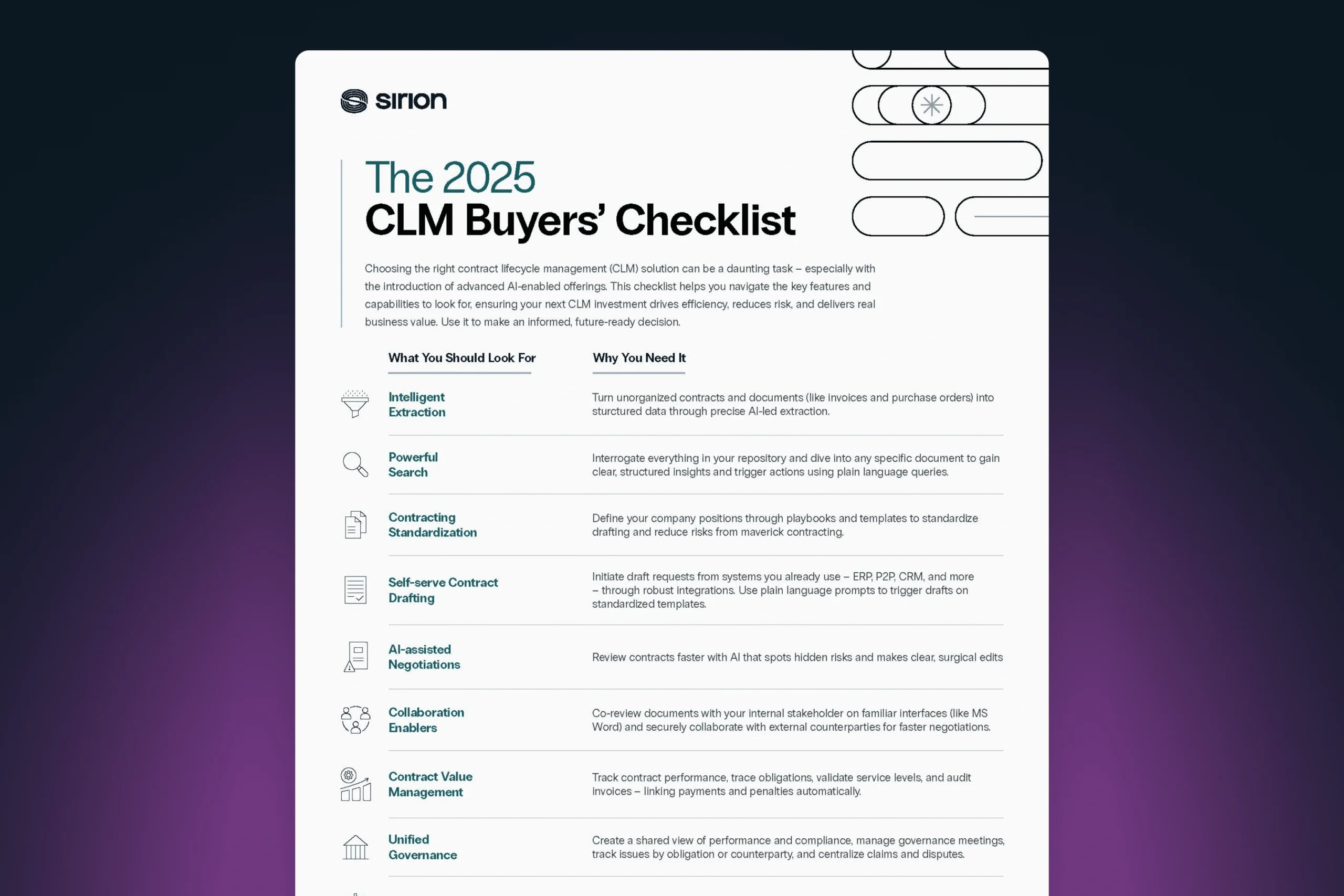
The 2025 CLM Buyers’ Checklist