What is Conversational CLM?

- Last Updated: Mar 10, 2026
- 15 min read
- Sirion
Contract work happens through questions and decisions. Which agreements are at risk? Should we accept these terms? What do we normally negotiate on payment language? How does this deal compare to precedent?
Traditional CLM makes you translate those questions into software actions: navigate modules, apply filters, open documents, cross-reference data, synthesize manually. These features offered greater control over contracts and contract data, but it also made the experience of using CLMs complicated. You spent more time operating the system than acting on what it tells you.
Conversational CLM collapses that gap. You state what you need—information, analysis, a draft, a decision recommendation—and the system executes.
Understanding Conversational CLM
Conversational CLM uses natural language as the interface for contract work. Rather than navigating through menus and forms, you describe what you need to accomplish and the system handles execution.
You describe the outcome. „Draft a services agreement for this supplier with our standard IP provisions“ or „Flag any risks in this contract that deviate from our playbook.“ The system understands what you’re asking for and what it needs to produce.
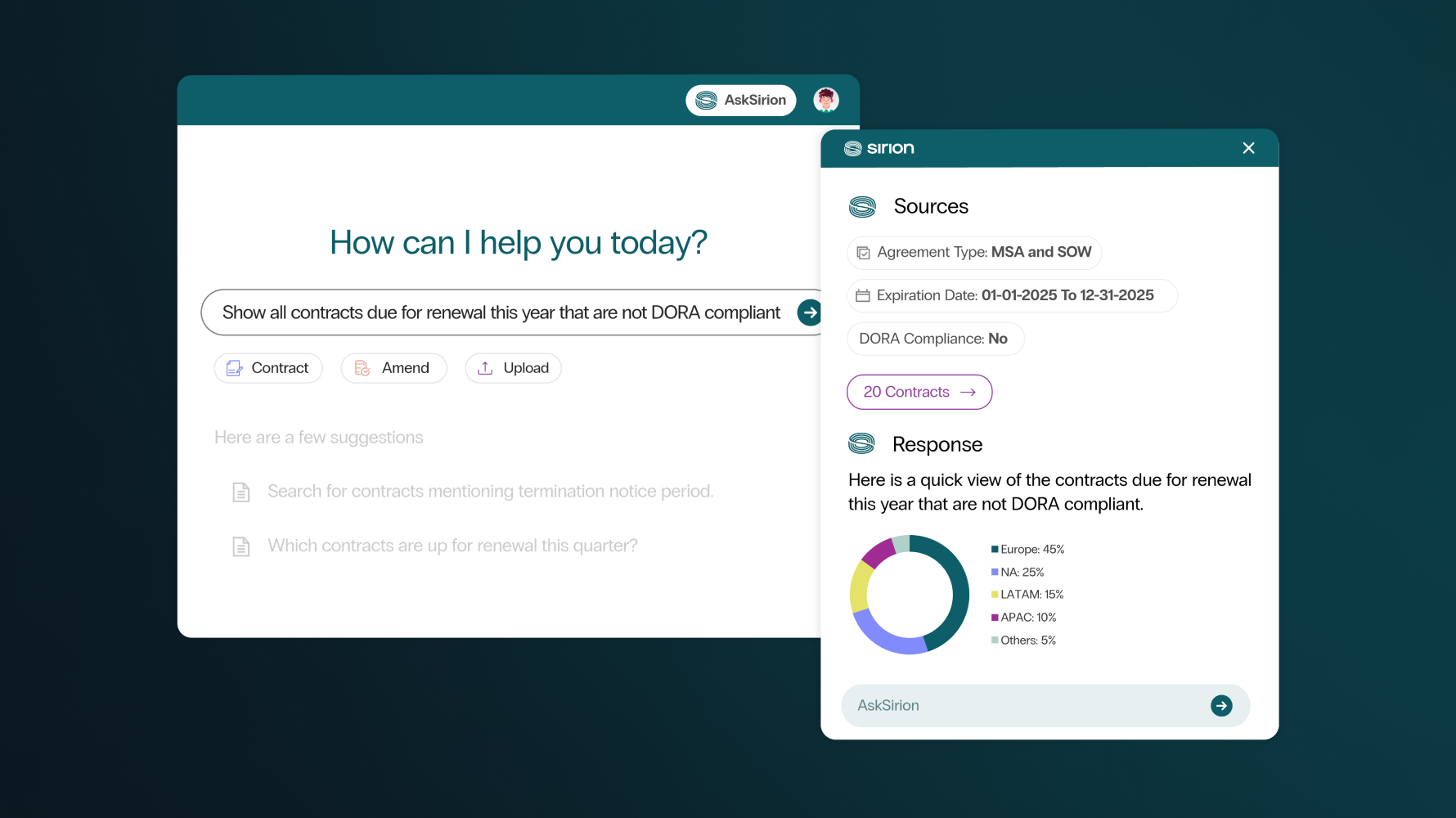
The system interprets intent. It knows the difference between „Show me our supplier contracts“ (retrieval), „Compare payment terms across our supplier contracts“ (analysis), and „Generate a supplier contract“ (creation). Same domain, different actions.
It maintains context. If you ask „What’s the liability cap in this agreement?“ and follow with „How does that compare to our last three deals with this vendor?“ the system knows you’re still talking about the same contract and vendor.
Conversational CLM doesn’t stop at showing you information. It drafts agreements, routes approvals, extracts obligations, monitors deadlines, generates redlines—all through natural language requests.
What Makes a CLM „Conversational“
Conversational CLM reasons about contracts, understands business context, and takes goal-directed action. To do this, it requires three foundational capabilities that distinguish it from traditional interfaces or simple chatbots.
Without these, natural language interaction becomes unreliable—good for basic retrieval, inadequate for contract work that demands precision and accountability.
Semantic understanding of contract language
Semantic contract knowledge is what allows a conversational CLM to converts raw contract data into actionable intelligence and natural language responses. The system doesn’t just match keywords; it comprehends what contractual terms mean and how they relate. A conversational CLM knows that „liability cap,“ „limitation of liability,“ and „maximum exposure“ refer to the same concept. It understands that payment terms in one section connect to default provisions in another.
Also Read: Conversational AI Workflows
Citated references to your own contract data
When the system flags a risk or recommends a position, it shows its reasoning. „This indemnification clause is broader than your standard playbook—here’s the specific language deviation and three precedent agreements where you negotiated it down.“ You’re not trusting a black box—you’re seeing the evidence and logic, which lets you verify accuracy and maintain control over critical decisions.
Orchestrated execution across systems
Conversational CLM coordinates actions that traditionally required multiple tools and manual handoffs. A single request—“Review this contract, flag deviations, generate a redline based on our last agreement with this vendor, and route to procurement for approval“—triggers analysis, document generation, precedent lookup, and workflow routing. The system handles the coordination; you focus on the decision.
Simplify Your Work with Plain Language Prompts
Conversational CLM doesn’t just make existing tasks faster—it changes what’s possible in a working session.
Contract creation:
- Before:
Find template → download → manually populate 15 fields → look up jurisdiction-specific clauses → cross-reference precedent for custom terms → 45 minutes to first draft
- After:
„Draft a three-year services agreement for this supplier, include standard data privacy terms, cap liability at $500K“ → draft ready in 30 seconds
Risk assessment:
- Before:
Read 40-page agreement → cross-reference playbook → check precedent deals → manually flag deviations → document findings → 2 hours
- After:
„Compare this contract to our playbook and flag any high-risk deviations“ → marked-up analysis in minutes
Portfolio analysis:
- Before:
Export all supplier contracts → build pivot table → calculate term distribution → identify outliers → half a day
- After:
„Which supplier contracts have payment terms longer than 60 days and how much spend do they represent?“ → answer with sources immediately
Workflow execution:
- Before:
Determine approval path → manually route to finance → follow up if no response → escalate if needed → track in spreadsheet
- After:
„Route this contract to finance for approval, escalate to CFO if no response in 48 hours“ → workflow executes and monitors automatically
Obligation monitoring:
- Before:
Set calendar reminders → manually check contracts approaching deadlines → email stakeholders → update tracking sheet
- After:
„Alert me 60 days before any deliverable deadlines in our active services agreements“ → proactive monitoring established
What It’s NOT
We’ve seen what a conversational CLM is. Now, let’s take a look at what it’s not:
NOT a chatbot overlay. Adding a chat window to traditional CLM doesn’t make it conversational. If you still need to know which module contains what data or how to phrase queries to match system structure, it’s search with a different interface.
NOT just natural language search. Search retrieves documents matching criteria. Conversational CLM creates contracts, assesses risk, executes workflows, and monitors obligations. The distinction is execution capability.
NOT removing the need for structure. Conversational CLM requires more operational rigor. AI needs well-defined playbooks to assess risk, structured templates to generate contracts, clear approval frameworks to route decisions. Organizations with mature contract processes see the transformation; those without it struggle to get reliable outputs.
NOT replacing expertise. Conversational systems accelerate analysis and execution—they don’t make strategic decisions. Whether to accept a liability cap, approve a supplier, or escalate a negotiation still requires human judgment. What changes is how fast you get the intelligence needed to make those decisions.
Why Enterprise are Adopting Conversational CLM
Conversational CLM represents a different model for how organizations work with contracts. The interface isn’t a layer on top of traditional workflows, it’s a replacement. You describe outcomes, the system executes.
The organizations adopting conversational CLM aren’t doing it for interface preference. They’re doing it because the work itself happens differently: faster, more accessible, more aligned with how people actually think about contracts than how software is structured.

Sirion is the world’s leading AI-native CLM platform, pioneering the application of Agentic AI to help enterprises transform the way they store, create, and manage contracts. The platform’s extraction, conversational search, and AI-enhanced negotiation capabilities have revolutionized contracting across enterprise teams – from legal and procurement to sales and finance.