
Contract Data: The Hidden Asset Your Organization Is Leaving on the Table

- Nov 27, 2025
- 15 min read
- Arpita Chakravorty
Every enterprise loses value daily without knowing it. A sales team misses renewal dates buried in email attachments. Finance can’t identify payment terms scattered across vendor contracts. Legal can’t track compliance obligations locked in PDFs across departments. This isn’t negligence—it’s the inevitable result of contract data living everywhere except where it’s actually useful.
Contract data is simply the structured and unstructured information within contracts: obligations, dates, terms, conditions, counterparties, and financial commitments. Yet most organizations treat contracts as documents to store, not as data assets to extract, analyze, and leverage strategically. The result is operational friction, missed savings, and regulatory exposure that compounds silently across hundreds or thousands of agreements.
Unlike “data contracts” (formal agreements between data producers and consumers that govern data quality and SLAs), contract data represents the actionable intelligence already embedded in your existing agreements—waiting to be unlocked.
Why Contract Data Matters Now
Contract data extraction has moved from “nice to have” to essential infrastructure. Here’s why:
- Revenue leakage is quantifiable. Research indicates 9% of organizational revenue is lost to contract value leakage—forgotten discounts, untracked rebates, missed renewal opportunities. A mid-market enterprise with $100M in annual contracts loses roughly $9M without systematic contract data management.
- Compliance complexity is accelerating. Regulatory frameworks like GDPR, HIPAA, and emerging ESG requirements embed data obligations directly into contracts. Without structured access to contract data, compliance teams operate reactively, discovering gaps during audits rather than preventing violations proactively.
- AI-powered extraction changes the game. Modern natural language processing can now identify obligations, extract dates, map counterparty relationships, and surface risk signals in seconds—not hours. This transforms contract data from archival records into real-time operational intelligence.
The Three Layers of Contract Data
Understanding contract data requires recognizing its structural dimensions:
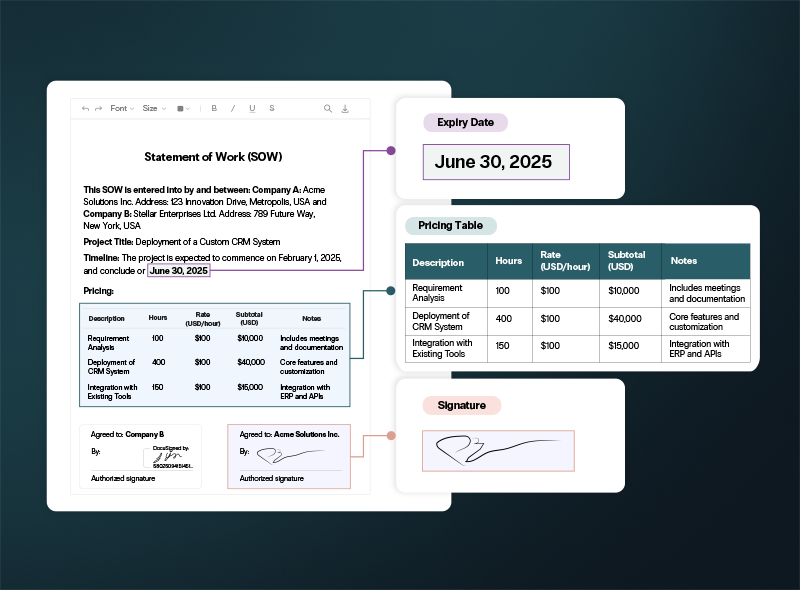
- Explicit data is immediately visible: contract dates, monetary amounts, signatory names, renewal clauses. These are easy to extract but often scattered across unstructured text, making systematic capture difficult without automation.
- Implicit obligations lie within narrative clauses: payment schedules hidden in Terms & Conditions, confidentiality restrictions embedded in boilerplate, compliance requirements woven through legal language. These require contextual intelligence to identify and extract meaningfully.
- Relational metadata connects contracts to business outcomes: vendor performance against SLAs, cascade effects of contract changes across the organization, correlation between contract terms and financial results. This layer transforms static contract data into strategic intelligence.
Most organizations capture only the first layer manually. The second and third layers—where real value compounds—remain invisible without structured extraction and analysis processes.
Contract Data Management: From Siloed Documents to Strategic Asset
The journey from chaos to clarity follows a predictable pattern:
Stage 1: Decentralization. Contracts live in email, shared drives, legal systems, procurement platforms. Each department maintains its own version of truth. Finance sees purchase agreements. Legal sees risk profiles. Procurement sees vendor terms. Nobody sees the complete picture.
Stage 2: Centralization. A central repository emerges—sometimes a CLM (Contract Lifecycle Management) platform. Contracts now live in one location, but extraction remains manual. Teams still spend hours searching, copying, and re-entering data into operational systems.
Stage 3: Intelligent extraction. AI-powered systems automatically identify and extract contract data elements. Structured extraction reduces manual effort by 80-90%, enabling real-time access to obligation data. This layer transforms contracting from a legal function into an operational capability.
For a deeper look at technologies that automate this shift, explore our page on Tools for Automated Contract Data Extraction.
Stage 4: Analytics and optimization. With contract data systematized, organizations can now analyze patterns: Which vendor terms drive the highest profitability? Which contract clauses correlate with disputes? Where do compliance risks cluster? This enables predictive decision-making.
The Hidden Cost of Contract Data Blindness
Organizations without systematic contract data management face three compounding risks:
- Operational inefficiency. Procurement teams spend 40% of contract lifecycle time on manual data entry and retrieval. Finance can’t automate invoice matching because payment terms aren’t accessible. Supply chain teams miss critical dates because obligations aren’t tracked centrally.
- Financial leakage. Untracked renewal dates lead to automatic extensions at worse-than-negotiated rates. Unused volume commitments expire unmeasured. Earned discounts go unclaimed. For a $500M procurement organization, this typically represents $5-25M in annual leakage.
- Compliance exposure. Data processing agreements (DPAs) required under GDPR contain specific obligations about data handling, retention, and deletion. Without structured access to these requirements, compliance teams can’t ensure consistent adherence. The cost of discovery failures in regulatory audits—fines, remediation, reputational damage—dwarfs the investment in contract data systems.
For solutions that help teams stay ahead of these risks, see our guide on Contract Tracking Systems.
Building Contract Data System Infrastructure
Implementing systematic contract data management system requires three parallel workstreams:
- Technology integration. Modern CLM platforms with contract data extraction capabilities use AI to automatically identify key data elements. These systems integrate with ERP, procurement, and finance systems, feeding extracted data directly into operational workflows. The result: contracts become sources of real-time information, not static records.
- Metadata definition. Before extraction can scale, organizations must define which data elements matter. This requires cross-functional alignment: What does Finance need? What does Legal require? What does Compliance track? The resulting data model becomes the blueprint for extraction and classification. Contract metadata includes explicit fields (dates, amounts, parties) and contextual tags (risk classifications, performance metrics, compliance requirements).
- Governance and ownership. Contract data only becomes strategic when someone owns it. Many organizations assign data stewardship responsibility to a Chief Contracting Officer or Head of Contract Operations. This role ensures data quality, manages integration with operational systems, and drives continuous improvement in extraction accuracy.
Contract Data in Your Operating Model
The competitive organizations we observe treat contract data as a core operational asset, not an archival function. This manifests in three ways:
- Real-time obligation tracking. Rather than discovering contract obligations during renewal cycles, organizations with mature contract data systems automatically alert teams to approaching dates, changing requirements, and compliance deadlines. This shifts contracting from reactive management to proactive optimization.
- Integrated financial reporting. Contract analytics platforms now enable finance teams to trace contract commitments directly into general ledgers, forecast cash impacts, and reconcile spend against negotiated terms. This bridges the traditional gap between procurement and finance.
- Risk-informed decision-making. With contract data systematized, organizations can identify patterns in contract risk exposure, analyze which contract structures correlate with disputes, and adjust negotiation strategies Rather than reviewing each contract in isolation, teams see the portfolio view.
Organizations implementing these capabilities report 15-25% improvement in contract cycle time, 8-15% reduction in contract-related disputes, and recovery of 3-7% in previously untracked value.
With these stages in mind, here’s how an AI-native CLM like Sirion activates contract data across the enterprise.
How Sirion Unlocks the Full Power of Contract Data Management
Most organizations stop at centralizing contracts. Sirion goes several steps further—transforming every agreement in your repository into an active source of intelligence that drives decisions across legal, procurement, finance, and compliance.
Sirion’s contract data engine is built on a multi-model AI architecture trained on millions of enterprise agreements. This allows the platform not just to extract surface-level information, but to uncover the deeper layers of contract intelligence that traditional tools miss.
Here’s how Sirion turns static documents into strategic advantage:
- Advanced AI Extraction Across Explicit, Implicit & Relational Data
Sirion’s Extraction Agent identifies key terms, obligations, renewal triggers, compliance requirements, pricing structures, and dependencies across contracts with high precision.
It analyzes not only explicit fields but also implicit obligations hidden in narrative clauses and relational metadata that links terms across entire contract networks.
- Obligation Intelligence That Drives Real Business Impact
Every extracted obligation is automatically mapped to owners, timelines, workflows, and alerts.
Sirion’s obligation management engine ensures that no renewal deadline, performance requirement, or compliance mandate goes unnoticed—preventing leakage and reducing disputes across the value chain.
- A Contract Intelligence Graph Built for Enterprise Complexity
Sirion connects terms, clauses, parties, KPIs, risks, SLAs, and performance data across thousands of agreements.
This relational graph reveals patterns such as risk clusters, high-friction clauses, vendor performance trends, and financial exposures that remain invisible in document-based systems.
- Predictive Insights for Renewals, Compliance & Risk
Sirion’s analytics layer uses extracted data to generate portfolio-level intelligence:
- renewal probability scoring
- supplier performance predictions
- compliance deviation alerts
- dispute pattern analysis
- risk scoring across categories and geographies
This enables proactive decision-making rather than post-event cleanup.
For a deeper look at tools that turn extracted data into actionable intelligence, see our guide on Contract Analysis Software.
- Seamless Data Flow Across Procurement, Finance & ERP Systems
Extracted contract data flows directly into surrounding systems—P2P, ERP, CRM, billing, procurement, and finance automation platforms.
This eliminates manual re-entry, accelerates reconciliations, and creates a unified operational truth.
- Enterprise-Grade Data Governance
Sirion enforces consistent taxonomies, metadata standards, clause models, and policy controls across global teams.
Audit trails, standardized templates, and automated validations keep data consistent and compliant across jurisdictions.
Organizations using Sirion report double-digit reductions in leakage, faster cycle times, fewer disputes, better compliance, and a more accurate understanding of financial and operational commitments.
Your Next Step
Contract data is not a technical problem; it’s a strategic opportunity. The organizations winning in their markets treat contracts as living data sources that inform procurement strategy, financial planning, and compliance management—not as static documents filed away post-signature.
Begin by auditing your current state: Where do your contracts live? Who has access? How do you currently track obligations, dates, and compliance requirements? The answers will reveal whether you’re leaving value on the table and where systematic contract data infrastructure would create the most impact.
Frequently Asked Questions: FAQs on Contract Data Essentials
What's the difference between contract data and data contracts?
Contract data is information within contracts: terms, dates, obligations, amounts. Data contracts are formal agreements between data producers and consumers that define data quality standards and SLAs. They're addressing different problems—one unlocks value from existing agreements, the other ensures reliability in data pipelines.
How long does contract data extraction implementation typically take?
Initial deployment with a CLM platform usually takes 4-8 weeks for core setup. Training extraction models on your contract library and integrating with operational systems extends this to 3-6 months. ROI typically emerges within 6-9 months as teams access and act on extracted data.
Which contract data elements should we prioritize extracting first?
Start with high-impact, low-complexity data: renewal dates, payment terms, counterparty names, and key financial commitments. These drive immediate operational value and establish credibility for more complex extraction like obligation mapping and compliance requirements. Analytics capabilities help identify which additional elements would unlock the most value for your organization.
Can contract data integrate with ERP, procurement, or billing systems?
Yes. Mature CLM platforms map extracted data into operational systems, enabling automated invoice matching, spend reconciliation, supplier scorecards, and predictive forecasting.
What’s the ROI timeline for contract data extraction programs?
Most organizations see impact within the first 6–9 months via reduced manual effort, fewer missed renewals, improved compliance tracking, and clearer spend visibility.
Additional Resources

Why Contract Management Data Security is Non-Negotiable for Enterprises
 1 min read