2026 Guide to End‑to‑End Signature Block Parsing for Legal Teams
- Apr 21, 2026
- 15 min read
- Sirion
- Signature block parsing turns static contracts into usable data.
Extracting signer names, roles, and dates enables contracts to be indexed, tracked, and audited more effectively across systems. - Accuracy at extraction directly impacts compliance and audit readiness.
Errors in signature data can lead to missed validations, incomplete audit trails, and downstream lifecycle risks. - Integration with CLM unlocks real business value.
Parsed signature data becomes actionable when it drives obligations, renewals, and compliance workflows across the contract lifecycle. - Automation must be paired with validation and governance.
Confidence scoring, audit logs, and human review ensure that AI-driven parsing remains reliable and defensible. - Continuous monitoring improves performance over time.
Tracking accuracy and feeding corrections back into the system helps maintain high-quality parsing across evolving contract formats.
Automating the parsing of signature blocks in executed contracts has become essential for legal, procurement, and compliance teams managing thousands of agreements across systems. Signature block parsing helps identify who signed what, when, and under which authority—transforming static, scanned contracts into structured, auditable data. This guide explains the seven key steps to implement reliable, AI‑driven signature parsing, from secure ingestion to integration with contract lifecycle management (CLM) platforms, and outlines best practices to keep workflows explainable and compliant at enterprise scale.
Understanding Signature Block Parsing and Its Importance for Legal Teams
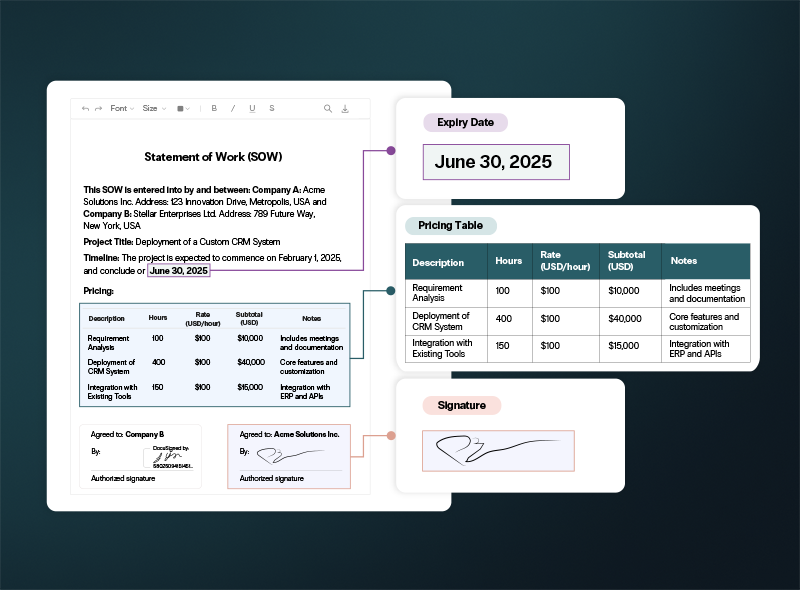
Signature block parsing is the process of programmatically extracting signer names, roles, signature images, signing dates, and related metadata from executed contracts. It turns unstructured signature regions into structured data that can be indexed, searched, and monitored.
For legal teams, parsing is more than data capture—it’s the foundation for automated contract intelligence. When integrated into a CLM like Sirion’s AI‑native platform, parsed signature data supports obligation tracking, prevents missed renewals, and maintains audit readiness through complete post‑execution visibility.
Risks from inadequate signature parsing include:
- Missing signer authority validation during audits
- Lack of a traceable audit trail for compliance teams
- Renewal delays caused by unlinked or unidentified signatures
By embedding signature extraction and CLM automation into their workflows, legal teams can ensure continuous compliance and avoid costly oversights.
Step 1: Ingest Documents from Multiple Sources Securely
The parsing process begins by securely acquiring executed contracts from multiple repositories. Legal teams can ingest documents through e‑signature APIs, email attachments, or contract repositories. API‑first e‑signature solutions such as DocuSign, Adobe Acrobat Sign, and SignNow enable event‑driven ingestion via webhooks—ensuring immediate, traceable access to final contract versions. Sirion’s CLM can serve as the central repository for these integrated inputs, maintaining a unified system of record.
“API‑first” simply means the system is designed to integrate programmatically, allowing reliable automation across enterprise applications. Each document should enter a secure staging area with enforced encryption and data residency controls. For compliance, vendors must adhere to SOC 2 Type II and ISO 27001 standards, ensuring tamper‑proof transfer and verifiable auditability.
Step 2: Detect Signature Blocks Using Layout Analysis
Once documents are staged, layout analysis identifies where signature regions appear. Advanced layout models analyze the visual structure of each page, segmenting it into functional zones—such as body text, form fields, footers, and signature blocks.
AI‑based layout detection significantly improves OCR precision by narrowing the extraction scope to relevant regions. Traditional rule‑based methods rely on coordinates or templates; AI‑driven approaches learn contextual patterns across layouts, providing more reliable results when dealing with varied templates or scanned pages.
Approach | Basis of Detection | Typical Accuracy |
Rule‑based templates | Coordinates and keywords | Moderate |
AI‑driven layout analysis | Visual and text features combined | High |
Step 3: Apply OCR and Image Processing for Data Extraction
Optical Character Recognition (OCR) converts images of text or handwriting into structured, machine‑readable data. This stage is crucial for scanned pages or image‑based PDFs, where text cannot be natively parsed.
Successful OCR begins with image preprocessing—enhancing contrast, removing noise, and binarizing content to improve recognition accuracy. Once processed, OCR identifies characters and assembles them into fields such as names, dates, or titles. Image hashing is often applied to link extracted signature images back to the corresponding signer’s data.
When confidence levels fall below defined thresholds, low‑accuracy extractions are flagged for manual review, creating a safety net for compliance‑sensitive workflows. Sirion’s AI maintains this feedback loop automatically, strengthening accuracy and audit reliability at scale.
Step 4: Extract and Normalize Signature Entities
Entity extraction uses AI and natural language processing (NLP) to identify specific fields—like signer name, title, organization, and signing date—from unstructured text. Normalization then standardizes these outputs into consistent formats suitable for automation.
For example, names may vary across documents (“J. Smith,” “John P. Smith,” or “John Smith – CEO”). Normalization reconciles these variants under a single record, preserving data consistency for downstream applications.
Entity Type | Example Input | Normalized Output |
Signer Name | J. Q. Public | John Q. Public |
Role/Title | Chief Exec. | CEO |
Date | 03‑05‑26 | 2026‑03‑05 |
Accurate normalization mitigates fragmentation, ensuring every contract connects to the right counterpart, signer, and compliance record.
Step 5: Verify Signer Identity and Ensure Compliance
Verification ensures that extracted fields correspond to real, authenticated signers. Systems cross‑check signer data against digital certificate chains, authentication logs, and event histories stored within e‑signature platforms.
Auditable evidence—such as time‑stamped logs, hash validation, and identity credentialing—is vital for SOC 2 and ISO audits. A compliant system should enable:
- Role‑based access controls
- Immutable audit logs
- Document encryption at rest and in transit
- Clear chain‑of‑custody tracking
These features not only satisfy regulators but also build enterprise trust in fully automated signature verification.
Step 6: Integrate Parsed Data with Contract Lifecycle Management Systems
Structured signature data achieves its true value when pushed into a CLM or contract intelligence platform. Integration via API or webhook connections enables automated triggers—such as renewal reminders, non‑compliance alerts, and obligation monitoring—without manual intervention.
For example, when a signed contract is parsed, the CLM can automatically calculate renewal windows or flag missing counter‑signatures. This seamless integration eliminates data silos between legal, procurement, and finance systems, reinforcing consistent risk and performance management enterprise‑wide. Sirion’s AI‑native CLM performs this synchronization automatically, ensuring that every agreement remains traceable, measurable, and compliant.
Step 7: Monitor Parsing Accuracy and Continuously Improve Models
Sustained accuracy demands continuous monitoring. Teams should track metrics such as extraction precision, recall, and exception rates while maintaining explainability logs for every automated decision.
Low‑confidence outputs should feed an active learning loop: human validation corrects errors, improving the model with each iteration. As document types evolve, this approach ensures parsing quality remains high and transparent—a crucial factor for regulated enterprises subject to audit scrutiny
Best Practices for Designing a Secure and Explainable Parsing Pipeline
A secure, explainable parsing pipeline balances automation efficiency with demonstrable oversight. Core best practices include:
- Setting confidence thresholds and escalation rules
- Choosing API‑first vendors with webhook support
- Enforcing SOC 2 Type II and ISO 27001 compliance
- Maintaining an explainability log for every extraction event
Explainability means the AI system can articulate why it made specific identifications or flags—empowering legal teams to validate findings quickly during audits or disputes.
Pipeline Stage | Risk Control | Compliance Check |
Ingestion | Encryption & access control | SOC 2 verification |
Detection | Accuracy thresholds | Explainability reviewed |
Extraction | Confidence scoring | Human‑review loop |
CLM Integration | Data lineage tracking | Audit log continuity |
Connecting parsing outputs directly to post‑signature contract management ensures every agreement remains accountable, searchable, and compliant from signature to renewal. Sirion’s platform unifies this chain, linking parsed signature data to performance analytics and SLA tracking.
Frequently Asked Questions (FAQs)
How does AI parse signature blocks in contracts?
AI uses a combination of layout detection, OCR, and natural language processing to identify signature regions and extract key details such as signer names, roles, and dates. These elements are then structured into searchable and usable data.
What security and compliance standards matter for signature parsing?
How accurate is AI for extracting signer details and signatures?
How can legal teams integrate signature parsing into existing workflows?
What should legal teams consider when selecting a signature parsing solution?

Sirion is the world’s leading AI-native CLM platform, pioneering the application of Agentic AI to help enterprises transform the way they store, create, and manage contracts. The platform’s extraction, conversational search, and AI-enhanced negotiation capabilities have revolutionized contracting across enterprise teams – from legal and procurement to sales and finance.
Zusätzliche Ressourcen
 4 min read