Best AI Tools for Contract Search and Analysis: A Practical Guide for Enterprise Teams

- Last Updated: Mar 27, 2026
- 15 min read
- Arpita Chakravorty
Contracts hold the answers to some of the most critical business questions—revenue exposure, compliance risk, renewal opportunities, and supplier performance. Yet, in most enterprises, those answers remain buried in static documents, scattered repositories, and inconsistent formats.
The real challenge isn’t access to contracts. It’s finding the right information inside them—quickly, accurately, and at scale.
This is where AI-powered contract search and analysis tools are changing the equation. Instead of manual reviews and keyword guessing, enterprises can now query contracts like a dataset, uncover risks proactively, and make faster, data-driven decisions.
This guide breaks down the best AI tools for contract search and analysis, what differentiates them, and how to choose the right solution for your enterprise.
What Are AI Tools for Contract Search and Analysis?
Before evaluating tools, it’s important to understand what “AI-powered contract search and analysis” actually means in practice.
At a functional level, these tools combine:
- Natural language search across contract repositories
- AI-driven data extraction from unstructured agreements
- Clause-level analysis and risk identification
- Contextual insights tied to obligations, renewals, and compliance
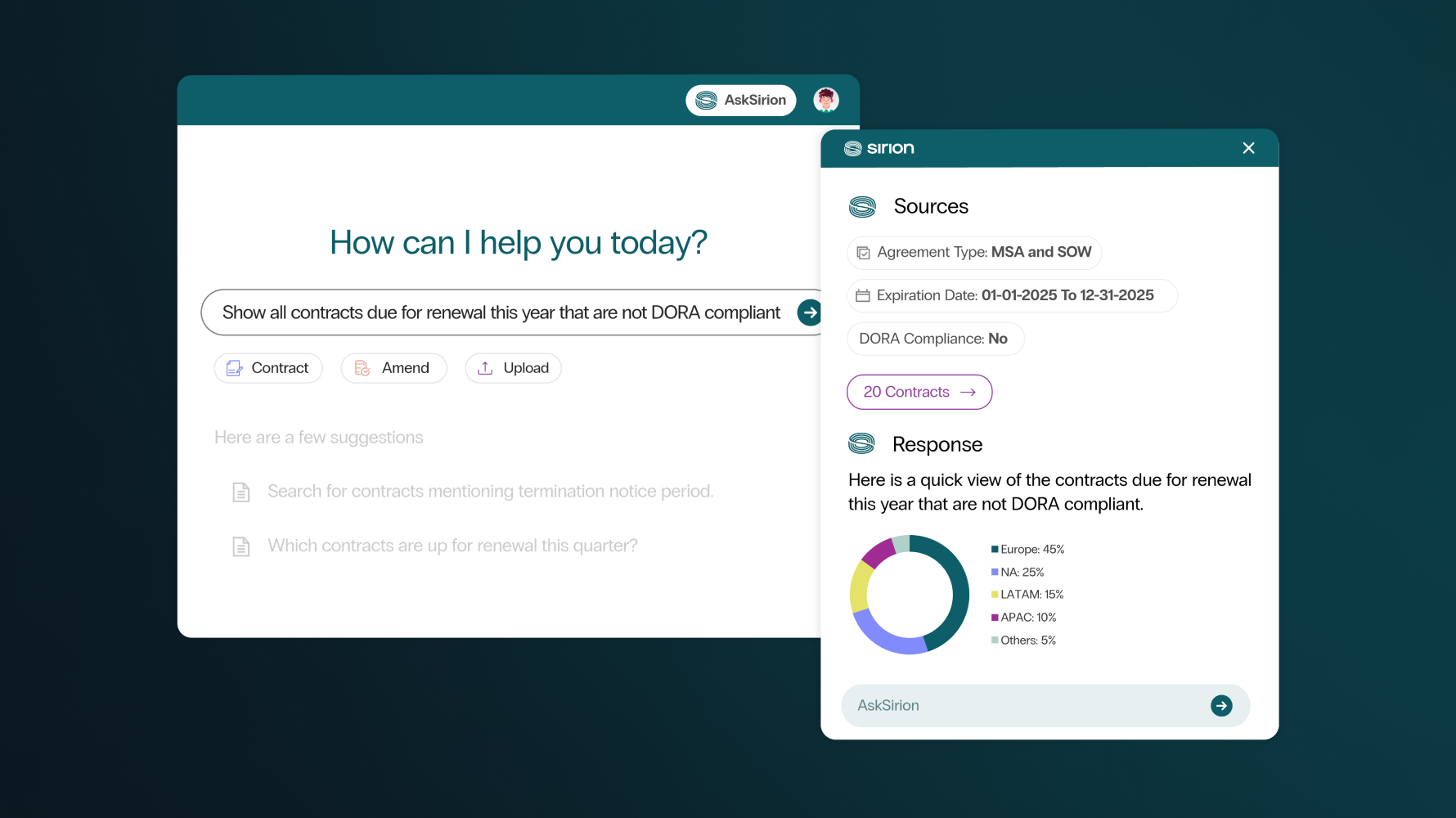
Unlike traditional keyword search, AI tools understand intent, context, and relationships between clauses, enabling users to ask questions like:
- “Which contracts have auto-renewal clauses in the next 90 days?”
- “Show agreements with non-standard indemnity clauses”
- “What revenue is tied to contracts expiring this quarter?”
This shift transforms contracts from documents into queryable business assets.
Unlock deeper visibility with Automated Contract Analysis to surface risks, track obligations, and turn contract data into actionable business insights at scale.
Why Enterprises Are Adopting AI for Contract Search
Manual contract review doesn’t scale with growing contract volume and complexity. AI addresses this gap by enabling speed, accuracy, and visibility across the contract lifecycle.
A few key drivers behind adoption:
- Volume and complexity: Enterprises manage thousands of contracts across jurisdictions and business units
- Risk exposure: Missed clauses, obligations, or compliance requirements can lead to significant financial and legal impact
- Siloed systems: Contracts often live across CLM platforms, CRMs, shared drives, and legacy systems
- Time-to-insight: Business teams need answers in minutes—not days of manual review
AI tools bridge these gaps by delivering instant, reliable insights across the entire contract portfolio.
Core Capabilities to Look for in the Best AI Tools for Contract Search and Analysis
Choosing the right AI tool isn’t about checking feature boxes—it’s about ensuring the platform can reliably surface, interpret, and operationalize contract data at enterprise scale. The following capabilities separate surface-level tools from true contract intelligence platforms.
1. Natural Language and Conversational Search
Modern contract search must move beyond static filters and Boolean logic.
- Users should be able to ask layered, contextual questions (e.g., “Show revenue at risk from contracts with uncapped liability clauses expiring this quarter”)
- The system should interpret intent, not just keywords, accounting for legal language variations and clause structures
- Results should be explainable, with traceability back to specific clauses and contract sections
This is particularly critical in enterprises where non-legal stakeholders (sales, procurement, finance) need access to contract insights without relying on legal teams.
2. High-Fidelity AI Data Extraction at Scale
Search is only as good as the data it operates on.
- AI models should extract both standard metadata (dates, values, parties) and complex clause constructs (termination rights, indemnities, SLAs)
- Accuracy must hold across diverse contract types, geographies, and legacy formats
- The system should continuously learn from enterprise-specific language, fallback clauses, and negotiated variations
In practice, this determines whether your AI tool delivers trusted insights—or noisy, unreliable outputs that require manual validation.
3. Clause Intelligence and Deviation Analysis
Enterprise risk rarely lies in whether a clause exists—it lies in how it deviates.
- Identify non-standard language against approved clause libraries and playbooks
- Quantify deviation severity (e.g., financial exposure, compliance risk)
- Enable bulk analysis across thousands of contracts to uncover systemic risks
This capability transforms contract review from document-level inspection to portfolio-level risk intelligence.
4. Obligation Mapping and Performance Visibility
Most tools stop at extraction. Enterprise value begins post-signature.
- Automatically identify and structure obligations (payment terms, SLAs, deliverables)
- Track fulfillment status and link obligations to business outcomes
- Trigger alerts for missed milestones, penalties, or compliance breaches
Without this, organizations gain visibility—but still lose value due to missed commitments and unmanaged obligations.
5. Contextual Contract Analytics
Search answers individual questions. Analytics answers business questions.
- Aggregate contract data across portfolios to surface trends (e.g., recurring risky clauses, renewal concentration)
- Enable segmentation by region, vendor, business unit, or contract type
- Support audit readiness with traceable, reportable insights
This is where AI moves from operational efficiency to strategic decision support.
6. Enterprise-Grade Governance and Integration
AI insights are only useful if they fit into enterprise workflows.
- Bi-directional integrations with systems like Salesforce, ERP, and procurement platforms
- Role-based access controls and audit trails
- Policy-driven workflows to enforce standardization and compliance
For large enterprises, this is non-negotiable—without governance, AI introduces risk instead of reducing it.
Explore the Benefits of AI in Contract Management to understand how intelligent automation enhances contract visibility, reduces risk, and drives faster, data-backed decisions across the lifecycle.
Best AI Tools for Contract Search and Analysis in 2026
The market includes both AI-native platforms and workflow-centric CLM systems with AI overlays. Understanding this distinction is critical when evaluating tools.
1. Sirion CLM
Sirion stands out as an AI-native platform designed to unify contract search, analysis, and lifecycle execution—not as isolated capabilities, but as a continuous intelligence layer.
What differentiates Sirion:
- AI trained on millions of enterprise contracts, enabling high-accuracy extraction and contextual understanding
- Conversational search that delivers precise answers tied to clause-level evidence—not just document retrieval
- Advanced clause intelligence, identifying deviations, benchmarking against playbooks, and quantifying risk exposure
- Deep post-signature capabilities, including obligation tracking, compliance monitoring, and value leakage detection
- Enterprise-grade governance, ensuring data security, auditability, and controlled access across stakeholders
Most importantly, Sirion connects insights to execution—so findings from contract analysis directly inform renewals, negotiations, supplier performance, and revenue realization.
2. Agiloft
Agiloft is well-suited for organizations that prioritize process flexibility and workflow customization.
Key strengths:
- No-code/low-code configuration for tailoring contract workflows
- Flexible schema design for aligning with unique business processes
- Strong compliance tracking and audit capabilities
That said, its AI capabilities for contract search and analysis are typically not as deeply embedded or AI-native, often requiring additional configuration, tuning, or integrations to achieve comparable intelligence depth.
3. Ironclad AI
Ironclad focuses heavily on streamlining contract creation, negotiation, and approvals.
Key strengths:
- Strong workflow automation for drafting and approvals
- AI-assisted redlining and clause suggestions
- Seamless alignment with sales and legal collaboration
However, its capabilities in post-signature analytics, obligation management, and deep contract intelligence are relatively less mature compared to platforms built for full lifecycle visibility.
4. Icertis Contract Intelligence
Icertis is a CLM platform designed for enterprises with complex process requirements.
Key strengths:
- Scalable workflows for contract lifecycle standardization
- Compliance and governance capabilities
- Structured approach to contract data management
However, its AI capabilities tend to be more workflow-embedded rather than insight-first, which can limit flexibility in exploratory search and advanced analytics use cases.
5. Evisort
Evisort is often chosen by organizations looking to quickly unlock data from existing contract repositories.
Key strengths:
- Fast ingestion and automated metadata extraction across large document sets
- Strong baseline search capabilities for retrieving contract information
- Quick time-to-value for organizations starting their AI journey
However, organizations may encounter limitations when scaling into advanced analytics, obligation tracking, and cross-functional workflows, where deeper lifecycle integration becomes necessary.
Comparison of the Best AI Tools for Contract Search and Analysis
Capability | Sirion CLM | Evisort | Agiloft | Ironclad AI | Icertis |
AI-Native Contract Search | Advanced conversational search with clause-level accuracy and explainability | Strong keyword + AI-assisted search | Basic search with configurable enhancements | Moderate search focused on workflows | Structured search with limited conversational capability |
Data Extraction Accuracy | High accuracy across complex enterprise contracts with continuous learning | Strong extraction for standard fields | Configurable but requires setup and tuning | Moderate extraction, stronger pre-signature | Structured extraction with dependency on configuration |
Clause Intelligence & Risk Analysis | Deep clause analysis, deviation detection, and risk quantification | Basic clause identification | Limited native intelligence, relies on rules | Clause suggestions during drafting | Rule-based risk identification |
Post-Signature Visibility | Comprehensive (obligations, compliance, value leakage tracking) | Limited | Moderate with configuration | Limited | Moderate |
Analytics & Reporting | Advanced portfolio-level analytics and actionable insights | Basic reporting | Custom reporting (manual setup required) | Workflow-centric reporting | Structured enterprise reporting |
Workflow & Lifecycle Coverage | End-to-end (pre-signature + post-signature) | Primarily repository and search-focused | Strong workflow customization | Strong pre-signature workflows | Strong lifecycle workflows |
Ease of Deployment | Enterprise implementation with structured onboarding | Fast time-to-value | Requires configuration effort | Moderate | Longer enterprise deployment cycles |
Best Fit | Large enterprises seeking end-to-end contract intelligence | Teams starting with AI-based contract extraction | Organizations needing flexible workflows | Legal teams focused on contract creation | Enterprises prioritizing process standardization |
How to Choose the Right AI Contract Search and Analysis Tool
Selecting the right platform requires aligning capabilities with business outcomes—not just technical features.
Here’s a structured evaluation lens:
1. Depth of AI Intelligence vs Surface-Level Automation
Start by assessing whether the tool delivers true understanding or just structured search.
- Can it interpret clause meaning and context?
- Does it quantify risk or simply flag keywords?
- Are insights actionable without manual validation?
2. Pre-Signature vs Post-Signature Coverage
Most organizations underestimate the importance of post-signature intelligence.
- Does the tool track obligations and performance?
- Can it surface value leakage and missed opportunities?
- Is it built for lifecycle visibility—or just document handling?
3. Scalability Across Contract Complexity
Enterprise environments introduce variability that many tools struggle with.
- Can it handle multiple contract types (buy-side, sell-side, NDAs, MSAs)?
- Does it adapt to regional legal language and formats?
- How well does it perform on legacy or scanned documents?
4. Integration into Business Workflows
Insights must flow into action.
- Does it integrate with CRM, ERP, and procurement systems?
- Can insights trigger workflows (renewals, escalations, approvals)?
- Is contract data synchronized across systems in real time?
5. Governance, Security, and Auditability
For large enterprises, this is a critical decision factor.
- Are there robust access controls and audit trails?
- Is data protected and not used to train external models?
- Can the system support regulatory and compliance requirements?
The Future of AI in Contract Search and Analysis
The next evolution of contract intelligence is already underway.
We’re moving toward:
- Conversational interfaces where business users interact with contracts like they would with an analyst
- Predictive intelligence that flags risks and opportunities before they materialize
- Continuous monitoring of contract performance, not just static analysis
- Autonomous workflows triggered directly by contract insights
In this model, contracts are no longer passive records—they become active drivers of business strategy and operational execution.
See how AI Contracting Software is enabling predictive insights, continuous monitoring, and autonomous workflows that turn contracts into active drivers of business strategy.
Conclusion: From Searching Contracts to Unlocking Contract Value
AI has fundamentally changed what’s possible with contract data. But the real value isn’t in faster search—it’s in turning contract insights into measurable business outcomes.
Enterprises that adopt AI-native platforms gain:
- Faster access to critical information
- Reduced legal and financial risk
- Greater compliance and audit readiness
- Improved revenue realization and supplier performance
The best AI tools for contract search and analysis don’t just help you find answers—they help you act on them at scale.
And that’s the difference between managing contracts—and maximizing their value.
Frequently Asked Questions: Best AI Tools for Contract Search and Analysis
Can AI tools analyze contract risk?
Yes, advanced AI tools can identify and analyze contract risk by:
- Detecting non-standard or high-risk clauses
- Comparing agreements against approved playbooks
- Highlighting financial, legal, or compliance exposure
More advanced platforms also quantify risk and prioritize remediation actions, not just flag issues.
Are AI contract tools secure for enterprise use?
Leading enterprise-grade platforms ensure:
- Data is protected and not used to train external models
- Role-based access controls and audit trails are enforced
- Compliance with regulatory and organizational security standards
Security and governance are critical—especially when dealing with sensitive legal and financial data.
Do AI tools support both buy-side and sell-side contracts?
Yes, most enterprise AI contract tools support:
- Buy-side contracts (procurement, vendor agreements)
- Sell-side contracts (sales agreements, customer contracts)
However, the depth of analysis may vary. AI-native platforms are better equipped to handle diverse contract types and complex structures across both sides.
How long does it take to implement an AI contract analysis tool?
Implementation timelines vary:
- Lightweight tools: a few weeks
- Enterprise-grade platforms: several weeks to a few months
The timeline depends on factors like data volume, integration complexity, and workflow configuration.

Sirion is the world’s leading AI-native CLM platform, pioneering the application of Agentic AI to help enterprises transform the way they store, create, and manage contracts. The platform’s extraction, conversational search, and AI-enhanced negotiation capabilities have revolutionized contracting across enterprise teams – from legal and procurement to sales and finance.
Additional Resources
 7 min read