Contract Intelligence: Turning Static Contracts Into Strategic Assets
- Last Updated: Jun 28, 2026
- 15 min read
- Arpita Chakravorty
- Contract intelligence transforms static contracts into actionable business assets.
AI extracts and analyzes contract data to improve visibility, decision-making, and operational performance. - Contract intelligence software goes beyond document storage.
It identifies risks, tracks obligations, monitors performance, and surfaces opportunities across the contract portfolio. - Organizations gain measurable business value.
Faster reviews, reduced revenue leakage, stronger compliance, and improved risk management drive enterprise-wide impact. - Contract intelligence and CLM serve complementary roles.
CLM manages contract processes, while contract intelligence helps organizations understand and act on contract data. - AI-powered contract intelligence supports enterprise scale.
Automated extraction, monitoring, analytics, and workflow automation help organizations manage thousands of agreements more effectively.
Contracts contain some of the most valuable business information in an enterprise—commercial commitments, revenue opportunities, supplier obligations, compliance requirements, pricing structures, and risk exposure. Yet for many organizations, that information remains trapped inside static documents that are difficult to analyze, monitor, or act upon.
Contract intelligence changes that dynamic. By combining artificial intelligence, machine learning, and advanced analytics, contract intelligence transforms contracts from passive records into strategic business assets. Instead of manually reviewing documents and tracking obligations through spreadsheets, organizations can automatically extract insights, identify risks, monitor performance, and uncover opportunities across their entire contract portfolio.
This article explores what contract intelligence is, how it works, the business problems it solves, how it differs from traditional contract lifecycle management, and how modern contract intelligence software helps enterprises improve visibility, reduce risk, and maximize contract value.
What Is Contract Intelligence?
Contract intelligence is the use of artificial intelligence, machine learning, and analytics to extract, interpret, analyze, and manage data contained within contracts.
Rather than treating contracts as static documents stored in repositories, contract intelligence software converts unstructured contract language into structured, searchable business data. AI-powered systems automatically identify key clauses, obligations, financial terms, renewal dates, risks, service levels, and performance commitments across thousands of agreements.
This enables organizations to gain actionable insights from their contract portfolio, improve compliance monitoring, reduce manual review efforts, and make better-informed business decisions. Modern contract intelligence platforms often work alongside contract lifecycle management systems, providing deeper visibility into contract performance, risk exposure, and commercial outcomes throughout the contract lifecycle.
How Does Contract Intelligence Work?
- Data Ingestion and Extraction
Contract intelligence platforms ingest contracts from repositories, shared drives, legacy systems, and third-party applications. AI models then extract key metadata, obligations, financial terms, clauses, renewal dates, and other critical information from both structured and unstructured documents.
- Search and Risk Detection
Natural language processing enables users to search contracts using business language rather than document titles or filenames. The platform identifies risky clauses, non-standard language, compliance concerns, and potential contractual exposure across the entire portfolio.
For a deeper view into how AI is reshaping contract creation, review, and execution, explore our guide on modern AI Contracts.
- Active Lifecycle Management and Automation
Once contract data is extracted and normalized, organizations can automate obligation tracking, renewal management, compliance monitoring, workflow triggers, and performance reporting. Intelligent alerts ensure important deadlines, commitments, and risks are proactively managed rather than discovered too late.
The Core Benefits of Contract Intelligence for Enterprise
- Accelerated Cycles
Contract intelligence reduces the time required to locate information, review agreements, assess risk, and respond to business requests. Teams can make faster decisions without manually reviewing large volumes of documents.
- Reduced Revenue Leakage
AI continuously monitors pricing terms, obligations, rebates, renewals, and commercial commitments that may otherwise be missed. This helps organizations recover value and prevent revenue leakage.
- Enhanced Risk Visibility
Contract intelligence surfaces liability exposure, non-standard clauses, compliance obligations, and concentration risks across the contract portfolio, enabling proactive risk management.
- Automated Obligation Tracking
Key commitments, milestones, service levels, and deadlines are automatically monitored, reducing reliance on spreadsheets and manual oversight.
- Lower Legal Burden
Legal teams spend less time searching, reviewing, and extracting information from contracts, allowing them to focus on strategic advisory work.
- Portfolio Transparency
Organizations gain a centralized view of contract performance, risk, obligations, and commercial commitments across business units, geographies, and counterparties.
How Contract Intelligence Creates Business Impact
Contract intelligence operates in three interconnected stages, each delivering measurable value:
Stage 1: Analytics & Visibility
The contract intelligence platform ingests contracts and extracts structured data—parties, dates, financial terms, key obligations. Legal teams gain enterprise-wide contract visibility for the first time. They answer questions in seconds: “Which contracts contain non-compete clauses?” “What’s our total committed spend with vendors in Japan?” “How many agreements expire in Q2?” This visibility alone prevents blind spots that traditionally surface only during audits or disputes.
Stage 2: Operations & Automation
With contract data normalized and indexed, the platform automates routine operational tasks. Renewal reminders trigger automatically. Compliance deadlines escalate to responsible parties. Agentic AI workflows autonomously handle standardized tasks—flagging contracts with missing signatures, identifying agreements exceeding budget thresholds, or extracting payment terms for accounts payable integration. Procurement teams spend less time chasing paper trails and more time on negotiation strategy.
Stage 3: Performance & Continuous Improvement
The system monitors contract performance against agreed terms. Did the vendor meet service level agreements? Are penalties being tracked? Has the customer paid invoices on time? Contract analytics dashboards surface where contracts underperform, enabling renegotiation or enforcement. Continuous learning capabilities mean the AI models become progressively more accurate at identifying risks, obligations, and optimization opportunities—improving without manual retraining.
But visibility and automation alone don’t solve the deeper challenges enterprises face.
Future-Proof Your Contracts with GenAI
Discover how pairing GenAI with CLM unlocks new efficiencies and risk insights in How to Build a Generative AI Contracting Strategy.
Understanding the Critical Difference: CLM vs. Contract Intelligence
Aspect | CLM | Contract Intelligence |
Core Purpose | Manages the full contract lifecycle from request to renewal | Extracts insights from contracts to support smarter business decisions |
Primary Focus | Workflows, approvals, drafting, storage, and renewals | Data, obligations, risk, performance, and contract analytics |
What It Helps With | Creating, negotiating, and managing contracts efficiently | Understanding contract content and identifying required actions |
Key Users | Legal, procurement, sales, finance, and operations teams | Legal, compliance, finance, procurement, and executive leadership |
Main Benefit | Improves process efficiency and collaboration | Improves visibility, risk management, and strategic decision-making |
Example Use Case | Automating approvals and renewal workflows | Identifying risky clauses, missed obligations, and revenue leakage |
Best Used For | Managing day-to-day contract operations | Turning contract data into actionable business intelligence |
While CLM and contract intelligence are closely related, they solve different problems. Contract lifecycle management focuses on managing the contract process, while contract intelligence focuses on understanding contract content and generating actionable insights. Together, they create a more complete approach to contract operations.
The Business Problems Contract Intelligence Actually Solves
Beyond preventing leakage, contract intelligence addresses three enterprise pain points:
- Fragmented Risk Management. Most enterprises lack centralized contract risk visibility. Legal assesses risk manually; procurement sees only supplier relationships; finance tracks payment terms in separate systems. A contract containing high liability exposure might be owned by a subsidiary nobody cross-checks against corporate risk appetite. Contract intelligence creates unified risk scoring across the portfolio, flagging agreements that violate policy or concentrate exposure inappropriately.
- Compliance Complexity at Scale. As companies operate across jurisdictions, maintaining compliance becomes exponentially harder. Which contracts contain data residency requirements? Which obligations trigger GDPR implications? Manually auditing thousands of agreements for regulatory compliance is impractical. AI-driven contract analysis flags compliance obligations automatically, preventing violations that trigger penalties or reputational damage.
- Negotiation Without Leverage. Sales teams often accept unfavorable terms because they lack visibility into what competitors negotiated or what the company typically accepts. Contract intelligence creates benchmarks—”similar customers typically accept 60-day payment terms; this buyer is requesting 90″—enabling smarter negotiation decisions. Procurement gains similar advantage: “We paid $8 per unit for this service last time; this proposal at $10 reflects a 25% increase that we can challenge with data.”
- Legal Bottlenecks and Slow Sales Cycles: Legal teams are frequently overwhelmed by repetitive contract review requests, slowing negotiations and delaying revenue-generating activities. Contract intelligence accelerates contract analysis by automatically identifying key terms, deviations, and risks, helping legal teams respond faster without compromising quality.
- Hidden Risk and Liability Exposure: Many organizations lack visibility into contractual liabilities distributed across thousands of agreements. Contract intelligence continuously scans contracts for risky clauses, indemnification provisions, regulatory obligations, and exposure concentrations, helping enterprises identify risks before they become costly problems.
Where Contract Intelligence Integrates Into Your Enterprise
Contract intelligence doesn’t exist in isolation. Its power emerges through integration with the systems where contracts create business impact.
- Finance & Accounting: Contract terms feed directly into ERP systems, automating revenue recognition, expense accrual, and payment scheduling. Obligations automatically sync, eliminating manual journal entry errors.
- Sales & Account Management: Sales teams access contract performance data—customer compliance history, renewal dates, expansion opportunities—within CRM systems, enabling proactive account management and reducing churn.
- Procurement & Vendor Management: Vendor contract data integrates with procurement platforms, enabling suppliers to fulfill obligations within familiar workflows while flagging deviations immediately.
- Legal & Compliance: Centralized contract repositories with AI-extracted obligations create a single source of truth for legal risk, compliance monitoring, and regulatory reporting.
For a full landscape of solutions that support this level of integration, explore our resource page on AI Contract Management Software.
The Strategic Shift: From Document Management to Contract Operations
Adopting contract intelligence requires a mindset shift from viewing contracts as legal documents to viewing them as operational assets. It means recognizing that the real value of a contract doesn’t exist until you extract its data, understand its obligations, and act on its implications systematically.
This shift unlocks tangible outcomes:
- Reduced contract execution time through pre-populated intelligent templates and risk alerts during negotiation
- Lower compliance and audit costs through automated monitoring rather than manual review
- Revenue recovery through systematic obligation tracking and enforcement
- Better vendor and customer relationships through proactive performance management rather than surprise disputes
The companies winning in contract intelligence aren’t treating it as a “nice-to-have” efficiency improvement. They’re treating it as a core capability that separates disciplined contract operations from chaotic ones.
How CLM Platform Powers Contract Intelligence at Enterprise Scale
Most organizations stop at centralizing contracts and automating workflows. Sirion goes further by embedding contract intelligence into every stage of the contract lifecycle — transforming agreements into continuously monitored, operational assets.
- AI-Native Extraction Across All Contract Types
Sirion’s multi-model extraction engine identifies financial terms, obligations, risk clauses, renewal dates, dependencies, SLAs, KPIs, and jurisdictional nuances with high accuracy.
It reads thousands of contracts in minutes, turning static documents into usable data without manual review.
- Obligation Intelligence That Prevents Leakage
Obligations are automatically mapped to owners, timelines, and workflows.
Sirion tracks compliance deadlines, renewal triggers, service levels, penalty conditions, and commercial milestones — ensuring nothing slips into “contract blind spots.”
- Portfolio-Level Risk & Performance Insights
Sirion’s intelligence layer connects terms across your entire portfolio, revealing patterns such as:
- where pricing exposure or liability is concentrated
- which vendors consistently underperform against SLAs
- which customers miss obligations that affect revenue
- which contract structures correlate with disputes
This empowers legal, procurement, finance, and sales to make proactive decisions rooted in real contract data.
- Seamless Integration Into Enterprise Systems
Contract intelligence flows directly into ERP, CRM, SCM, billing, and procurement systems, enabling:
- automated invoice validation
- accurate cash forecasting
- vendor performance scoring
- renewal planning and revenue management
This eliminates manual re-entry and ensures contract data informs daily operations.
- Governance & Standardization Built In
Sirion enforces clause taxonomies, metadata models, and policy controls across regions and teams — ensuring consistency, audit readiness, and regulatory alignment at scale.
With Sirion, contract intelligence becomes the connective tissue between legal, procurement, finance, and sales — driving operational discipline, reducing leakage, and strengthening performance across your entire portfolio.
For a broader view of how AI is reshaping the entire lifecycle, not just extraction, see our guide on AI in Contract Lifecycle Management.
These capabilities shift contract intelligence from a theoretical concept to a fully operational discipline — setting the stage for a broader transformation in how enterprises treat contracts.
Next Steps: Moving From Awareness to Action
If your organization relies on manual contract processes or fragmented systems, contract intelligence warrants investigation. Start by auditing your current state: How many contracts do you actively monitor? How long does it take to answer a simple question like “Which agreements expire in 60 days?” How many compliance gaps surface only during audits?
These questions often reveal the hidden costs of contract blindness. Once you recognize the gap, exploring becomes a strategic priority rather than a software decision.

Experience AI-Native CLM in Action
See how Sirion transforms contracting with automation, compliance, and faster time-to-contract.
FAQs: Common Questions About Contract Intelligence
How does AI transform traditional contract document searches?
AI transforms contract document searches by replacing keyword-based lookups with natural language search and contextual understanding. Users can ask questions in plain language, instantly locate relevant clauses, obligations, risks, or key terms across large contract repositories, and receive accurate, context-aware answers. This significantly reduces manual review time while improving productivity and decision-making.
How does enterprise contract intelligence improve contract analysis?
Enterprise contract intelligence applies AI to extract, organize, and analyze data across an organization's contract portfolio. It identifies risks, obligations, deviations, renewal opportunities, and compliance issues at scale, providing actionable insights that support faster negotiations, better governance, and more informed business decisions.
Is contract intelligence the same as contract automation?
No. Automation focuses on workflow efficiency—moving contracts through approval steps faster. Contract intelligence focuses on understanding contract content using AI. A contract can be automated without being intelligent, and it can be intelligent without automated workflows. The best solutions combine both.
How long does it take to extract data from existing contracts?
Modern AI-powered extraction platforms process large portfolios rapidly. A typical enterprise can have historical contracts fully ingested and indexed within weeks, not months. The speed depends on contract volume, format consistency, and language variety—but processing thousands of documents takes days or weeks, not the quarters manual review would require.
Will contract intelligence replace legal teams?
No. It augments them. Lawyers interpret ambiguity, negotiate exceptions, and provide judgment calls. AI handles volume and pattern recognition—tasks that occupy junior lawyers and paralegals reviewing documents for hours. This frees senior counsel for higher-value strategic work and client relationships.
How does contract intelligence differ from OCR-based contract extraction tools?
OCR tools convert documents into searchable text, but they don’t interpret meaning. Contract intelligence goes further by understanding context — identifying obligations, commercial terms, renewal triggers, dependencies, and risks. Unlike OCR, which stops at text recognition, contract intelligence enables analytics, pattern detection, and automated obligation tracking.
Can contract intelligence work with legacy contracts or poorly structured documents?
Yes. AI-native platforms like Sirion can extract data even from scanned PDFs, legacy templates, multi-language contracts, and unstructured formats. The system learns from your contract library, improving accuracy over time and standardizing data from even the most inconsistent historical agreements.
Additional Resources
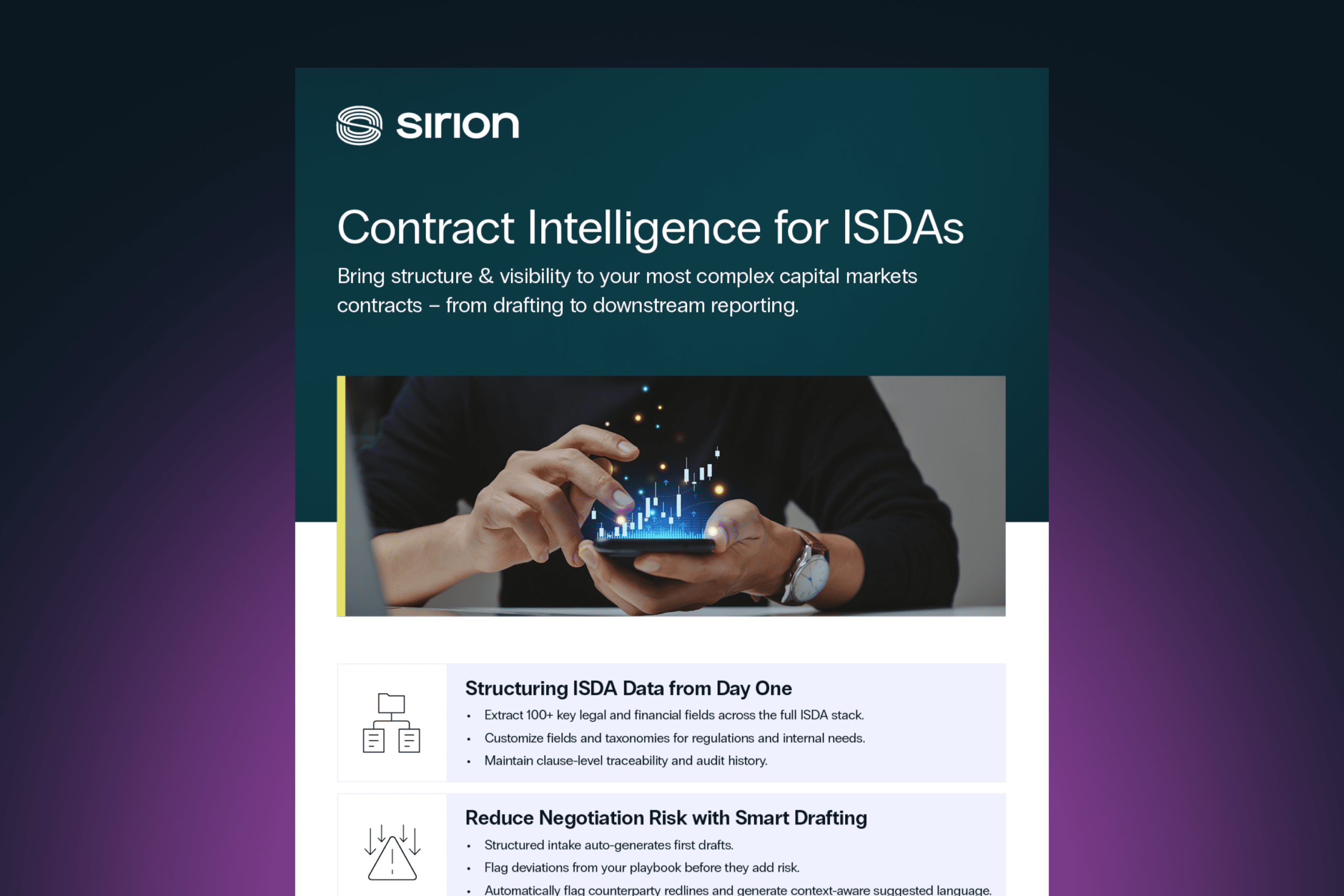
Contract Intelligence for ISDAs
What Are Contract Insights? Unlocking Business Value with CLM