
- Last Updated: Apr 30, 2026
- 15 min read
- Sirion
- A purchase and sale agreement (PSA) is the foundation of any real estate transaction.
It defines price, timelines, responsibilities, and legal obligations between buyer and seller. - Clarity in key components prevents disputes and delays.
Accurate property details, pricing terms, contingencies, and disclosures ensure smoother execution. - Contingencies act as critical safeguards.
They allow buyers and sellers to exit or renegotiate under specific conditions without financial loss. - A well-structured PSA reduces legal and financial risk.
Proper drafting ensures enforceability and alignment with regulatory requirements. - Modern contract lifecycle management improves efficiency and visibility.
Digital tools help track deadlines, obligations, and compliance across transactions.
Buying or selling a home is one of the most significant financial milestones in a person’s life. It’s a moment filled with excitement and anticipation, but it also comes with a mountain of paperwork. At the very top of that mountain sits the single most important document of the entire transaction: the purchase and sale agreement (PSA) of real estate, often just called the purchase agreement.
For many, this document is a source of anxiety. It’s dense, filled with legal terms, and carries immense weight. But what if you could look at it not as an obstacle, but as a roadmap? This guide will demystify the real estate purchase and sale agreement (PSA). We’ll break it down, section by section, in plain English, so you can sign on the dotted line with confidence and clarity.
What is a Purchase and Sale Agreement?
A purchase and sale agreement (PSA) is a legally binding contract that defines the terms under which a property is bought and sold. It is created once a buyer’s offer is accepted and serves as the formal blueprint for the transaction.
In simple terms, if you’re asking what is a purchase and sale agreement, it is the document that turns intent into a legally enforceable commitment.
The PSA outlines critical details such as price, financing, timelines, contingencies, and obligations—ensuring both parties are aligned from signing through closing.
Key Components of Purchase and Sale Agreements
A PSA is only as strong as its components. Each section plays a specific role in ensuring clarity, fairness, and enforceability.
Understanding these components helps answer common queries like key elements of a purchase and sale agreement and why each one matters.
Identification of Parties
Every PSA begins by clearly identifying the buyer, seller, and any involved agents.
Accurate identification is critical—errors or omissions can lead to disputes, delays, or even invalidation of the agreement.
Property Description
The property must be described precisely, including address, boundaries, and legal description.
This ensures there is no ambiguity about what is being transferred and protects both parties from future disputes.
Purchase Price
The agreement must clearly state the purchase price and any conditions attached to it.
This includes payment structure, financing details, and adjustments, ensuring financial clarity throughout the transaction.
Earnest Money Deposit
Earnest money is a good-faith deposit made by the buyer to demonstrate commitment.
The PSA should specify the amount, holding party, and conditions under which it is refundable or forfeited.
Contingencies
Contingencies act as contractual safety nets.
Common examples include financing, inspection, and appraisal contingencies—each allowing parties to exit or renegotiate under defined conditions.
Closing Date and Possession
The PSA defines the closing timeline and when possession transfers to the buyer.
Clear timelines help prevent delays and ensure all parties are aligned on execution milestones.
Disclosures
Sellers are required to disclose known issues or legal constraints related to the property.
Proper disclosures protect buyers and reduce legal risk for sellers.
Find out how the Essential Clauses of a Contract protect your rights and prevent costly disputes.
What Should be Included in a Purchase and Sale Agreement?
A purchase and sale agreement (PSA) must capture all key details of the transaction to ensure clarity, enforceability, and smooth execution.
At a minimum, the agreement should include the following elements:
- Property Information
Clearly identifies the property through its address and legal description, ensuring there is no ambiguity about what is being transferred. - Purchase Price and Terms
Specifies the agreed price, payment structure, and any financing conditions, providing financial clarity for both parties. - Earnest Money Deposit
Defines the deposit amount, who holds it, and when it is refundable or forfeited, signaling commitment while managing risk. - Closing Date and Costs
Outlines the closing timeline and how costs are allocated, helping avoid delays and disputes. - Disclosures
Includes any known issues or legal constraints related to the property, ensuring transparency and reducing post-sale risk. - Signatures
Confirms agreement by all parties, making the contract legally binding.
How to Write a Simple Purchase Agreement?
Writing a simple purchase agreement is less about legal complexity and more about capturing the essential terms clearly and completely. The goal is to create a document that both parties understand and can rely on without ambiguity.
A structured approach helps ensure that nothing critical is missed while keeping the agreement easy to follow.
Start with the Basic Details
Begin by identifying the buyer and seller and clearly describing the property or asset being transferred.
This section establishes the foundation of the agreement and ensures there is no confusion about the parties involved or the subject of the transaction.
Define the Financial Terms
Clearly outline the purchase price, payment method, and any financing conditions.
Including timelines for payments and specifying how funds will be handled helps avoid disputes later in the process.
Include Key Conditions and Contingencies
Add any conditions that must be met for the transaction to proceed—such as inspections, financing approval, or regulatory clearances.
These contingencies provide flexibility and protect both parties if circumstances change.
Set Timelines and Closing Terms
Specify the closing date and outline when ownership or possession will transfer.
Clear timelines help align expectations and ensure the transaction progresses smoothly.
Add Disclosures and Legal Clauses
Include any required disclosures and basic legal protections, such as representations, warranties, or dispute resolution terms.
This ensures transparency and strengthens the enforceability of the agreement.
Finalize and Execute the Agreement
Once all terms are agreed, the document should be reviewed, signed, and shared with all parties.
Execution formalizes the agreement and makes it legally binding.
Learn why the Purpose of Templates in Contract Creation goes beyond convenience—it’s about accuracy and compliance.
Best Practices for Drafting a Purchase and Sale Agreement
A strong purchase and sale agreement ensures clarity, reduces risk, and supports smooth execution from signing to closing.
A short prelude before bullets:
The following practices help create agreements that are clear, balanced, and enforceable:
- Use Clear and Precise Language
Define terms and obligations simply and unambiguously to avoid misinterpretation. - Capture All Key Terms
Clearly outline property details, pricing, timelines, and contingencies to prevent gaps. - Set Realistic Timelines
Align deadlines with practical execution to avoid delays and disputes. - Include Balanced Risk Protections
Add contingencies and disclosures that protect both parties. - Verify Accuracy Before Finalizing
Double-check critical details like property description and financial terms. - Ensure Legal Compliance
Confirm the agreement meets applicable laws and disclosure requirements.
Are You Spotting the Red Flags Before You Sign?
Understanding the sections of a contract is one thing; knowing how to spot potential problems is another. A good real estate agent or attorney is your first line of defense, but being an informed client is your best asset. Part of effective contract risk management is knowing what to look for.
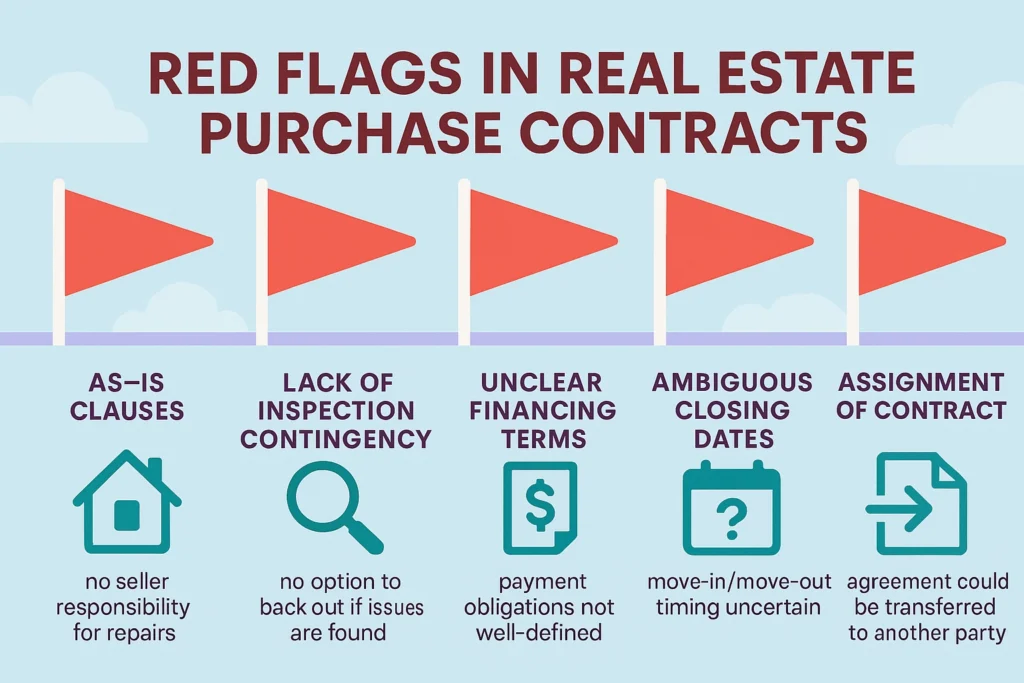
Spotting red flags in your real estate contract can save you from costly mistakes. Learn to recognize and understand common warning signs before you sign.
Keep an eye out for these common red flags and be prepared to discuss them. Addressing them often involves a contract negotiation to find a fair solution.
- Vague or Missing Deadlines: A contract without firm dates for contingencies, inspections, and closing is a recipe for delays and disputes. Every key milestone should have a clear deadline.
- The Absence of Key Contingencies: Be wary of any pressure to waive essential protections like the inspection or financing contingency, especially if you are not a cash buyer or an experienced investor. This can expose you to significant financial risk.
- An « As-Is » Clause Without an Inspection Right: While many homes are sold « as-is, » this shouldn’t prevent you from conducting an inspection. An « as-is » clause means the seller won’t pay for repairs, but the inspection informs you of what you’re taking on. You should still have the right to back out if the findings are too severe.
- Unclear Details on What Property is Included: Never assume the beautiful chandelier or the brand-new washer and dryer are included. If it’s not in writing, it’s not guaranteed. Make sure every item you expect to stay is listed in the contract.
- Blank Spaces or Unanswered Questions: Never sign a contract with blank spaces. Ensure every field is filled in or marked « N/A » (not applicable) before you sign.
Spotting red flags is crucial, but many buyers and sellers also fall into avoidable mistakes.
Mistakes to Avoid in a Real Estate PSA
Some of the most common errors include:
- Assuming verbal agreements are enforceable.
- Failing to review or negotiate contingency clauses.
- Leaving blanks in the contract.
- Overlooking inspection rights or appraisal conditions.
- Not clarifying what fixtures and personal property are included.
These mistakes can lead to disputes, lost deposits, or even contract termination—reinforcing why every clause should be reviewed in detail.
Today’s real estate agreements don’t just live on paper—they’re increasingly managed through secure digital tools.

Learn how the Best Contract Management Software simplifies tracking, compliance, and negotiation for smoother transactions.
Why Contract Lifecycle Management (CLM) Matters in Sale and Purchase Real Estate Transactions
For a single home purchase, a real estate agent and attorney may be enough. But for developers, real estate investment firms, lenders, and enterprises with large property portfolios, manual management of purchase agreements quickly becomes unmanageable.
This is where Contract Lifecycle Management (CLM) software comes in:
- Centralized Repository: Store all purchase agreements, amendments, and related contracts in a searchable, digital hub.
- Automated Workflows: Track critical dates like financing deadlines, inspection periods, and closing dates with automated alerts.
- Risk Mitigation: Use AI-powered analytics to flag missing disclosures, unusual clauses, or unfavorable terms before they become costly.
- Compliance & Audit Readiness: Ensure agreements meet state-specific requirements and retain a digital trail for regulatory or financial audits.
- Scalability: Whether it’s 5 transactions or 5,000, CLM platforms standardize the process and reduce human error.
By digitizing and automating these agreements, businesses unlock efficiency, reduce value leakage, and gain real-time visibility into their real estate obligations and risks.
Your Path Forward
The real estate purchase agreement is the cornerstone of your home buying or selling journey. By understanding its fundamental purpose, key components, and potential red flags, you transform it from an intimidating legal document into an empowering tool that protects your interests. While this guide provides a strong foundation, always rely on the expertise of a qualified real estate professional and/or attorney to navigate the specifics of your unique transaction.
This focus on clarity and risk management is at the heart of all great agreements, from a simple home sale to complex enterprise deals. By applying these principles, you’re not just buying or selling a house—you’re practicing smart contracting.
Frequently Asked Questions (FAQs)
Can I use a standard real estate contract template I find online?
While it’s technically possible, it is highly discouraged. Real estate law is extremely state-specific, and sometimes even county-specific. A generic online template may not include crucial local clauses or disclosures, potentially rendering it invalid or putting you at risk. It’s always safer to use a contract provided by a local real estate association and reviewed by professionals.
What happens if the property appraisal comes in lower than the purchase price?
If you have an appraisal contingency, you have several options. You can try to renegotiate a lower price with the seller. You can choose to pay the difference in cash between the appraised value and the purchase price. Or, you can terminate the contract and, in most cases, get your earnest money back.
How does an escalation clause work in a competitive market?
An escalation clause is a provision you can add to your offer that automatically increases your purchase price by a certain amount over a competing offer, up to a maximum cap you set. For example, “Buyer offers $500,000, but agrees to increase their offer by $2,000 above any other bona fide offer, not to exceed $520,000.” It’s a strategy to stay competitive without immediately offering your highest price.
Can a seller back out of a real estate PSA contract?
Yes, but it’s not simple. Once both parties sign, the contract is legally binding. A seller may only back out under specific conditions—for example, if the buyer fails to meet contingencies (like financing approval) or breaches the contract. Otherwise, the seller risks legal action, financial penalties, or being forced to complete the sale.
How long does a real estate PSA contract take from signing to closing?
The timeline varies, but most residential deals close within 30 to 60 days. Factors that can speed up or delay the process include mortgage approval, appraisal scheduling, inspection repairs, and title searches. Having clear deadlines in the agreement helps avoid unnecessary delays.
What is the difference between earnest money and a down payment?
Earnest money is a good faith deposit made when the contract is signed, held in escrow to show the buyer’s seriousness. It’s usually 1–3% of the purchase price and is applied toward the down payment at closing. The down payment, on the other hand, is a much larger sum (often 10–20% of the purchase price) paid at closing to secure the loan and finalize the transaction.
Sirion is the world’s leading AI-native CLM platform, pioneering the application of Agentic AI to help enterprises transform the way they store, create, and manage contracts. The platform’s extraction, conversational search, and AI-enhanced negotiation capabilities have revolutionized contracting across enterprise teams – from legal and procurement to sales and finance.