Implementing Document Automation in Insurance

- Last Updated: Jun 28, 2026
- 15 min read
- Sirion
- Document automation streamlines insurance operations.
AI-powered workflows accelerate claims, underwriting, onboarding, and compliance while reducing manual effort. - Automating high-volume documents delivers immediate value.
Prioritizing claims forms, KYC documents, COIs, onboarding records, and invoices improves speed and efficiency. - AI enhances accuracy and strengthens compliance.
Intelligent document processing reduces errors, supports regulatory requirements, and maintains reliable audit trails. - Successful automation depends on strong implementation.
Integrating with legacy systems, improving data quality, and driving employee adoption are critical to long-term success. - Automation improves both efficiency and customer experience.
Faster processing, lower costs, and quicker decisions help
Insurance organizations process enormous volumes of policy documents, claims forms, underwriting submissions, certificates, invoices, and customer records every day. Managing these document workflows manually can create delays, increase operational costs, and introduce compliance risks that affect both insurers and policyholders.
Document automation for insurance uses artificial intelligence and automation technologies to streamline document processing, improve data accuracy, and accelerate critical insurance operations. From claims processing and underwriting to customer onboarding and compliance management, automation helps insurers reduce manual effort while improving customer experiences and operational efficiency.
As insurers continue investing in digital transformation initiatives, document automation is becoming a foundational capability for organizations seeking to maximize revenue, reduce risk, and improve service delivery.
Explore Underwriting in Insurance to understand how risk assessment influences policy pricing, approvals, and compliance.
What Is Document Automation for Insurance?
Document automation for insurance refers to the use of software, artificial intelligence, and machine learning technologies to automatically generate, process, classify, extract, validate, and manage insurance-related documents.
Rather than relying on manual review and data entry, insurance automation software can process large volumes of policy documents, claims forms, underwriting submissions, invoices, certificates, and customer records with greater speed and accuracy. These systems combine document processing technologies such as optical character recognition (OCR), natural language processing (NLP), computer vision, and workflow automation to streamline document-intensive operations.
By automating repetitive document workflows, insurers can improve claims processing efficiency, reduce operational costs, enhance compliance, and provide faster service to policyholders while enabling employees to focus on higher-value activities.
Benefits of Document Automation for Insurance Companies
1. Accelerated Claims Processing
Automation significantly reduces the time required to review, classify, and extract information from claims documents. Faster claims processing improves operational efficiency and enables quicker settlements for policyholders.
- Significant Cost Reduction
By eliminating manual data entry and repetitive administrative tasks, insurers can lower operational costs while increasing document processing capacity without adding headcount.
- Enhanced Accuracy and Error Reduction
AI-powered document processing reduces human errors associated with manual document handling, improving data quality and decision-making across insurance operations.
- Streamlined Compliance
Automated workflows help ensure documents are processed consistently and according to regulatory requirements, reducing compliance risks and improving governance.
- Empowered Workforce
Employees spend less time on repetitive administrative work and more time on underwriting, customer service, risk assessment, and strategic decision-making.
- Improved Customer Experience
Faster response times, quicker claims resolution, and streamlined onboarding processes create a better experience for policyholders and insurance partners.
Which Insurance Document Types Should Be Automated First?
- Customer Onboarding and Intake
New customer applications often contain large volumes of information that must be reviewed and validated. Automating onboarding documents improves processing speed and reduces friction during policy issuance.
- KYC (Know Your Customer) Documents
Identity verification documents are frequently reviewed during onboarding and compliance checks. Automation improves accuracy while reducing processing times.
- Certificates of Insurance (COIs)
COIs contain structured information that can be automatically extracted and validated, reducing administrative burden and improving turnaround times.
- Standardized Claims Forms
Claims forms represent one of the highest-volume document categories in insurance. Automating their processing accelerates claims handling and improves service levels.
- Invoices and Receipts
Automated extraction of payment-related information supports claims validation, reimbursement processing, and financial reconciliation activities.
Explore how Intelligent Automation in Insurance streamlines policy administration, claims processing, and risk management with AI-driven workflows.
Document Automation vs Manual Processing in Insurance
Feature | Manual Processing | Automated Processing |
Speed & Efficiency | Slow and resource-intensive | Processes large document volumes rapidly |
Accuracy & Error Reduction | Higher risk of human error | Consistent extraction and validation |
Claims Processing | Longer review cycles | Faster claims handling and resolution |
Customer Experience | Delays and service bottlenecks | Faster responses and improved satisfaction |
Scalability & Cost | Requires additional staff as volume grows | Scales efficiently with minimal incremental cost |
Compliance Monitoring | Manual oversight required | Automated validation and reporting capabilities |
What Compliance Risks Come with Automating Insurance Documents?
- Explainability and Bias
AI models may make decisions that are difficult to explain or audit. In regulated environments, insurers must be able to justify how automated decisions are made and ensure that outcomes remain fair and unbiased.
- Data Privacy and Security
Insurance documents contain highly sensitive customer information. Organizations must implement strong security controls, access management policies, and data protection measures.
- Audit Trail Failures
Without proper governance, organizations may struggle to demonstrate how automated decisions were made. Maintaining a comprehensive Audit Trail is essential for regulatory compliance and operational transparency.
- Regulatory Drift
Insurance regulations evolve continuously. Automation systems must be updated regularly to ensure they remain aligned with changing regulatory requirements and reporting obligations.
Key Challenges and How to Overcome Them When Automating Insurance Documents
Before successfully implementing data and document automation solutions, it is important to understand the potential roadblocks. For the insurance industry, these challenges typically include:
- Legacy System Compatibility and Disparate Data
Many insurers operate with legacy systems that were not designed for modern automation technologies.
How to Overcome
Use integration-first automation platforms that can connect with existing policy administration, claims, and underwriting systems without requiring complete system replacement.
- Unstructured, Handwritten, and Messy Formats
Insurance documents often arrive in inconsistent formats that are difficult to process using traditional technologies.
How to Overcome
Deploy AI-powered document processing solutions that combine OCR, NLP, and computer vision capabilities to extract information from diverse document formats.
- Strict Legal and Regulatory Pressures
Insurance organizations must comply with extensive regulatory requirements across jurisdictions.
How to Overcome
Build compliance controls directly into document workflows and establish governance frameworks that support ongoing regulatory monitoring.
- Employee Resistance to Change
Employees may view automation as disruptive or fear job displacement.
How to Overcome
Focus on change management, training, and demonstrating how automation supports employees by eliminating repetitive work rather than replacing expertise.
- Poor Data Quality
Inaccurate or inconsistent data can undermine automation initiatives and reduce trust in automated outputs.
How to Overcome
Establish data quality standards, validation rules, and continuous monitoring processes before scaling automation programs.
Read how Automating the Insurance Policy Lifecycle transforms insurance operations through AI-powered automation and connected workflows.
Your Use Case
Given how far technology has come, there are plenty of processes and areas within insurance that would benefit from automation. If you are looking at digital transformation and where to begin your automation journey, here are the eight key areas where automation can bring significant improvements.
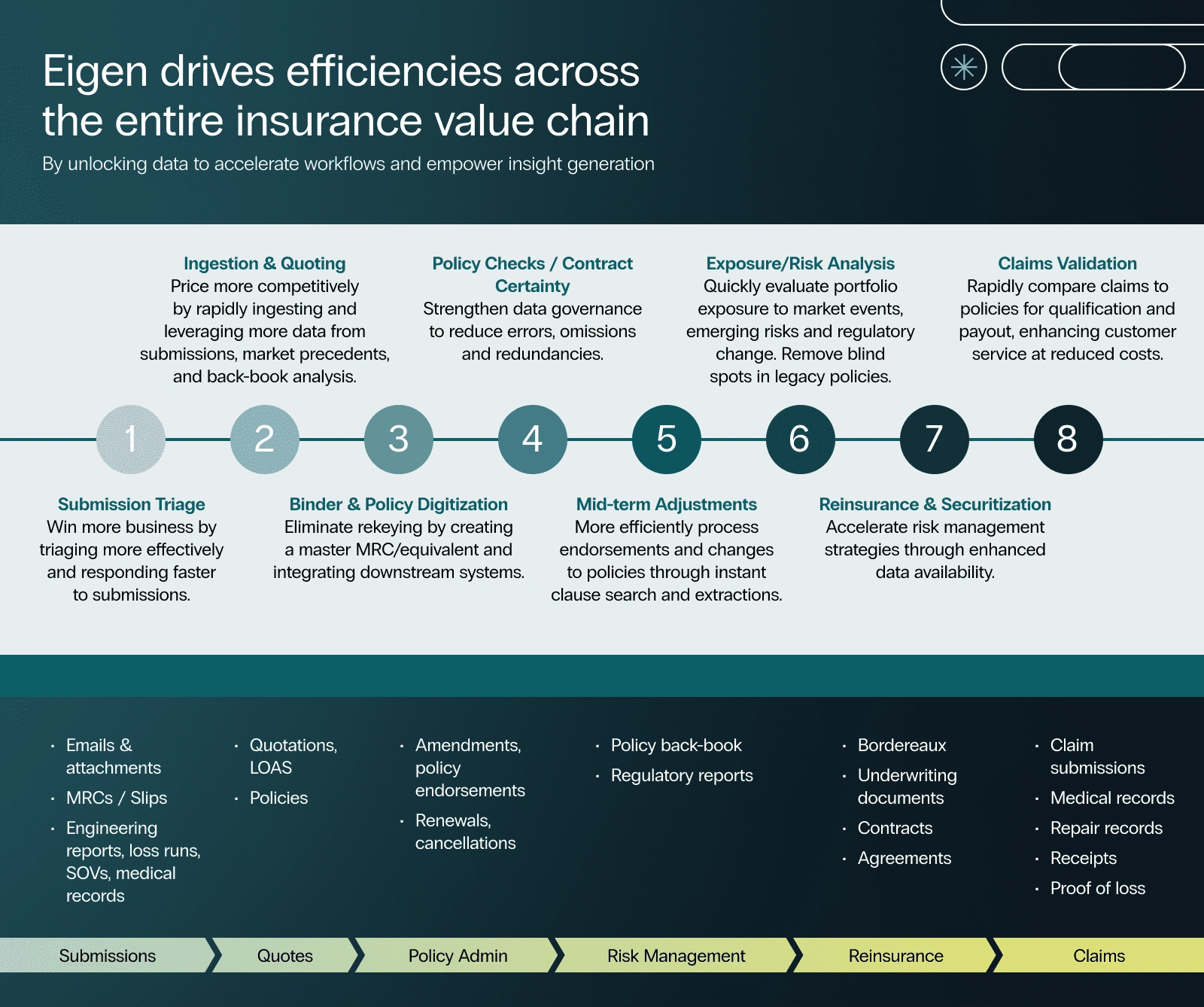
Of course, these are just some starting points. If you have a specific use case or if you are interested in learning more about what Eigen Sirion can do for your business, request a call with one of our automation specialists today.
Key Takeaways: Maximizing the Impact of Document Automation in Insurance
Document automation for insurance enables organizations to streamline document workflows, accelerate claims processing, improve compliance, and enhance customer experiences. By automating high-volume insurance documents and integrating AI-powered document processing into core operations, insurers can reduce costs while improving accuracy and operational efficiency.
Experience AI-Native CLM in Action
See how Sirion transforms contracting with automation, compliance, and faster time-to-contract.

Success depends on balancing technology adoption with strong governance, regulatory compliance, and employee engagement. Organizations that implement document automation strategically will be better positioned to improve service delivery, strengthen risk management, and achieve long-term competitive advantage.
Frequently Asked Questions (FAQs)
Why should insurers prioritize automating policy and claims documents?
Policy documents and claims forms represent some of the highest-volume document types in insurance. Automating these workflows reduces processing time, improves data accuracy, accelerates claims resolution, and lowers administrative costs while improving customer satisfaction.
How can insurers maintain audit trails in automated workflows?
Insurers should implement automation platforms that automatically capture document activity, user actions, workflow decisions, and approvals. Comprehensive audit trails support regulatory compliance, improve transparency, and simplify internal and external audits.
How can automation improve customer onboarding and FNOL intake?
Automation speeds up data collection, document verification, and validation processes during onboarding and First Notice of Loss (FNOL) intake. This reduces delays, improves accuracy, and creates a smoother experience for policyholders.
Why is employee training essential when implementing document automation?
Training helps employees understand how automation works, how to validate outputs, and how to integrate new workflows into daily operations. Well-trained teams are more likely to adopt automation successfully and maximize its value.
How can automation support underwriting and broker submissions?
Automation can review, classify, and extract information from underwriting submissions and broker-provided documents, helping underwriters prioritize opportunities, reduce manual review effort, and focus on higher-value risk assessment activities.

Sirion is the world’s leading AI-native CLM platform, pioneering the application of Agentic AI to help enterprises transform the way they store, create, and manage contracts. The platform’s extraction, conversational search, and AI-enhanced negotiation capabilities have revolutionized contracting across enterprise teams – from legal and procurement to sales and finance.