AI Contract Generator: The Evolution of Smart and Efficient Legal Agreements
- 22 mars 2025
- 15 min read
- Arpita Chakravorty
- AI contract generators accelerate contract creation by automating drafting, review, and clause recommendations.
This helps organizations reduce turnaround times while improving consistency across agreements. - The most effective AI contract generators combine speed with risk management.
Features such as automated legal review, compliance checks, and workflow automation help reduce errors and strengthen governance. - Human oversight remains essential for reliable AI-assisted contracting.
Legal professionals play a critical role in validating outputs, managing complex negotiations, and ensuring contracts align with business and regulatory requirements. - Organizations gain the greatest value when AI extends beyond drafting.
Integrating AI into the broader contract lifecycle enables better visibility, compliance monitoring, obligation management, and performance tracking. - Enterprise CLM platforms combine AI contract generation with end-to-end contract intelligence.
By embedding AI across pre-signature and post-signature processes, organizations can improve efficiency, reduce risk, and drive better contract outcomes at scale.
Contracts are at the centre of business transactions, legal agreements, and professional engagements. Yet, traditional contract creation is often slow, costly, and prone to human error. Enter AI contract generators—intelligent tools that streamline contract drafting, reduce legal risks, and enhance efficiency. One such solution leading the charge is Sirion, a robust AI-native platform redefining contract lifecycle management.
What Is an AI Contract Generator?
An AI contract generator is a software tool that uses artificial intelligence to automate contract creation, drafting, and review. By combining technologies such as natural language processing (NLP), machine learning, and generative AI, these platforms can generate contract language based on user inputs, approved templates, playbooks, and organizational policies.
Unlike traditional document automation tools, modern AI contract generators do more than populate fields. They can recommend clauses, identify risks, suggest alternative language, and help legal teams maintain consistency across agreements.
For enterprises, an AI contract generator accelerates the drafting process while helping reduce errors, improve compliance, and standardize contract creation across the organization.
Learn how Automated Contract Drafting helps legal teams create accurate, compliant contracts faster with AI-powered automation.
How AI Contract Generator Templates Simplify Contract Drafting
AI-powered templates provide a starting point for generating agreements while ensuring consistency and compliance with organizational standards.
Sample AI-Generated Contract Template
NON-DISCLOSURE AGREEMENT (NDA)
Parties: [Company Name] and [Counterparty Name]
Effective Date: [Date]
Purpose: The parties intend to exchange confidential information for the purpose of evaluating a potential business relationship.
Confidential Information: Includes business, technical, financial, and operational information disclosed by either party.
Obligations: The receiving party agrees to maintain confidentiality and use the information solely for the stated purpose.
Term: This agreement remains effective for [X] years.
Governing Law: [Jurisdiction]
Signatures:
[Party A Representative]
[Party B Representative]
While templates accelerate drafting, AI can further customize language based on deal terms, industry requirements, and organizational policies.
Rethink How You Manage Contracts
Learn how GenAI is reshaping contract creation, execution, and analysis in GenAI in Contract Management: Myths vs. Reality.
The Benefits of Using an AI Contract Generator
Organizations increasingly adopt AI-powered contract generators because they improve efficiency throughout the contract lifecycle.
- Unmatched Speed: AI significantly reduces drafting time by generating first drafts within minutes rather than hours or days.
- Cost Efficiency: Automating routine contract creation reduces reliance on manual legal effort, allowing teams to focus on higher-value work.
- Reduced Errors: AI helps identify missing clauses, inconsistent language, and drafting mistakes that can create downstream risks.
- Automated Workflows: Many platforms automatically route contracts for review, approval, and execution, eliminating manual handoffs.
- Enhanced Risk Management: AI can flag non-standard language, compliance concerns, and potential legal risks during drafting and negotiation.
- Collaboration & Integration: Modern solutions integrate with CRM, procurement, ERP, and business applications, enabling cross-functional collaboration.
- Secure Cloud Storage: Enterprise-grade platforms provide encrypted storage, permission controls, and audit trails to protect sensitive contract data.
Top Features to Look for in an AI Contract Generator
Not all AI contract generators offer the same capabilities. Organizations evaluating solutions should prioritize the following features.
- Advanced Document Generation: The platform should create complete agreements from templates, prompts, and approved clause libraries while maintaining consistency.
- Automated Legal Review: AI should analyze contracts for missing terms, risky language, and deviations from approved standards.
- Collaboration & Workflow: Look for tools that support version control, approvals, negotiation workflows, and stakeholder collaboration.
- Security & Compliance: Enterprise-grade security, audit trails, role-based permissions, and regulatory compliance capabilities are essential.
- Integration & Analytics: Leading platforms connect with existing business systems and provide insights into contract performance, risk, and cycle times.
Explore the Contract Management Software Features that help organizations streamline the contract lifecycle and strengthen governance.
How Does an AI Contract Generator Work?
AI contract generators combine multiple technologies to streamline contract drafting and management.
- Input Prompts & Details: Users provide key information such as contract type, parties, terms, obligations, and business requirements.
- Template Matching: The AI identifies the most appropriate template, playbook, or clause library based on the contract’s purpose.
- Clause Generation: Generative AI creates or recommends clauses tailored to the specific transaction, industry, and organizational standards.
- Review & Refine: The platform analyzes language, identifies risks, and suggests improvements before the contract moves forward.
- Execution: Once approved, contracts can be routed for signature, stored centrally, and tracked throughout the contract lifecycle.
Are AI Contract Generators Reliable?
AI contract generators can dramatically improve efficiency and consistency, but they are most effective when combined with human oversight.
How AI Excels in Contract Drafting
- Fast First Drafts: AI rapidly produces draft agreements, reducing administrative effort and accelerating contract turnaround times.
- Standardization: By leveraging approved templates and clause libraries, AI helps maintain consistency across contracts.
- Summarizing & Redlining: AI can summarize lengthy agreements, compare versions, and identify deviations from approved language.
Where AI Falls Short: Understanding Its Boundaries
- Hallucinations & Errors: Generative AI may occasionally produce inaccurate or unsupported language, requiring validation before use.
- Lack of Contextual Nuance: AI may not fully understand unique business circumstances, negotiation strategies, or complex legal considerations.
- No Legal Advice: AI can support legal work but does not replace qualified legal counsel or professional judgment.
Best Practices for Safe and Effective AI Contract Drafting
Organizations can maximize the value of AI contract generators by implementing appropriate governance and oversight.
- Maintain Strict Human Oversight: Legal professionals should review AI-generated contracts before execution, particularly for high-value or complex agreements.
- Craft Precise Prompts and Inputs: Clear instructions improve output quality and reduce the likelihood of inaccurate or irrelevant contract language.
- Ensure Data Privacy and Security: Organizations should use platforms that provide robust security controls, data isolation, and compliance certifications.
- Continuous Process Optimization: Regularly reviewing AI outputs and refining templates, playbooks, and workflows helps improve long-term performance.
How Different Sectors Benefit from AI-Powered Contract Drafting
AI contract generators support a wide range of industries and use cases.
- General Business & Corporate Operations: Organizations use AI to generate NDAs, statements of work, supplier agreements, and other standard business contracts.
- Healthcare & Life Sciences: AI helps streamline compliance-driven agreements while supporting industry-specific regulatory requirements.
- Finance & Insurance: Financial institutions use AI to automate loan documentation, policy agreements, and customer contracts.
- Real Estate & Construction; AI simplifies lease agreements, construction contracts, vendor arrangements, and property management documentation.
- Technology & SaaS: Software companies use AI to accelerate licensing agreements, subscription contracts, partnership agreements, and procurement contracts.
Discover how AI for Contract Drafting reduces manual effort while improving contract consistency, speed, and governance.
Smarter Contract Lifecycle Management with AI
While AI contract generators significantly improve contract creation, drafting is only one part of the contract lifecycle. Contracts continue to create obligations, risks, and business value long after they are signed. As a result, organizations increasingly require AI capabilities that extend beyond document generation.
Modern contract lifecycle management (CLM) platforms embed AI across the entire contract lifecycle—from authoring and negotiation to execution, compliance monitoring, obligation tracking, and renewal management. By automating repetitive tasks, surfacing risks, and providing actionable insights, these platforms help legal and business teams improve efficiency while maintaining governance and control.
Key capabilities include:
- AI-powered contract drafting and clause recommendations
- Intelligent contract review and risk identification
- Workflow automation for approvals and negotiations
- Obligation, milestone, and compliance tracking
- Contract analytics and performance monitoring
- Centralized collaboration and version control
Sirion’s AgentOS extends these capabilities by providing AI-powered assistance throughout both pre-signature and post-signature processes. From generating first drafts and accelerating negotiations to monitoring obligations and identifying contractual risks, AgentOS helps enterprises manage contracts more efficiently while maintaining compliance and reducing operational risk.
By combining AI contract generation with end-to-end contract lifecycle management, organizations can accelerate contracting, improve visibility, and ensure greater consistency across their agreements.

Experience AI-Native CLM in Action
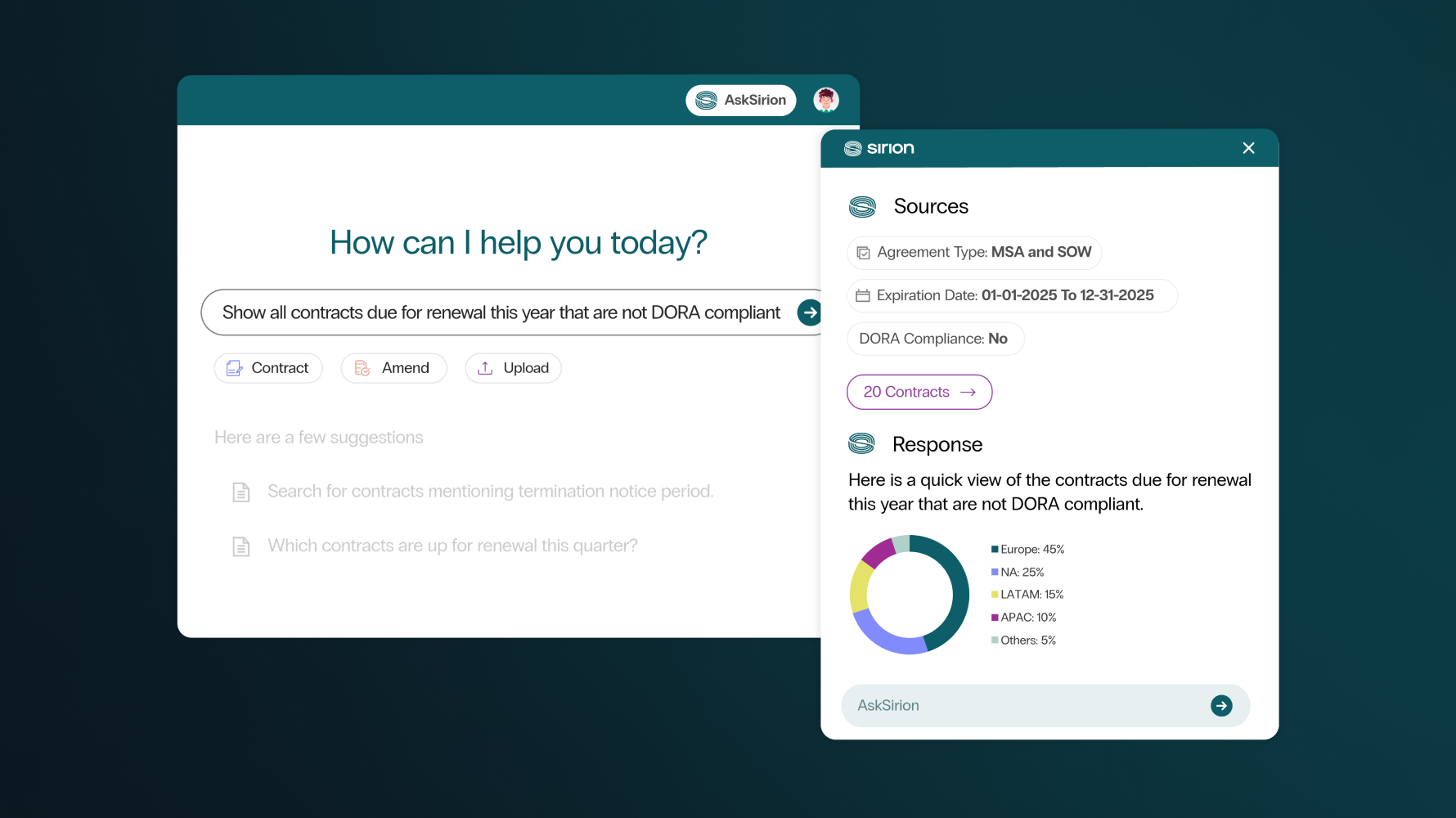
See how Sirion transforms contracting with automation, compliance, and faster time-to-contract.
Final Thoughts: The Future of AI in Contract Management
AI contract generators, are not just enhancing contract creation—they are redefining contract management. As AI technology continues to advance, businesses that adopt AI-powered legal solutions will gain efficiency, reduce risks, and stay ahead of regulatory complexities.
The future of contract management is digital, automated, and intelligent. Investing in an AI contract generator today ensures smoother, smarter, and legally sound agreements for tomorrow.
Frequently Asked Questions (FAQs)

How can global companies ensure AI contract outputs meet regional compliance standards?
Global organizations can improve compliance by using AI systems trained on jurisdiction-specific legal requirements, approved clause libraries, and internal playbooks. However, AI-generated contracts should still undergo legal review to verify alignment with local regulations, industry standards, and evolving legal requirements across different regions.
Why are legal teams in large organizations cautious about fully automating contracts?
Large enterprises manage complex agreements involving significant financial, regulatory, and operational risk. While AI can accelerate drafting and review, legal teams remain cautious because contracts often require nuanced business judgment, stakeholder alignment, and risk assessment that cannot be fully automated without human oversight.
What enterprise risks should be managed when relying on AI contracts
Organizations should monitor risks related to inaccurate contract language, regulatory non-compliance, data privacy, security, and AI-generated errors. Establishing governance policies, maintaining approved clause libraries, and implementing review workflows can help reduce these risks while maximizing the benefits of AI-assisted contract creation.
Why is human oversight critical in enterprise-level AI contract management?
Human oversight ensures that AI-generated contracts accurately reflect business objectives, risk tolerances, and legal requirements. Legal professionals provide contextual judgment, validate AI recommendations, and identify issues that automated systems may miss, helping organizations maintain compliance and contractual integrity.
Why do certain industries benefit more from AI contract generators than others at scale?
Industries with high contract volumes, standardized agreements, and complex compliance requirements often realize the greatest benefits. Sectors such as technology, financial services, healthcare, procurement, and telecommunications can use AI to streamline contract creation, improve consistency, and reduce administrative burden across large contract portfolios.
Arpita has spent close to a decade creating content in the B2B tech space, with the past few years focused on contract lifecycle management. She’s interested in simplifying complex tech and business topics through clear, thoughtful writing.