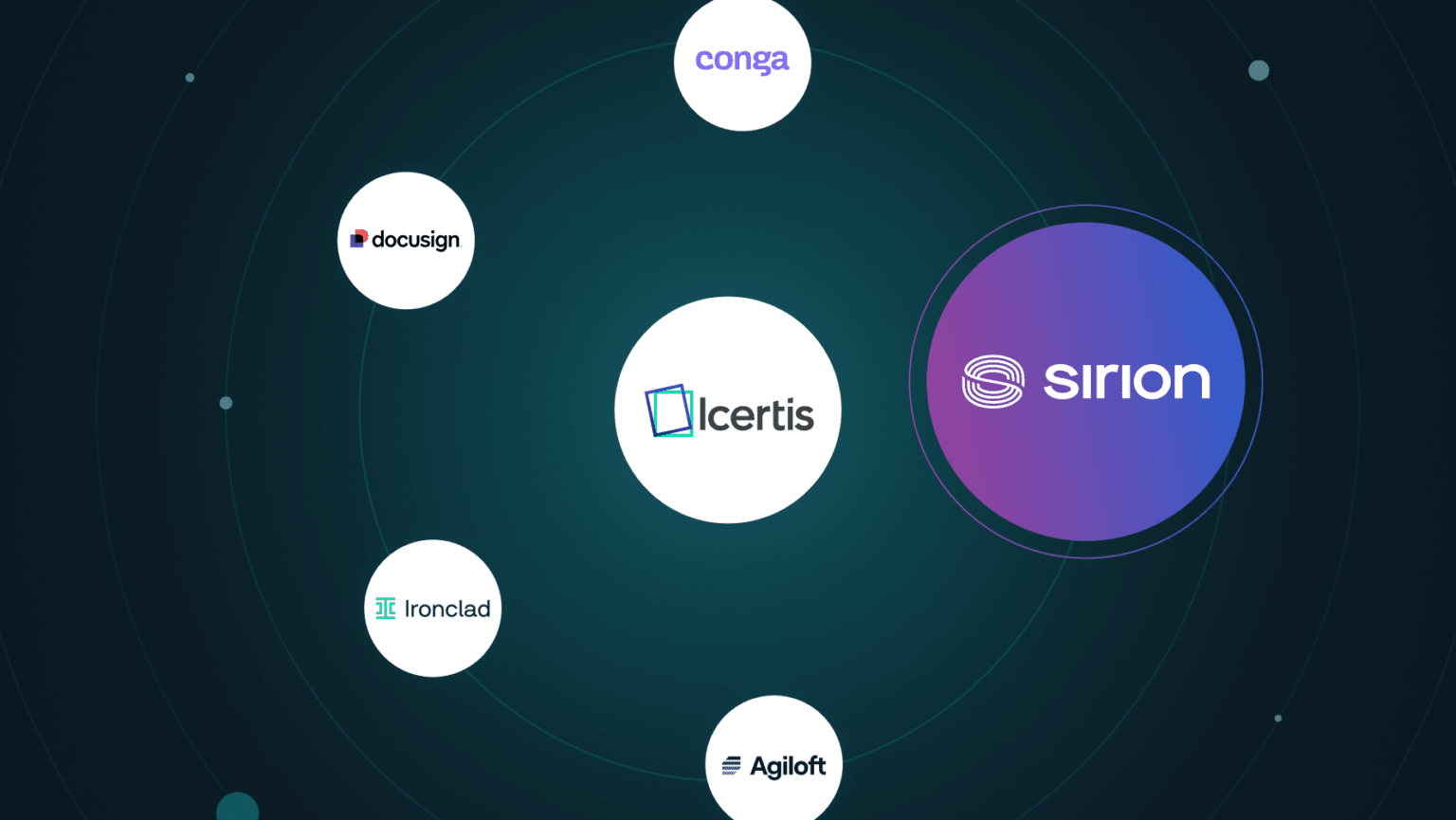
Top Icertis Competitors in 2026: A Comparative Guide
- May 28, 2026
- 15 min read
- Sirion
- Icertis is an enterprise CLM platform, but it may not fit every business requirement.
Organizations often evaluate Icertis alternatives based on implementation complexity, usability, pricing, or industry-specific needs. - AI capabilities are becoming a major differentiator among Icertis competitors.
Modern CLM platforms increasingly offer AI contract review, obligation extraction, workflow automation, and conversational search capabilities. - The best Icertis competitors balance automation, integrations, and operational intelligence.
Enterprises now look beyond repositories toward platforms that support end-to-end contract lifecycle management. - Different CLM platforms serve different organizational needs.
Some solutions focus on enterprise-scale governance, while others prioritize simplicity, speed, or collaboration for mid-market teams. - Sirion differentiates itself through AI-native contract intelligence and end-to-end lifecycle visibility.
Its enterprise-grade architecture, agentic AI capabilities, and operational analytics make it a preferred option for complex contracting environments.
Contracts sit at the center of modern enterprise operations. They govern revenue, supplier relationships, compliance obligations, procurement terms, and operational accountability. As organizations scale, manual contract management quickly becomes unsustainable, driving demand for advanced Contract Lifecycle Management (CLM) platforms.
Icertis remains one of the most recognized CLM vendors in the enterprise market, but it is not the only option available. Many organizations evaluating CLM platforms now compare multiple Icertis competitors based on AI capabilities, usability, deployment speed, integrations, analytics, and pricing flexibility.
This guide explores the top Icertis competitors in 2026, compares their strengths and limitations, and helps enterprises identify the right contract management solution for their operational and strategic needs.
Why Businesses Look for Icertis Competitors?
Icertis is widely recognized in the contract lifecycle management market, particularly among large enterprises. However, organizations evaluating CLM platforms often explore alternatives to Icertis to address operational, financial, or usability concerns that better align with their specific requirements.
Cost Considerations
For enterprise organizations, CLM pricing goes far beyond software licensing. Implementation timelines, customization requirements, training, and long-term administrative overhead all contribute to total cost of ownership.
In some cases, businesses discover that they are paying for enterprise complexity they may not fully use. Mid-market organizations, lean legal teams, or companies with less mature contracting processes often look for alternatives that provide strong automation and governance without the same level of implementation investment.
This is one reason why cost-effectiveness remains a major driver behind the search for Icertis alternatives.
Feature Gaps
As contract management evolves from document storage toward operational intelligence, businesses increasingly expect CLM platforms to do more than manage approvals and repositories.
Organizations now evaluate whether a platform can surface obligations automatically, identify risk patterns, support AI contract review, and connect contract data across systems.
For example, procurement teams may need visibility into supplier performance obligations after signature, while finance teams may want forecasting insights tied directly to commercial commitments. In these scenarios, businesses often compare how competitors approach AI, analytics, and post-signature intelligence rather than simply comparing authoring workflows.
Ease of Use or Implementation
One of the most common frustrations in enterprise software adoption is low user engagement.
A CLM platform may offer extensive functionality, but if legal, procurement, sales, and finance teams struggle to use it consistently, adoption suffers. Some organizations therefore prioritize platforms with cleaner interfaces, faster onboarding experiences, and lower dependency on extensive technical configuration.
Deployment speed also matters. Businesses pursuing digital transformation initiatives often want measurable operational improvements within months, not multi-year implementation cycles.
Industry-Specific Requirements
Contracting requirements vary significantly across industries.
In healthcare, contracts often involve strict compliance obligations and data privacy controls. Financial institutions require explainable workflows, auditability, and governance transparency. Manufacturing and procurement-heavy organizations frequently prioritize supplier obligations, service-level visibility, and operational accountability.
As a result, businesses evaluating CLM platforms often look for vendors that understand the realities of their specific operating environment rather than offering only generic workflow automation.
Overkill for Simpler Needs
Not every organization requires enterprise-scale contract governance.
Some businesses simply need a reliable way to standardize approvals, collaborate on agreements, automate signatures, and centralize contracts. For these organizations, highly configurable enterprise platforms may introduce unnecessary complexity.
That is why lighter CLM tools continue to gain traction among smaller organizations and rapidly growing commercial teams looking for speed, simplicity, and ease of administration.
How We Evaluated Icertis Alternatives?
Selecting the best Icertis competitors requires evaluating far more than surface-level feature lists. Modern enterprises increasingly expect CLM platforms to operate as connected systems of intelligence rather than static contract repositories.
Our evaluation focused on five key areas.
Core CLM Features
Effective contract lifecycle management platforms should support the complete contract journey, including:
- Contract authoring
- Clause management
- Negotiation workflows
- Approval automation
- E-signature support
- Repository management
- Obligation tracking
- Renewal management
Enterprise users often require deeper governance, compliance, and analytics capabilities, while mid-market teams may prioritize ease of collaboration and deployment speed.
For organizations evaluating a modern Contract Lifecycle Management solution, the ability to manage contracts across pre-signature and post-signature workflows is increasingly critical.
AI and Automation Capabilities
AI is reshaping contract management.
Modern CLM buyers now expect:
- AI contract review
- Automated metadata extraction
- Clause deviation detection
- Risk scoring
- Contract summarization
- Conversational search
- Workflow recommendations
The maturity of AI implementation varies significantly across vendors. Some platforms offer basic automation, while others deliver AI-native capabilities embedded across the lifecycle.
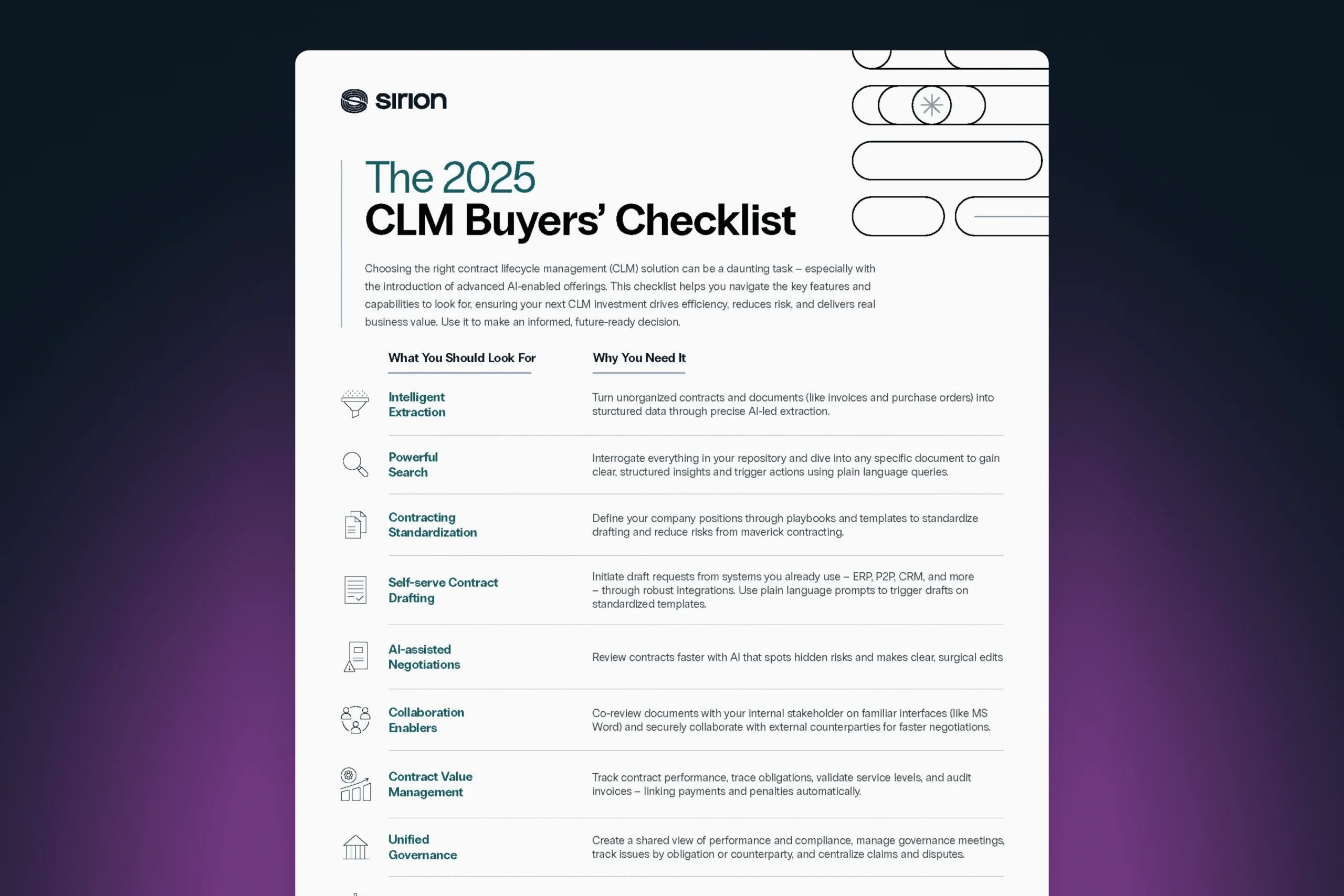
Explore CLM AI Capabilities to see how modern contract lifecycle management platforms use AI for contract review, risk detection, obligation tracking, and operational intelligence.
We also evaluated how competitors support contract automation through workflow orchestration and intelligent decision support.
Integrations (ERP, CRM, Legal & Procurement Systems)
CLM platforms rarely operate independently. Enterprises increasingly require seamless integration with:
- ERP systems
- CRM platforms
- Procurement suites
- Legal operations tools
- Finance systems
- E-signature providers
Integration flexibility directly impacts operational efficiency and adoption across departments.
Pricing & ROI
Pricing models vary widely among Icertis competitors.
We evaluated:
- Enterprise licensing structures
- Per-user pricing models
- Implementation complexity
- Scalability costs
- Long-term ROI considerations
Organizations should evaluate not only software costs but also:
- Deployment timelines
- Training requirements
- Administrative overhead
- Ongoing support expenses
Customer Support & Implementation
CLM implementations can significantly impact enterprise operations. Vendor onboarding quality, training support, customer success engagement, and implementation expertise all influence adoption outcomes.
We therefore assessed:
- Onboarding support
- Training resources
- Customer responsiveness
- Enterprise implementation maturity
- Availability of professional services
Who Are the Competitors of Icertis?
Competitor | Key Features | Pros | Cons | Cost |
Sirion | End-to-end CLM, AI agents, obligation management, analytics | Strong AI-native intelligence, enterprise-grade workflows | Focused primarily on large enterprises | Enterprise subscription |
Ironclad | Workflow automation, contract collaboration, e-signature | User-friendly interface | Limited advanced analytics | Tiered subscription |
Agiloft | No-code configuration, AI workflows, compliance tracking | Highly customizable | Longer implementation cycles | Flexible enterprise pricing |
DocuSign CLM | E-signature, workflow automation, repository management | Strong integrations | Less configurable for complex workflows | Per-user or enterprise pricing |
Conga CLM | Contract automation, Salesforce integration, clause analysis | Strong CPQ ecosystem integration | UI complexity for smaller teams | Enterprise subscription |
Sirion
Sirion is an AI-native CLM platform designed for large enterprises managing complex contracting operations across procurement, legal, finance, and supplier ecosystems. The platform combines conversational AI, workflow orchestration, obligation management, and advanced analytics across the full contract lifecycle.
Key Features
- AI-native contract intelligence
- End-to-end contract lifecycle management
- Obligation and performance tracking
- Workflow automation
- Advanced analytics and reporting
Pros
- Strong post-signature visibility
- Enterprise-scale configurability
- Deep analytics and operational intelligence
- Extensive AI capabilities
Compare the Best Icertis Alternative for 2026 to evaluate which CLM platforms offer the strongest mix of AI, governance, automation, and enterprise scalability.
Cons
- Primarily designed for large enterprises
- May exceed requirements for smaller organizations
Price
Sirion typically offers customized enterprise pricing based on users, workflows, integrations, and deployment scope.
Reviews
· “User friendly tool that will transform your contract management processes.” – Gartner Peer Insights · “Effective Support and Responsive Communication Highlight Sirion Implementation Experience.” – Gartner Peer Insights · “Comprehensive CLM That Brings Legal, Procurement, and Business onto One Platform” – G2 Review · “Outstanding End-to-End CLM Automation with Powerful AI and Workflow Design” – G2 Review |
Ironclad
Ironclad is a widely recognized CLM platform focused on legal workflow automation and collaboration. It is often selected by legal teams seeking modern user experiences and streamlined contracting processes.
Key Features
- Contract workflow automation
- Collaboration tools
- Template management
- Approval workflows
- E-signature integrations
Pros
- Intuitive interface
- Strong collaboration features
- Faster onboarding
Cons
- Limited advanced analytics
- Less emphasis on deep post-signature management
Price
Ironclad generally follows tiered enterprise subscription pricing.
Reviews
Agiloft
Agiloft is known for its highly configurable no-code CLM environment and strong compliance management capabilities.
Key Features
- No-code customization
- Compliance tracking
- AI-powered workflows
- Reporting and dashboards
- Contract repository management
Pros
- Highly flexible platform
- Strong governance capabilities
- Extensive customization options
Cons
- Longer implementation timelines
- Greater administrative complexity
Price
Agiloft pricing is customized based on enterprise requirements.
Reviews
“In-Depth Look at Feature-Rich Product Marred by Slow Support” – Gartner Peer Insights “Customization and Maintenance Require Advanced Skills Amid Declining Support Experiences” – Gartner Peer Insights “Powerful and Flexible Platform, but there are Hurdles to overcome” – G2 Reviews “Centralized Contract Storage, Needs User-Friendly Improvements” – G2 Reviews |
DocuSign CLM
DocuSign CLM extends the company’s widely recognized e-signature ecosystem into broader contract lifecycle management workflows.
Key Features
- Workflow automation
- E-signature integration
- Contract repository
- Reporting
- Approval routing
Pros
- Strong brand recognition
- Seamless e-signature capabilities
- Broad integration ecosystem
Cons
- Less customizable for complex enterprise processes
- Advanced analytics may require additional tooling
Price
Pricing varies based on deployment scale and workflow complexity.
Reviews
· “Centralised Contract Management Streamlines Workflows But Presents Integration Challenges” – Gartner Peer Insights · “Technical Issues and Expensive Plans Limit Utility of Intuitive Tool” – Gartner Peer Insights · “Signature module is amazing, core CLM UI is not great” – G2 Review · “It allows many functionalities, but it is difficult to learn them in order to master it” – G2 Review
|
Conga CLM
Conga CLM is commonly used by organizations seeking strong Salesforce ecosystem integration and document automation capabilities.
Key Features
- Salesforce integration
- Template automation
- Workflow approvals
- Clause analysis
- Reporting tools
Pros
- Strong CRM integration
- Useful for sales contracting
- Good automation capabilities
Cons
- Interface complexity
- Implementation may require technical expertise
Discover the Best Conga CLM alternative for fast implementation and out of the box templates to understand which platforms simplify deployment while maintaining strong contract automation capabilities.
Price
Enterprise pricing varies based on modules and integrations.
Reviews
· “Strong OOTB functionality but below average UI/UX and customer support” – Gartner Peer Insights · “Salesforce Integration Offers Benefits, But Interface Complexity May Hinder Adoption” – Gartner Peer Insights · “Intuitive Contracts with Complicated Setup” – G2 Review · “Great in theory, but underwhelming in practice” – G2 Review |
Why Businesses Choose Sirion Over Icertis?
Organizations evaluating Icertis alternatives often choose Sirion when they require deeper operational intelligence, AI-native capabilities, and end-to-end lifecycle visibility.
Unlike platforms focused primarily on repository management or workflow orchestration, Sirion positions contracts as connected operational data assets.
Key differentiators include:
- AI-native contract intelligence
- Deep obligation management
- Enterprise analytics
- Contract performance monitoring
- Advanced workflow orchestration
- Multi-system integrations
Sirion also provides the agentOS platform, which enables enterprises to operationalize specialized AI agents across contracting workflows. These agents support tasks such as metadata extraction, issue detection, risk analysis, workflow recommendations, and conversational contract intelligence.
For enterprises managing high-volume procurement, supplier governance, or regulated contracting environments, Sirion’s combination of AI, analytics, and lifecycle visibility can provide advantages over traditional CLM architectures.
Organizations evaluating a modern CLM Platform increasingly prioritize operational intelligence rather than document storage alone.

Experience AI-Native CLM in Action
See how Sirion transforms contracting with automation, compliance, and faster time-to-contract.
How to Choose the Right Icertis Alternative for Your Business?
Choosing the right Icertis alternative starts with understanding what role contracts actually play inside your organization.
For some businesses, contracts are primarily legal documents that need approval workflows, centralized storage, and signature management. For others, contracts influence procurement operations, supplier accountability, revenue forecasting, compliance monitoring, and enterprise reporting. The broader the operational dependency on contracts, the more important it becomes to evaluate CLM platforms beyond surface-level functionality.
Business Size and Complexity
Business size is often one of the first considerations during CLM evaluation.
A mid-sized company with a lean legal team may prioritize ease of use, rapid deployment, and low administrative overhead. In these cases, a lightweight CLM platform that simplifies collaboration and approvals may deliver faster value than a heavily customized enterprise system.
Large enterprises typically face a different set of challenges. They often manage thousands of contracts across multiple regions, departments, and regulatory environments. These organizations usually require deeper workflow orchestration, granular permission controls, auditability, advanced analytics, and enterprise-scale integrations. For them, scalability and operational visibility become more important than simplicity alone.
Industry Requirements
Industry requirements can significantly influence which platform is the best fit.
Healthcare organizations may need stronger compliance controls and audit trails to support regulatory requirements. Financial institutions often prioritize explainability, governance transparency, and risk monitoring because of the sensitivity of contractual obligations. Procurement-heavy industries may focus more heavily on supplier performance tracking, obligation management, and operational accountability after execution.
This is why many organizations look beyond generic feature comparisons and evaluate whether a vendor truly understands the operational realities of their industry.
AI and Automation Priorities
AI capabilities are becoming one of the biggest differentiators among Icertis competitors.
Some vendors offer lightweight AI functionality focused mainly on metadata extraction or clause suggestions. Others are building AI-native environments that support conversational search, issue detection, workflow orchestration, contract summarization, and operational intelligence across the contract lifecycle.
As organizations invest more heavily in enterprise AI strategies, many are evaluating whether the platform can operationalize contract data rather than simply organize documents.
Integration Needs
Integration maturity is another major factor businesses sometimes underestimate during evaluation.
Contracts rarely operate independently from the rest of the enterprise technology stack. Commercial terms often need to connect directly with ERP systems, CRM platforms, procurement tools, invoicing workflows, and legal operations systems. If integrations are weak or fragmented, teams frequently continue relying on spreadsheets and manual reconciliation even after implementing a CLM platform.
Organizations pursuing connected enterprise operations should therefore evaluate not only whether integrations exist, but also how deeply contract data can flow across systems.
Deployment Speed
Deployment expectations also vary considerably between organizations.
Some enterprises are comfortable with longer implementation cycles in exchange for deep customization and governance controls. Others need measurable operational improvements quickly and may prioritize platforms with faster onboarding and easier adoption across business teams.
Adoption should not be overlooked during evaluation. Even the most feature-rich platform may struggle to deliver value if legal, procurement, sales, and finance teams find the experience too complex or difficult to navigate consistently.
Budget and ROI
Pricing discussions should extend beyond licensing alone.
The real cost of a CLM platform often includes implementation effort, workflow customization, training, ongoing support, and long-term administration. A lower-cost solution may create operational inefficiencies later if it cannot scale alongside business complexity. Conversely, a more advanced enterprise platform may generate stronger ROI through automation, improved compliance visibility, and reduced manual effort over time.
Ultimately, the right Icertis competitor is not simply the platform with the longest feature list. It is the one that aligns most closely with your organization’s operational complexity, governance requirements, AI strategy, and long-term contracting goals.
Conclusion
The market for Icertis competitors has evolved significantly as enterprises rethink the role contracts play across business operations.
What was once viewed primarily as a legal repository is increasingly becoming a connected operational system that supports procurement, finance, compliance, sales, supplier governance, and enterprise AI initiatives. As a result, organizations evaluating CLM platforms are looking beyond basic workflow automation toward deeper visibility, intelligence, and operational coordination.
That shift is also changing how businesses evaluate alternatives to Icertis.
Some organizations prioritize deployment speed and usability. Others focus on AI capabilities, post-signature visibility, analytics, or integration flexibility. Enterprise requirements can vary dramatically depending on industry complexity, governance expectations, and operational scale.
Platforms such as Sirion, Ironclad, Agiloft, DocuSign, and Conga each bring different strengths to the market. The best choice depends less on broad feature volume and more on how effectively the platform supports the organization’s actual contracting environment.
For enterprises pursuing long-term digital transformation, the most important question may no longer be how contracts are stored, but how contract data can be operationalized across the business.
As AI adoption accelerates, organizations increasingly need contract lifecycle management platforms that can transform agreements into structured, connected, and actionable business intelligence rather than static documents alone.
Frequently Asked Questions (FAQs)
What factors should I consider when switching from Icertis to another CLM platform?
Businesses should evaluate AI capabilities, integrations, usability, implementation complexity, analytics, scalability, and total cost of ownership. Industry-specific requirements, workflow flexibility, and post-signature visibility are also important considerations when selecting an alternative contract lifecycle management solution.
How do AI capabilities vary among Icertis competitors?
AI capabilities differ significantly across CLM vendors. Some platforms offer basic automation and metadata extraction, while others provide AI contract review, conversational search, obligation tracking, workflow recommendations, and advanced operational intelligence embedded throughout the contract lifecycle.
Can Icertis competitors integrate with existing enterprise systems?
Yes. Most major CLM platforms integrate with ERP, CRM, procurement, legal, and e-signature systems. However, integration depth and flexibility vary between vendors, making enterprise architecture compatibility an important evaluation factor.
What are the key differentiators when choosing among competitors?
Key differentiators include AI maturity, workflow flexibility, analytics depth, ease of deployment, configurability, post-signature management, pricing structure, and industry specialization. Organizations should align platform selection with operational complexity and long-term contracting goals.
What is the leading contract automation platform?
There is no single best platform for every organization. Enterprise buyers often evaluate vendors such as Sirion, Icertis, Ironclad, Agiloft, Conga, and DocuSign based on their AI capabilities, integrations, governance features, and contract automation maturity.
Sirion is the world’s leading AI-native CLM platform, pioneering the application of Agentic AI to help enterprises transform the way they store, create, and manage contracts. The platform’s extraction, conversational search, and AI-enhanced negotiation capabilities have revolutionized contracting across enterprise teams – from legal and procurement to sales and finance.