
You signed the deal. It’s a three-year agreement, and the pricing felt solid, locking in your costs and protecting your margins. But six months later, the world looks different. A sudden tariff on raw materials, unexpected inflation, or a supply chain disruption has sent your supplier’s costs soaring. Now, that “solid” price is actively costing them money, straining the relationship and putting your supply at risk. Or, from the other side, that great price you gave your client is now barely covering your expenses.
This is the hidden danger of long-term agreements in a volatile world. The price you agree to on day one can become unprofitable or unfair by day 100. So, how do you build contracts that are resilient enough to bend without breaking?
The answer often lies in a powerful but frequently misunderstood tool: the price adjustment clause. It’s a way to build a financial shock absorber directly into your agreement, creating a fair and predictable method for adapting to economic shifts.
What Is a Price Adjustment Clause?
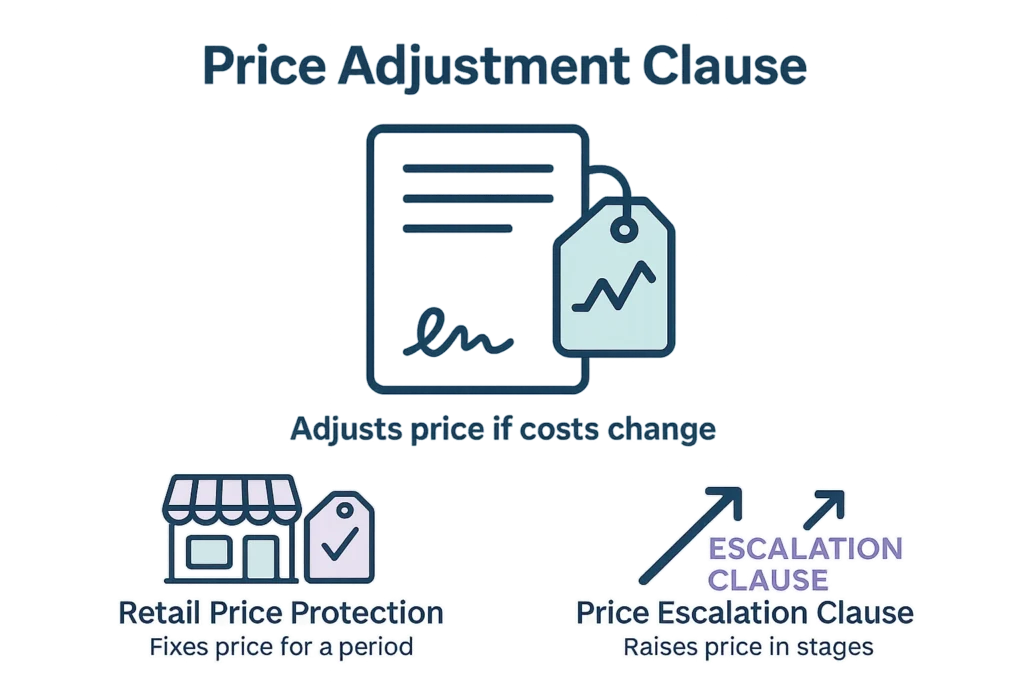
Think of a price adjustment clause as a pre-negotiated “if-then” statement for your contract’s pricing. It’s a formal provision that allows the price of goods or services to be modified in response to specific, predefined changes in underlying costs. The key is that it’s not arbitrary; it’s based on objective, verifiable data.
Many people confuse this with other pricing concepts, so let’s clear things up. A price adjustment clause is not:
- Retail Price Protection: It’s not like a store promising to refund you the difference if an item goes on sale next week. This is a B2B contractual mechanism, not a consumer sales tactic.
- A Simple Escalation Clause: While similar, a traditional escalation clause typically only allows for price increases. A true price adjustment clause is a two-way street; it can also trigger price decreases if costs go down, ensuring fairness for the buyer.
This mechanism transforms a rigid fixed-price contract into a more dynamic and durable agreement. It acknowledges that business doesn’t happen in a vacuum and provides a structured way to deal with change.
Now that we’ve clarified what a price adjustment clause is—and what it isn’t—let’s look at the different ways these clauses are structured in practice.
Types of Price Adjustment Clauses
Price adjustment clauses aren’t a one-size-fits-all mechanism. Depending on the contract type, industry, and the balance of risk between parties, they can take several forms:
- Index-Based Adjustments – Linked to public benchmarks such as CPI, PPI, or industry-specific indices. These are transparent and objective, but sometimes too broad to capture specific cost drivers.
- Cost-Based Adjustments – Directly tied to a supplier’s actual input costs, verified through documentation or audit rights. This provides accuracy but requires more trust and administrative effort.
- Fixed Schedule Adjustments – Prices are set to rise (or fall) at predetermined intervals, often used in long-term service contracts. While simple, they may not reflect actual market volatility.
- Hybrid Approaches – Combine indices with cost-based proof to strike a balance between fairness and practicality.
- Currency and Exchange Rate Adjustments – Essential in cross-border contracts where fluctuating exchange rates can quickly erode margins.
By defining the right clause type at the start, organizations can ensure their pricing model aligns with both business needs and external realities.
The Key Components of a Price Adjustment Clause
A vague or poorly written clause can cause more disputes than it solves. To be effective, a price adjustment clause needs to be crystal clear and built from several essential components that work together. Think of it as a small machine running inside your contract—every part has a specific job.
Before diving into the parts, it’s worth noting that having pre-vetted versions of these clauses in a central contract clause library can save immense time and reduce errors during drafting.
- The Trigger: This is the event that activates the clause. It must be specific and unambiguous. Vague triggers like “a significant increase in costs” are invitations for dispute. A strong trigger would be “a 5% or greater increase in the Producer Price Index (PPI) for commodity X over a three-month period.”
- The Index or Source of Truth: This is the objective, third-party benchmark used to measure the change. Relying on a supplier’s internal cost sheets can work, but it requires trust and auditing. Public indices like the Consumer Price Index (CPI) for general inflation or a specific Producer Price Index (PPI) for a commodity (e.g., steel, paper, fuel) are more transparent and harder to dispute. Using a clear index is fundamental to maintaining contract compliance.
- The Calculation Formula: This is the math that determines the new price. A common formula is: New Price = Base Price x (Current Index Value / Base Index Value). Defining this formula in the contract removes any guesswork when a trigger event occurs.
- Caps and Floors (The Ceiling and the Floor): These are crucial for managing predictability. A “cap” sets a maximum limit on how much the price can increase over a given period, protecting the buyer from extreme spikes. A “floor” does the opposite, ensuring the price doesn’t fall below a certain point, which protects the seller.
- The Notification Process: The clause must outline the logistics. Who needs to notify whom? What’s the time frame for notification after a trigger event? What documentation is required to support the adjustment? A clear process prevents procedural arguments.


Are There Different Ways to Structure These Clauses?
Yes, price adjustment clauses aren’t one-size-fits-all. They are typically structured in two primary ways, depending on the nature of the contract and the level of trust between parties. Choosing the right structure is a key part of managing the different types of risks in contract management.
Index-Based Adjustments
This is the most common and straightforward approach. The price is linked to a well-established, publicly available economic index, like those published by the Bureau of Labor Statistics.
- Pros: It’s transparent, objective, and easy to administer. There’s no need to audit a supplier’s books. The data is public and verifiable by both parties.
- Cons: The chosen index might not perfectly reflect the supplier’s specific cost structure. For example, the general CPI might rise by 3%, but the cost of a specific chemical a supplier needs could have risen by 15%.
Cost-Based Adjustments
This method ties the price adjustment directly to the supplier’s actual, documented cost increases for specific inputs. For example, if the price of a specific raw material in a vendor agreement goes up, the supplier can pass on that exact increase by providing invoices as proof.
- Pros: It’s highly accurate and ensures adjustments are based on real-world cost changes directly affecting the contract.
- Cons: It requires a high degree of trust and transparency. The buyer may need the right to audit the supplier’s financials to verify the cost increases, adding administrative burden and potential friction to the relationship.
The design of a price adjustment clause often depends on the industry context. A clause that works for a utility contract may not suit a pharmaceutical supply chain.
Industry-Specific Applications of Price Adjustment Clauses
Different industries face unique cost drivers, and price adjustment clauses evolve accordingly:
- Construction – Tied to commodity indices for steel, cement, or labor costs to address volatility in raw materials.
- Energy & Utilities – Adjustments often link to oil, gas, or electricity prices, reflecting the sector’s exposure to global market shifts.
- Pharma & Healthcare – Based on compliance-driven costs and raw material inputs, ensuring uninterrupted access to critical supplies.
- Technology & Telecom – Currency-linked clauses protect against import cost swings for hardware or cross-border services.
This industry alignment ensures clauses remain practical and defensible during negotiations.
Common Mistakes to Avoid in Price Adjustment Clauses
Even small drafting missteps can turn a price adjustment clause from a safeguard into a flashpoint for conflict. These are the errors most likely to cause disputes or erode contract value:
- Using vague or subjective triggers (“significant increase in costs”).
- Relying on indices that don’t accurately track the relevant commodity or service.
- Omitting caps or floors, creating unlimited exposure.
- Applying the clause to the full contract value instead of specific inputs.
- Failing to define whether adjustments are cumulative or one-time.
Avoiding these pitfalls turns a clause from a potential liability into a true risk management tool.
Drafting is just the beginning. The real advantage comes when technology helps you manage and monitor these clauses at scale.
AI & CLM Integration: Taking Price Adjustment Clauses Further
Modern contract lifecycle management software takes the complexity out of managing price adjustment clauses. AI-driven platforms like Sirion can:
- Automatically detect and classify price adjustment clauses across thousands of contracts.
- Flag risky or vague language and recommend standardized, compliant alternatives.
- Track indices in real-time and alert teams when triggers are met.
- Accelerate negotiation by inserting pre-approved clauses from a centralized clause library.
- Ensure compliance by monitoring whether caps, floors, and notification timelines are being followed.
By embedding intelligence directly into the contract process, enterprises move from reactive adjustments to proactive risk management—shortening cycle times and protecting long-term value.

Conclusion: Building Contracts for the Real World
In an increasingly unpredictable economic landscape, static contracts are a liability. They create a zero-sum game where one party’s gain is the other’s loss, leading to strained relationships, disputes, and broken deals.
The price adjustment clause transforms this dynamic. It turns a rigid agreement into a living document that can adapt to reality. By pre-agreeing on how to handle economic fluctuations, you replace uncertainty and conflict with a predictable, transparent process. This isn’t just a matter of good legal drafting; it’s a cornerstone of strategic contract risk management that fosters trust and builds partnerships that last.

Additional Resources

Contractual Payments: How to Structure, Secure, and Enforce Them