2026 CLM Checklist: Ensure Credentialing Requirements Are Always Met

- Mar 22, 2026
- 15 min read
- Sirion
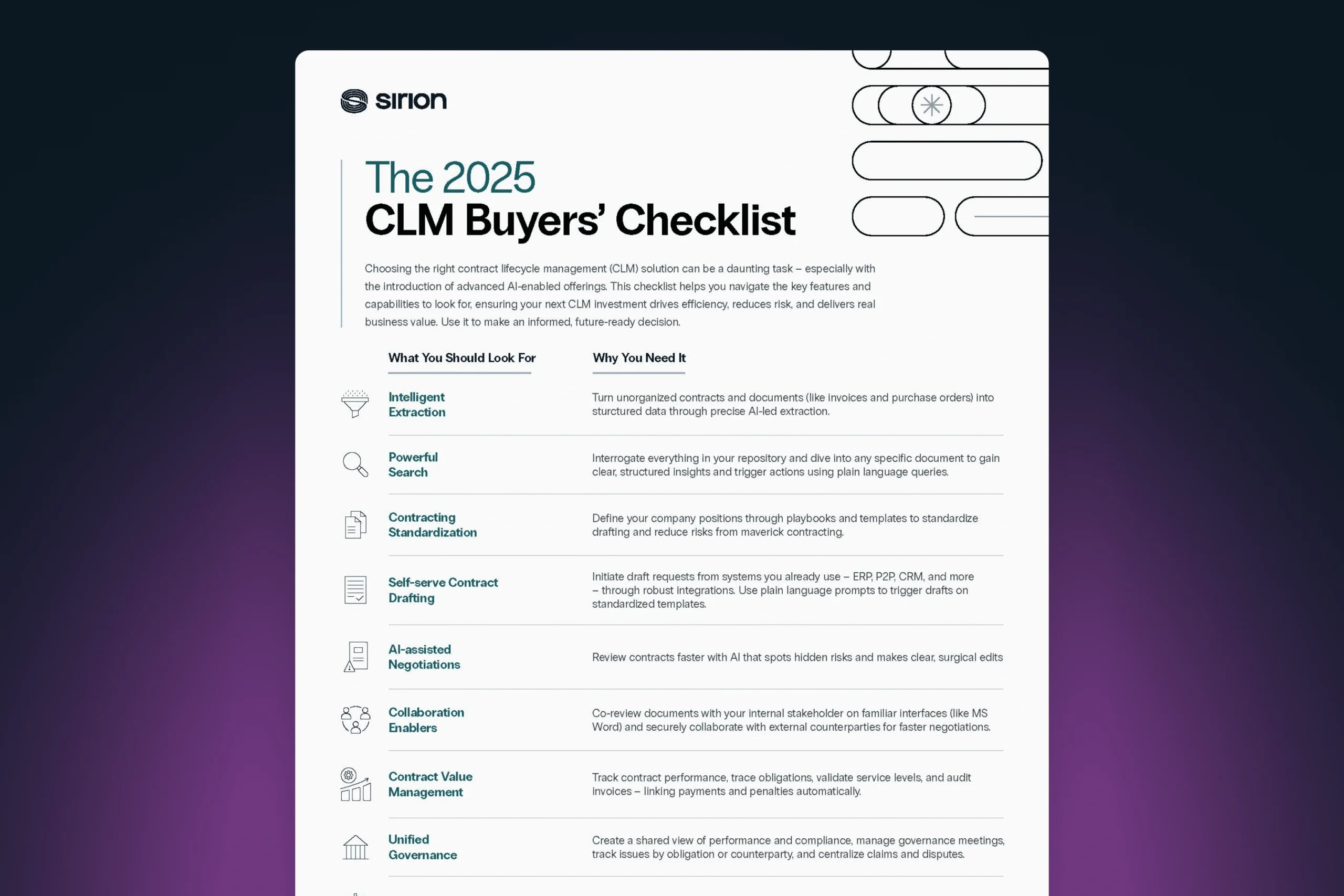
In healthcare and other regulated industries, credentialing has become a constant—no longer a periodic event, but a living process under continuous scrutiny. Missed renewals or incomplete validations can trigger payer denials, disrupt revenue cycles, and invite compliance risk. As the pace of regulation accelerates, Contract Lifecycle Management (CLM) platforms have become essential to sustaining credentialing integrity.
By 2026, modern CLM systems automate everything from primary source verification to expiration tracking through embedded integrations, real-time alerts, and data-driven oversight. This checklist examines how an AI-powered CLM like Sirion enables healthcare organizations to meet—and exceed—ever-tightening credentialing and compliance expectations.
Strategic Overview
Credentialing verifies a provider’s qualifications—including licenses, certifications, and practice history—ensuring eligibility for payer reimbursement and patient care delivery. Once renewed every few years, credentials now require near-continuous monitoring as payers and regulators demand ongoing validation.
A 2026-ready CLM platform connects legal, compliance, and operations teams with integrated workflows that track credential status, automate renewals, and centralize documentation. Key capabilities include continuous monitoring, real-time API integration with payer systems, and structured verification processes that ensure no credential goes unchecked.
Sirion AI-Powered CLM for Credentialing Compliance
Sirion’s AI-powered CLM platform delivers end-to-end compliance automation across the credentialing lifecycle. It enables healthcare providers and payers to manage contracts and credentials in one system—reducing manual tracking, enforcing policy consistency, and accelerating onboarding.
By streamlining credentialing obligations, Sirion mitigates risk, ensures payer audit-readiness, and empowers self-service compliance for legal, procurement, and operations teams. Recognized as a Leader in the Gartner® Magic Quadrant, Sirion combines intelligent analytics with enterprise-grade data security, making it a trusted platform for healthcare compliance at scale.
Continuous Monitoring and Automated Alerts
Continuous monitoring automates the ongoing verification of licensure, certification, exclusions, and sanction lists. As recredentialing cycles compress to monthly updates, this real-time oversight prevents lapse-driven payment delays or audit findings.
Typical CLM monitoring includes:
- Real-time credential verification through integrated data sources.
- Automated expiry alerts for responsible team members.
- Escalation workflows triggering corrective action or temporary deactivation.
- Dashboards summarizing credential status across departments.
This proactive model replaces reactive audits with continuous compliance intelligence.
Integration with CAQH and Payer APIs
In 2026, integration isn’t optional—it’s foundational. The CAQH ProView database supports more than two million healthcare providers, serving as a pivotal verification hub.
A CLM system integrated with CAQH and payer APIs enables:
- Instant status validation and credential updates.
- Automatic data pulls to minimize manual input.
- Reduced administrative overhead and human error.
- Faster turnaround for network enrollment and renewals.
Integration Benefit | Operational Impact |
API-based validation | Real-time license and payer status |
Fewer manual touchpoints | Streamlined credential updates |
Automatic alerts for mismatched data | Early error detection, less rework |
Structured Document Capture and Primary Source Verification
Primary source verification (PSV) confirms credentials directly with the issuing authority—such as state boards or certifying bodies—ensuring authenticity.
Modern CLMs like Sirion embed PSV into intake workflows using structured forms that capture critical credentials and metadata, such as:
- State and DEA licenses
- Board certifications
- Malpractice insurance
- Hospital privileges or payer agreements
By enforcing version control and linking metadata fields, Sirion simplifies audit readiness and creates a repeatable, scalable compliance process.
Identity and Signature Validation Workflows
Credentialing documents often require multiple signatures and identity proofing before submission. A digital signature validation workflow captures signer identity, email, IP address, and digital certificates, producing an unbroken audit trail.
This process verifies authenticity and aligns with electronic record regulations, providing legal defensibility across all executed credentialing contracts.
Approval Routing and Signatory Authority Controls
Approval routing ensures only authorized individuals can approve, sign, or certify credential-based contracts. Within a CLM, routing logic assigns tasks based on role, region, or risk level.
Key controls include:
- Multi-tier sign-off chains for high-risk agreements.
- Escalations for overdue approvals.
- Automatic referencing of enterprise directory permissions.
These mechanisms uphold governance and ensure compliance discipline across all credentialing workflows.
Obligation and Renewal Tracking Dashboards
A well-structured dashboard turns contract oversight into proactive management. Obligation tracking maps deadlines, recredentialing cycles, and renewal tasks, providing insights critical to operational continuity.
Common dashboard KPIs:
Metric | Purpose |
Credentials expiring in 30 days | Prevent last-minute renewals |
Pending verification tasks | Maintain oversight of compliance |
Revenue-at-risk flag | Quantify potential reimbursement gaps |
Sirion’s dynamic dashboards display these insights in real time, enabling teams to anticipate risks and sustain uninterrupted credentialing compliance.
Compliance Reporting and Business Intelligence
Compliance reporting converts credentialing data into executive insight. Within a CLM, business intelligence (BI) dashboards highlight trends in provider compliance, audit preparedness, and credential renewal timeliness.
Typical reporting workflow:
- Collect renewal metrics and compliance data.
- Generate ad hoc or scheduled compliance reports.
- Deliver dashboards to leadership.
- Maintain a historical audit archive for regulatory review.
With AI-powered BI tools like those in Sirion, organizations can forecast compliance risks and strengthen accountability.
Security and Regulatory Compliance Controls
Healthcare credentialing demands security equal to financial-grade systems. A compliant CLM enforces SOC 2 and ISO 27001 standards to protect sensitive personal and professional data.
Core safeguards include:
- Role-based access and user permissions.
- 256-bit AES encryption for stored data.
- HIPAA and GDPR privacy adherence.
- Immutable audit trails for all interactions.
Sirion’s enterprise-grade security architecture aligns to international standards, ensuring every credentialing workflow meets stringent regulatory requirements.
What to Look for in a CLM Platform for Credentialing
Choosing the right CLM platform for credentialing comes down to how well it can prevent compliance gaps while reducing manual effort at scale. Focus on these core capabilities:
- Continuous monitoring: Real-time tracking of credentials with automated alerts and escalations to avoid lapses and payer denials.
- Ecosystem integrations: Direct connectivity with CAQH, payer systems, and verification sources to eliminate manual updates and errors.
- Structured data capture: Standardized intake and primary source verification to ensure accuracy and audit readiness.
- Obligation and renewal visibility: Clear tracking of expirations, recredentialing cycles, and revenue-at-risk.
- Workflow automation with controls: Role-based approvals, escalation paths, and governance to maintain consistency and compliance.
- Analytics and audit readiness: Dashboards and reports that provide real-time insight and support regulatory reviews.
Platforms that bring these capabilities together enable organizations to move from reactive credential tracking to proactive compliance management.
Solutions like Sirion combine these elements within an AI-native CLM, connecting credentialing workflows with broader contract intelligence to ensure visibility, control, and continuity across the lifecycle.
Conclusion: From Credential Tracking to Continuous Compliance
Credentialing is no longer a back-office task—it’s a continuous process that directly impacts revenue, compliance, and provider readiness. As requirements tighten and validation cycles shorten, manual tracking and disconnected systems simply can’t keep up.
A modern CLM platform shifts credentialing from reactive oversight to proactive, system-driven compliance—where expirations are anticipated, obligations are tracked in context, and risks are surfaced before they impact operations.
For healthcare organizations, the goal isn’t just to manage credentials—it’s to ensure that every agreement, verification, and renewal contributes to uninterrupted care delivery and financial stability.
Frequently Asked Questions (FAQs)
How does CLM software track credential expiration dates?
What role does automation play in credentialing compliance?
How can payer API integration improve credentialing workflows?
What security features are essential in credential management?
How do approval workflows support credentialing accuracy?
Sirion is the world’s leading AI-native CLM platform, pioneering the application of Agentic AI to help enterprises transform the way they store, create, and manage contracts. The platform’s extraction, conversational search, and AI-enhanced negotiation capabilities have revolutionized contracting across enterprise teams – from legal and procurement to sales and finance.