
Ever wondered if a quick “yes” in an email is enough to create a binding contract? Or if you’re legally locked into a deal the moment you start working on a project? These aren’t just abstract legal questions; they’re everyday business scenarios where a simple misunderstanding can have significant consequences.
The heart of these situations lies in a crucial legal concept: contract acceptance. While it might sound straightforward, “acceptance” in contract law is a precise action that transforms a proposal into a legally enforceable promise. Getting it right ensures clarity and security, while getting it wrong can lead to disputes, financial loss, and damaged relationships.
Let’s break down what acceptance in contract law truly means, moving beyond the jargon to give you the practical understanding needed to navigate your business agreements with confidence.
The Essential Elements of a Contract: Where Acceptance in Contract Law Fits
Before we can properly understand acceptance, it helps to see where it fits in the bigger picture. Think of a valid contract as a three-legged stool. It needs all three legs to stand firm; if one is missing, the whole thing topples over.
These three legs, or essential elements of a contract, are:
- Offer: One party proposes a specific deal to another, outlining clear terms.
- Acceptance: The other party agrees to all the terms of the offer without any changes.
- Consideration: Each party agrees to give something of value to the other (e.g., money, services, goods).
According to Cornell Law School’s Legal Information Institute (LII), acceptance is an expression of assent to the terms of an offer and may be communicated expressly or implied through conduct. Along with offer and consideration, acceptance plays a central role in determining whether the parties have formed an enforceable agreement.
Acceptance is the critical moment of agreement—the “meeting of the minds”—that solidifies the deal. It’s the unqualified, absolute “yes” to the proposal on the table. But for this “yes” to be legally valid, it must follow certain rules, starting with one of the most important principles in contract law.
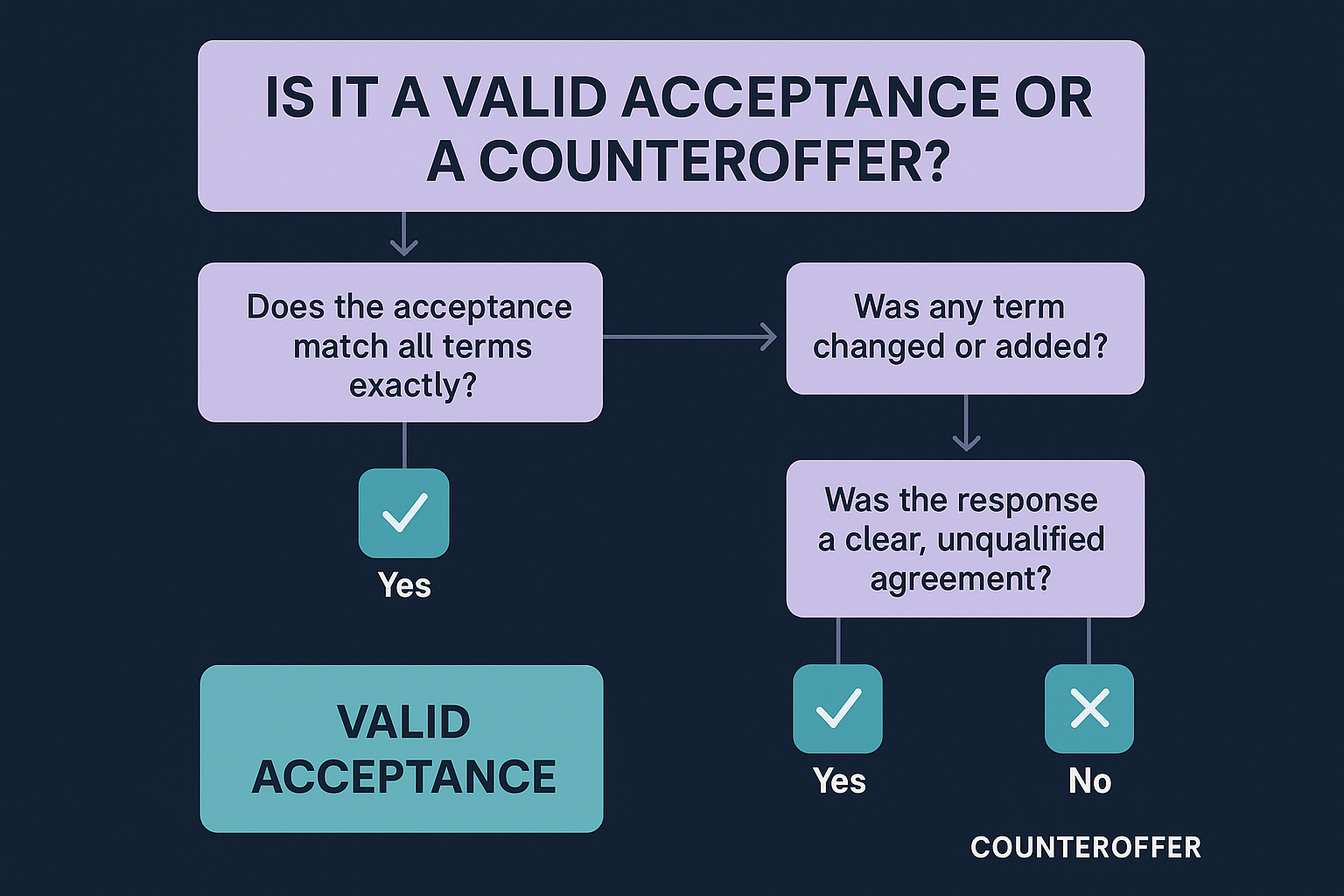
This is the Mirror Image Rule, which states that an acceptance must be an exact reflection of the original offer. If it changes any terms, even slightly, it’s not an acceptance at all.
A valid contract depends on more than a proposal alone. Acceptance demonstrates the offeree’s assent to the offer, while consideration establishes the exchange of value supporting the agreement. Together, these elements help establish whether the parties have formed an enforceable contract. Cornell Law School’s Legal Information Institute describes acceptance as assent to the terms of an offer and notes that it may be expressed directly or implied through conduct.
“Contracts are the connective tissue of every business and the silent architecture where risk, revenue, and performance live.” — Gordon Thompson, Executive Vice President
What Are the Different Ways to Accept an Offer?
So, how does acceptance actually happen? It’s not always a formal signature on a dotted line. The law recognizes several ways an offer can be accepted, each suited to different situations. Understanding these types helps you recognize when a deal has been formed, even if it wasn’t explicitly stated.
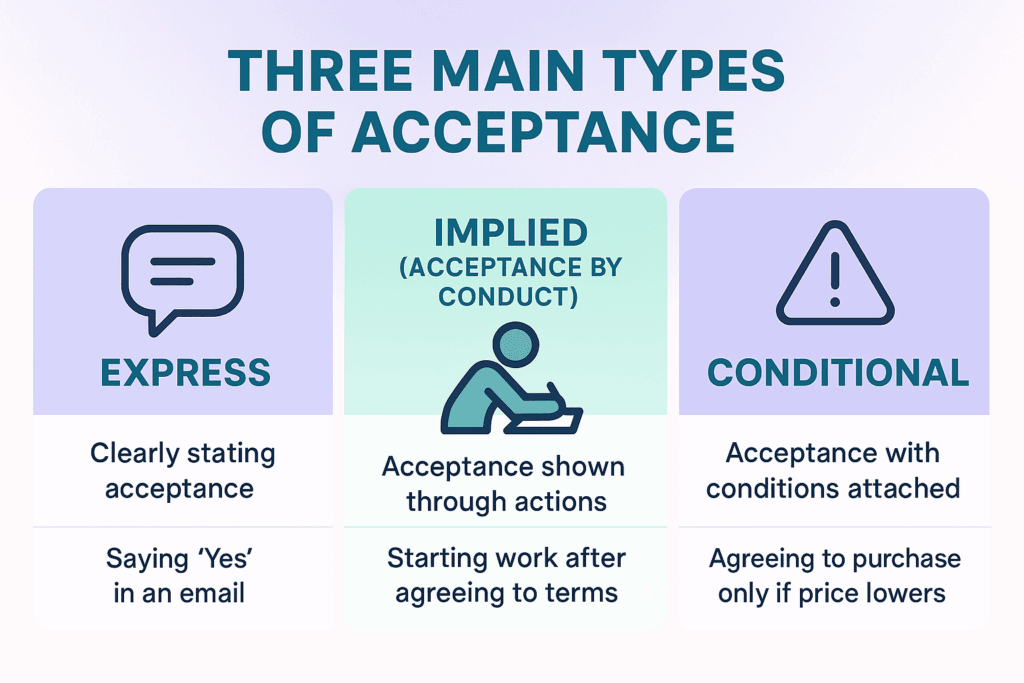
Here are the three main types of acceptance you’ll encounter:
- Express Acceptance: This is the most clear and common form. It happens when someone explicitly states their agreement, either orally or in writing. Think of signing a formal employment contract, replying “I accept your proposal” to an email, or verbally agreeing to the terms over the phone.
- Implied Acceptance (Acceptance by Conduct): Sometimes, actions speak louder than words. Implied acceptance occurs when the offeree’s conduct demonstrates their agreement. For instance, if a freelance graphic designer receives an offer to create a logo for $1,000 and responds by sending over initial design concepts, their action of starting the work implies acceptance of the offer.
- Conditional Acceptance: This one is a bit of a trick. A conditional acceptance is a statement that agrees to the offer only if a certain condition is met (“I accept, provided you can deliver by the 1st”). In the eyes of the law, this is not a valid acceptance. Instead, it functions as a counteroffer, which the original offeror is then free to accept or reject.
- Acceptance by Silence: Silence generally does not amount to acceptance because the offeree ordinarily needs to communicate or demonstrate agreement. However, limited exceptions can arise when previous dealings between the parties establish silence as an accepted response, when the offeree knowingly accepts the benefit of offered goods or services, or when the parties have agreed in advance that silence can indicate acceptance.
These exceptions depend heavily on the circumstances. Businesses should therefore avoid relying on silence where clear acceptance can be documented.
- Electronic and Digital Acceptance: Contract acceptance increasingly takes place through digital channels rather than handwritten signatures. A party may communicate acceptance by email, apply an electronic signature, click an “I agree” button, or complete another electronic action that demonstrates assent to contractual terms.
Whether a particular electronic action creates a binding agreement depends on factors such as the terms presented, the method of acceptance specified by the offer, the parties’ intent, and applicable law. Maintaining evidence of the action and the version of the terms accepted can therefore be important when establishing contract enforceability.
How Communication Shapes Acceptance in Contract Law
For an acceptance to be effective, it generally has to be communicated to the person who made the offer (the offeror). You can’t just agree in your head and expect a contract to be formed. But how and when that communication is considered complete can get complicated, especially in our digital world.
How acceptance is communicated depends first on whether the offer specifies a method. Where it does not, the circumstances of the transaction help determine what form of communication is appropriate.
Specific Methods of Acceptance
An offeror can specify how an offer must be accepted. For example, an offer may require a signed agreement, written confirmation, electronic signature, or another defined action. When a particular method is required, the offeree should follow those instructions so there is no uncertainty about whether valid acceptance has occurred.
Reasonable Methods of Acceptance
If the offer does not prescribe a specific method, acceptance may generally be communicated through a method that is reasonable in the circumstances. The nature of the transaction, how the offer was delivered, previous dealings between the parties, and customary business practices can all influence what constitutes a reasonable method.
The Mirror Image Rule and Acceptance Communication
Communication must also make clear what the offeree is accepting. Under the Mirror Image Rule, acceptance should correspond to the terms of the offer. A response that changes the proposed price, scope, delivery requirements, or other terms may instead operate as a counteroffer and continue the negotiation rather than complete contract formation.
The method of communication is only one part of the question. When acceptance becomes effective can be equally important, which is where the Mailbox Rule comes into play.
Historically, the rule stated that an acceptance is effective the moment it is dispatched (i.e., dropped in the mailbox), not when it’s received by the offeror. This was designed to create certainty in an era of slow-moving mail.
But how does this apply to electronic contracts? Here’s a modern interpretation:
- Emails: An acceptance email is generally considered effective when the sender hits “send,” as long as it’s sent to the correct address. At that point, it has left the sender’s control, much like a letter leaving their hands at the post office.
- Texts and Instant Messages: The same principle often applies. The acceptance is effective upon dispatch, not when the offeror reads the message.
The key takeaway is that the risk of the message being lost or delayed usually falls on the offeror, not the person accepting. However, an offer can specify that acceptance is only valid upon receipt, which overrides the Mailbox Rule.
Acceptance vs Counteroffer in Contract Law: Key Differences
This is one of the most common pitfalls in contract formation. As we touched on with the Mirror Image Rule, any response to an offer that changes the original terms is not an acceptance. It’s a counteroffer.
What’s the big deal? A counteroffer does two crucial things:
- It rejects the original offer, effectively killing it.
- It creates a new offer, putting the ball back in the other party’s court.
Let’s go back to our freelance designer. The client offers $1,000 for a logo with two rounds of revisions.
- Valid Acceptance: “I accept your offer to design the logo for $1,000 with two revision rounds.”
- Counteroffer: “I’d be happy to do it, but my rate includes only one round of revisions. For two, the price would be $1,200.”
In the second scenario, the original $1,000 offer is now off the table. The client cannot suddenly say, “Okay, fine, let’s just do the original deal.” The designer has presented a new offer that the client must now accept. This distinction is vital for knowing exactly what terms you are operating under.
These rules may sound abstract, but they play out every day in common business scenarios.
Practical Examples of Acceptance in Contract Law
- Employment Contracts: A job applicant signing an offer letter or replying “I accept” by email.
- Procurement & Vendor Deals: A supplier begins fulfilling a purchase order, showing implied acceptance.
- SaaS Subscriptions: Clicking “Subscribe” and entering payment details confirms acceptance of the service terms.
- Partnership or M&A Agreements: A board resolution or signed term sheet signals formal acceptance.
- Real Estate Agreements: A buyer signs a purchase agreement, formally accepting the agreed property terms.
- Manufacturing Agreements: A manufacturer signs a supply agreement or begins production, indicating acceptance of the agreed terms.
By grounding acceptance in real scenarios, organizations can better identify when they are legally bound.
Silence as Acceptance in Contract Law: Rare Exceptions Explained
Is it possible to be drawn into a contract without saying or doing anything at all? It’s a common belief that silence can never equal acceptance, and most of the time, that’s true. An offeror cannot simply state, “If I don’t hear from you by Friday, I’ll assume you accept.”
However, there are a few specific and rare exceptions where silence can legally constitute acceptance:
- Prior Dealings: If two parties have a history of doing business where silence was treated as acceptance, a court might uphold it. For example, a supplier who regularly sends a standing monthly order to a shop, which the shop owner pays without comment.
- Offeree Takes the Benefit: If someone receives goods or services and starts using them, knowing they were offered for a price and having a chance to reject them, their silence combined with their actions can be seen as acceptance. Think of a lawn care service that starts mowing your lawn every week with your knowledge; you can’t later claim you never agreed to pay.
- Agreement by the Parties: In some cases, the parties might have agreed beforehand that silence would be a valid form of acceptance for future offers.
These situations are exceptions, not the rule. It’s always safest to rely on clear, express communication to form a commercial agreement.
While exceptions exist, many disputes arise from common mistakes about what counts as valid acceptance in contract law.