
S1 E3-Part 2:
Five Questions to Ask Yourself Before Choosing a CLM Solution
Most CLM evaluations focus on drafting and negotiation. But the majority of contract lifecycle activity happens after the contract is signed. In Part 2 of Episode 3 we look at what a platform needs to do once execution is complete, and why it’s important that it scales as your organization grows.
- Last Updated : May 6, 2026
- 3:19 min
- by Gordon Thompson
What’s Covered in This Episode:
- Why post-signature is where the real return on CLM investment appears
- The obligations that platforms need to manage to deliver real value
- Why the CLM you choose today needs to grow with your organization
- What to consider when evaluating AI as part of a CLM platform
"A good CLM should be more valuable as your contract data grows, not harder to manage."
Key moments
00:29
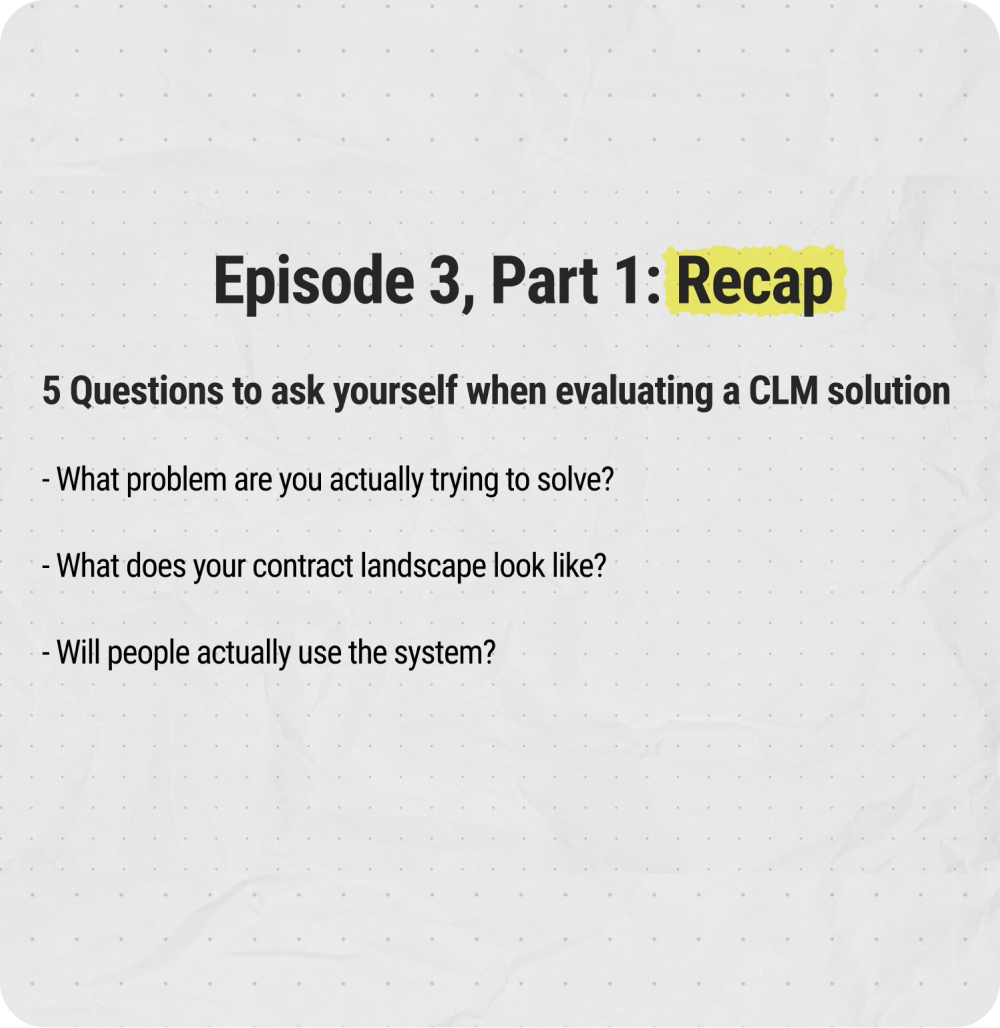
What problem are you actually trying to solve?
00:40
What happens after the contract is signed?

01:41
Will the platform evolve with your business?

02:38
Conclusion
03:10
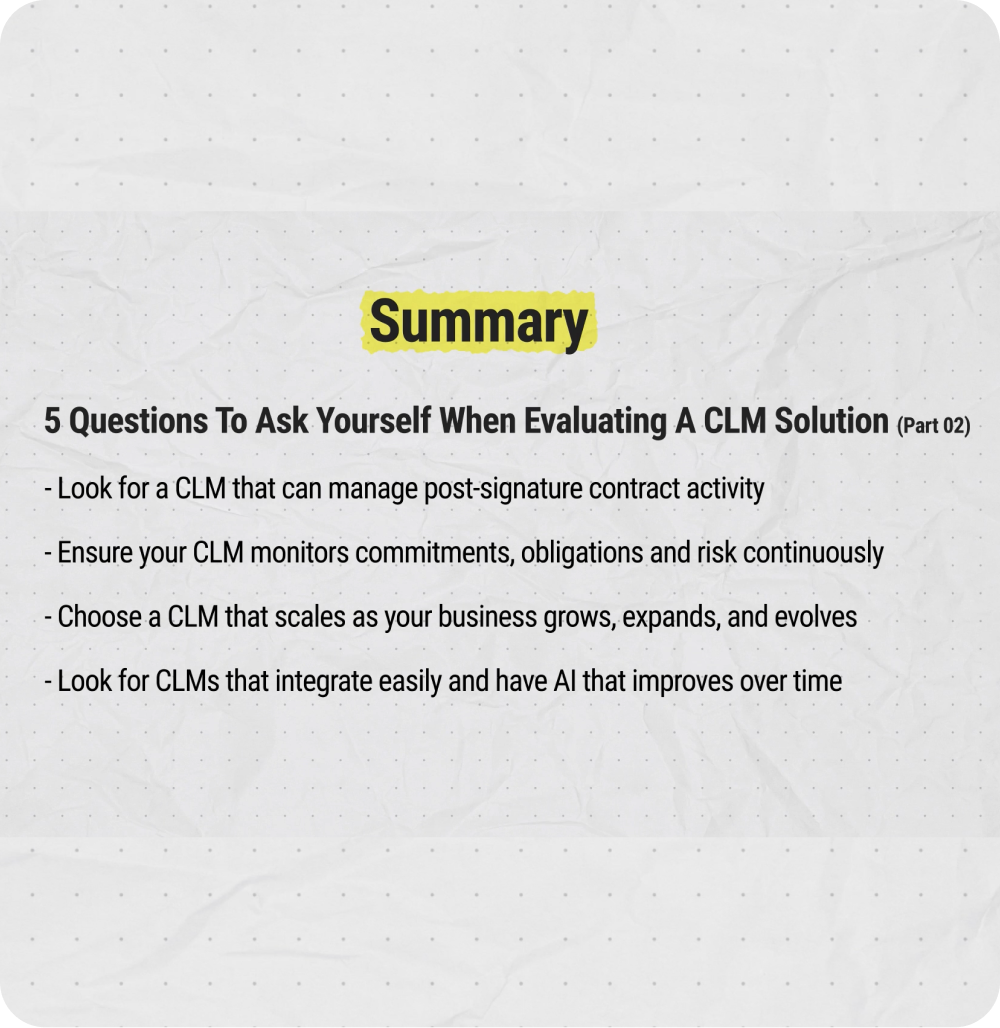
Summary of the episode
Actionable insights
- Evaluate for Post-Signature, Not Just Pre-Signature: Up to 70% of contract lifecycle activity happens after signature. Ask whether the platform can monitor commitments continuously, surface upcoming obligations, and alert teams to risk. That is where CLM value is either protected or lost.
- Plan for Scale Before You Sign: The CLM you choose today needs to support the organization you will become. Look for easy integration with CRM, ERP, and procurement systems, configurable workflows, and a platform that gets more capable as your contract data grows.
- Ask About AI in Terms of Long-Term Utility, Not Just Features: The question is not whether a platform has AI, it is whether it compounds in value over time. Strong AI implementation can reduce manual contract review effort by 50% or more. A strong CLM gets smarter as your data grows.
Read full transcript
Think about the future.
Contracts become more complex as the organization grows.
A good CLM should be more valuable as your contract data grows, not harder to manage.
The 4th question you have to ask is what happens after the contract is signed.
This is one of the most important questions you can ask and one that’s often overlooked.
Most CLM demonstrations focus heavily on drafting and negotiation, but contracting doesn’t stop at signature.
In fact, that’s when the real work begins.
Study suggests that up to 70% of the contract lifecycle activity happens in the post signature phase.
Contracts contain commitments, service levels, pricing structures, delivery schedules, renewal terms.
Managing those commitments is where the organization either protects value or loses it.
A strong CLM platform should help teams monitor those commitments continuously.
It should surface upcoming obligations, alert teams to potential risk, and connect contract terms to real operational data.
This post signature phase is where this real return on investment from CLM often appears.
The 5th question you need to ask is will the platform evolve with your business?
Think about the future.
Contracts become more complex as the organization grows.
You may expand into markets, add new product lines, or integrate additional systems.
You might have mergers and acquisitions down the road.
The CLM platform you choose today should be able to scale to support that growth.
Look for platforms that integrate easily with existing systems like CRM, ERP, and procurement platforms.
Understand how workflows can be configured as your processes evolve, and consider how the platform uses AI to improve contract analysis over time.
This can reduce manual contract review efforts by up to 50% or more.
A good CLM should be more valuable as your contract data grows, not harder to manage.
Here’s what it comes down to.
Contracts define your most important relationships with customers, suppliers, and partners.
Choosing the wrong CLM doesn’t just slow down the contracting process, it makes those relationships harder to manage.
If you start by asking the 5 questions we covered, you’ll be much closer to choosing the right system for your organization.
Thanks for watching and we’ll see you in the next episode.
Ep. 03 - Part 1: Five Questions to Ask Yourself Before Choosing a CLM Solution
Selecting a CLM isn’t a software decision. It’s a business one. Nearly 25% of enterprise employees interact with contracts, according to World Commerce & Contracting (World CC). Yet most teams start with demos, not direction. Before you invest in CLM, get clear on three things: the outcomes you need where your contracts live today, and how this will actually help your teams. The right decision starts with the right questions.
Additional Resources
 4 min read
Why Your Deal Cycle Velocity Numbers Are Lying to You

Stop Clicking. Start Asking: The CLM Experience Shift
Frequently Asked Questions
Why is post-signature contract management so often overlooked in CLM evaluations?
Because most CLM demonstrations are built around the parts of contracting that are easiest to show — drafting speed, negotiation workflows, and e-signature. Post-signature capabilities require more context to demonstrate, so they rarely get the attention they deserve during evaluation, even though that is where most of the lifecycle value sits.
What does post-signature CLM actually cover?
Post-signature contract management includes tracking and meeting contractual obligations, monitoring service levels, managing pricing structures and payment terms, flagging upcoming renewals, and connecting contract commitments to operational data. It is the phase where organizations either capture the value they negotiated or lose it through inattention.
How much of contract lifecycle activity happens after signature?
Studies suggest up to 70% of contract lifecycle activity occurs in the post-signature phase. Despite this, most CLM investments and evaluations concentrate on the pre-signature stages of drafting, negotiation, and execution.
What does CLM scalability mean in practice?
Scalability means the platform can grow with the organization—accommodating new markets, product lines, entities from mergers and acquisitions, additional integrations, and evolving workflows—without requiring significant re-implementation or manual workarounds. A scalable CLM is one that becomes more capable as contract data grows, not more difficult to govern.
How should AI factor into CLM platform selection?
AI should be evaluated for long-term utility, not just current features. The right question is not whether a platform has AI capabilities, but whether those capabilities improve as contract data accumulates. Specific areas to probe include AI-assisted contract review, obligation extraction, risk flagging, and analysis. Strong AI implementation can reduce manual contract review effort by 50% or more over time.
What are the five questions covered across Episode 3?
Part 1 covers: What problem are you actually trying to solve? What does your contract landscape actually look like? Will people actually use the system? Part 2 concludes with: What happens after the contract is signed? Will the platform evolve with your business? Together, these five questions reframe CLM selection from a feature comparison into a business decision.