Top Icertis Competitors in 2026: A Comparative Guide
- May 28, 2026
- 15 min read
- Sirion
- Ironclad remains a strong CLM platform for mid-market and growing enterprises focused on collaborative legal workflows.
Many businesses still evaluate Ironclad competitors when they need deeper analytics, ongoing contract operations visibility, or enterprise-scale operational governance. - AI capabilities are becoming a major differentiator among CLM platforms.
Modern contract management software increasingly includes AI-driven contract review, obligation extraction, workflow automation, and conversational search. - Different CLM platforms solve different business problems.
Some tools prioritize ease of use and fast deployment, while others focus on enterprise governance, compliance, and end-to-end contract lifecycle management. - Integration flexibility and operational scalability matter as much as features.
Organizations increasingly evaluate how contract data connects with ERP, CRM, procurement, and finance systems across the enterprise. - Sirion differentiates itself through AI-native operational intelligence and post-award contract management.
Its enterprise-grade architecture and agentOS platform support complex contracting environments across procurement, legal, and supplier operations.
Contracts are no longer just legal records sitting in repositories. They influence procurement operations, supplier accountability, revenue realization, compliance governance, and enterprise risk management. As organizations scale, managing contracts manually becomes increasingly difficult, pushing enterprises toward modern contract lifecycle management (CLM) platforms.
Ironclad has emerged as one of the most recognized names in CLM, particularly among legal and commercial teams seeking collaborative workflow automation. However, businesses evaluating long-term contract management strategies often compare multiple Ironclad competitors to determine which platform best aligns with their operational needs, AI priorities, and scalability goals.
This guide compares the leading Ironclad alternatives in 2026, including their strengths, limitations, AI capabilities, pricing considerations, and ideal use cases to help businesses choose the right CLM solution.
Why Companies Explore Alternatives to Ironclad
Ironclad is widely known for its modern interface and collaborative contract workflows. It has become particularly popular among legal teams looking to streamline approvals, negotiation, and contract authoring.
But as enterprise contracting requirements evolve, organizations often discover that their needs extend beyond workflow automation alone.
Some businesses require stronger post-signature visibility. Others prioritize AI-driven analytics, obligation management, procurement integration, or operational governance at scale. In many cases, companies are not necessarily replacing Ironclad because it lacks capability. Instead, they are evaluating whether another platform may align more closely with their long-term operational strategy.
Cost and Licensing Factors
Pricing is often one of the first considerations during CLM evaluation.
For smaller organizations or mid-market businesses, enterprise-grade CLM deployments can quickly become expensive once implementation services, integrations, onboarding, and workflow customization are added to licensing costs.
Some companies therefore evaluate Ironclad alternatives that offer:
- Simpler pricing structures
- Faster implementation
- Reduced administrative overhead
- Lower total cost of ownership
Affordability becomes especially important for organizations that do not require highly customized enterprise governance workflows.
Missing or Specialized Features
As CLM platforms evolve, organizations increasingly expect contracts to function as operational intelligence systems rather than static repositories.
Some businesses evaluating Ironclad competitors look for:
- Advanced obligation tracking
- Supplier performance monitoring
- AI contract analytics
- Contract risk intelligence
- Portfolio-level reporting
- Deep procurement integration
For example, procurement-heavy enterprises may need visibility into post-award supplier obligations, while financial institutions may prioritize explainability and governance controls.
Explore Best AI tools for Contract Search and Analysis to understand how AI-powered search, clause analysis, and contract intelligence help teams surface risks and insights faster.
This is where specialized CLM vendors often differentiate themselves.
User Experience and Deployment
Ease of adoption remains one of the most important drivers of CLM success.
Even feature-rich platforms can struggle if legal, procurement, finance, and sales teams find the workflows difficult to navigate consistently.
Organizations evaluating Ironclad alternatives frequently compare:
- Interface usability
- Learning curves
- Deployment timelines
- Workflow configuration complexity
- Training requirements
Some vendors prioritize rapid onboarding and simplicity, while others focus more heavily on enterprise configurability and governance depth.
Tailored Solutions for Specific Industries
Industry requirements often shape CLM selection decisions.
Healthcare organizations may require stronger compliance workflows and auditability. Financial institutions typically prioritize governance transparency and explainable AI. Manufacturing enterprises often need deeper supplier performance tracking and procurement visibility.
As a result, many organizations evaluate whether a CLM vendor supports the operational realities of their industry rather than offering generic workflow automation alone.
Right-Sized Options for Smaller Teams
Not every organization requires enterprise-scale CLM complexity.
Some legal and commercial teams primarily need:
- Faster approvals
- Centralized repositories
- Template management
- E-signature workflows
- Lightweight collaboration
For these businesses, highly configurable enterprise platforms may introduce unnecessary operational overhead. Simpler CLM tools can sometimes deliver faster adoption and quicker ROI for smaller teams.
Evaluation Methodology for Ironclad Competitors
Choosing the right Ironclad alternative requires more than comparing feature lists.
Contracts influence procurement operations, supplier governance, compliance management, revenue realization, and enterprise decision-making across multiple departments. Because of this, evaluating a CLM platform requires understanding how effectively it supports operational workflows across the full contract lifecycle.
Our comparison framework focused on the areas most relevant to enterprise contract operations.
Core Functional Capabilities
Every CLM platform supports contract storage and approvals to some extent. The real difference lies in how deeply the platform manages the lifecycle beyond those basics.
Some vendors focus heavily on pre-signature workflows such as drafting, negotiation, collaboration, and approvals. Others extend much further into post-signature activities like obligation tracking, supplier performance management, compliance monitoring, renewals, and operational reporting.
Organizations evaluating a modern contract lifecycle management solution increasingly prioritize end-to-end visibility rather than repository functionality alone.
AI and Automation Comparison
AI is rapidly reshaping the CLM market.
However, not all AI capabilities deliver the same operational value.
Some platforms focus on lightweight automation such as metadata extraction and clause suggestions. Others support AI-native workflows that include:
- Contract summarization
- Conversational search
- Issue detection
- Workflow recommendations
- Risk analytics
- Obligation extraction
We also evaluated how vendors support contract automation through workflow orchestration and operational intelligence.
Integration and Workflow Compatibility
Contracts rarely operate independently from enterprise systems.
Commercial terms often need to connect directly with:
- ERP platforms
- CRM systems
- Procurement workflows
- Legal operations tools
- Finance environments
- Supplier management systems
Weak integrations frequently force teams back into spreadsheets and manual reconciliation processes. Integration maturity therefore remains a major evaluation factor for enterprises pursuing connected operations.
Return on Investment and Pricing
Pricing discussions should extend beyond licensing costs alone.
Organizations should also evaluate:
- Implementation effort
- Workflow customization requirements
- Training overhead
- Scalability costs
- Ongoing support needs
In many cases, platforms with stronger automation and operational visibility may generate better long-term ROI despite higher upfront investment.
Support, Training, and Onboarding
Successful CLM adoption depends heavily on implementation quality and change management.
We evaluated vendors based on:
- Customer support responsiveness
- Onboarding assistance
- Training resources
- Enterprise implementation maturity
- Long-term customer success engagement
For large enterprises especially, implementation expertise can significantly influence adoption outcomes.
The Best Contract Management Software Alternatives to Ironclad
Tool Name | Best For |
Sirion | Large enterprises needing post-award contract tracking and operational intelligence |
Agiloft | Organizations seeking highly customizable no-code CLM |
Juro | Mid-market teams requiring fast deployment and collaboration |
DocuSign CLM | Companies prioritizing e-signature and workflow automation |
Conga CLM | Salesforce-centric enterprises needing contract automation |
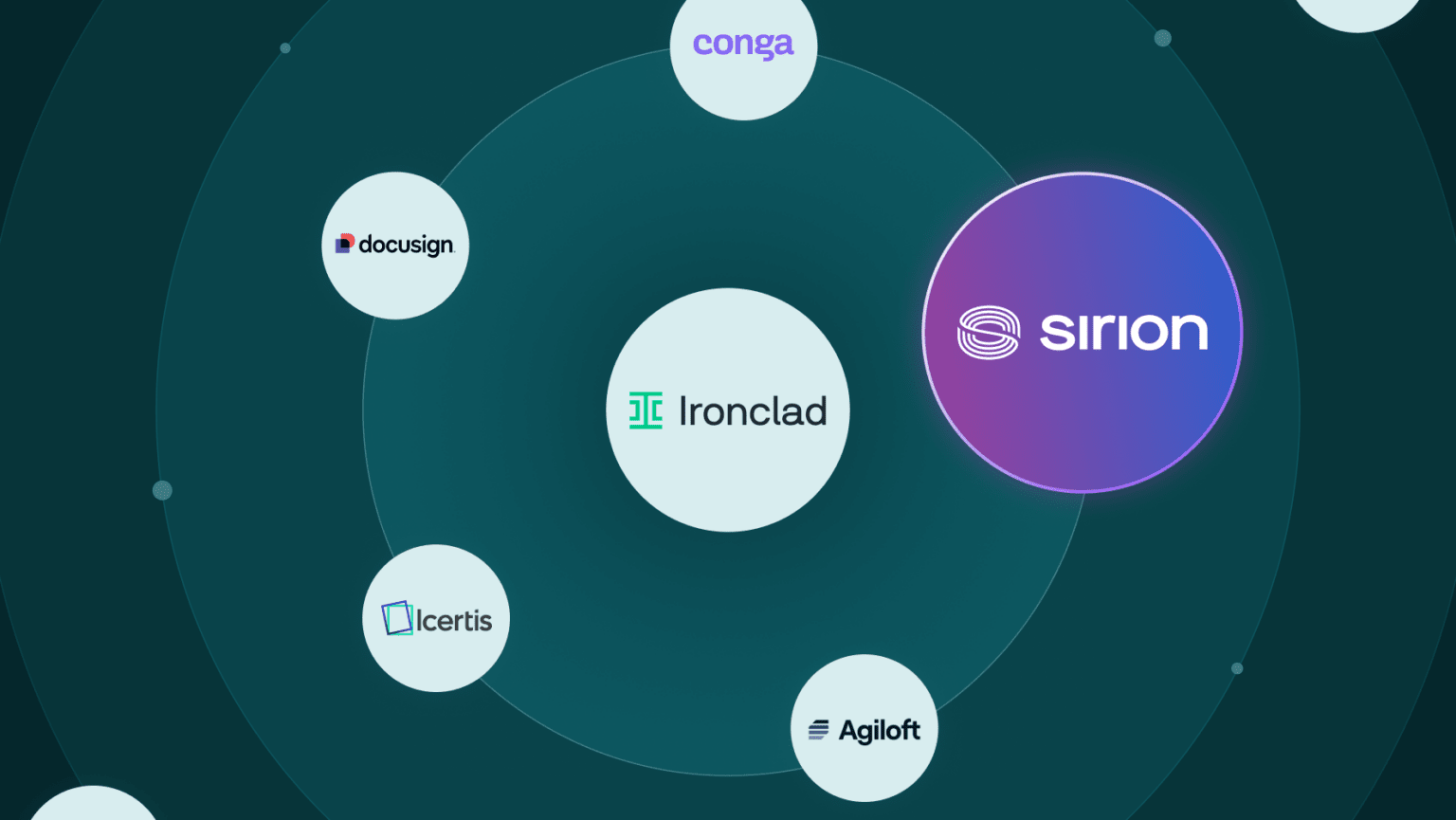
Icertis | Large enterprises requiring comprehensive enterprise CLM governance |
Sirion
Sirion is an AI-native CLM platform built for large enterprises managing complex procurement, legal, supplier, and operational contracting workflows. The platform combines AI-driven intelligence, workflow orchestration, obligation management, and analytics across the full contract lifecycle.
Key Features
- AI-native contract intelligence embedded across the lifecycle
- Real-time obligation and milestone tracking
- Configurable workflows for procurement, legal, and supplier operations
- Performance visibility tied directly to contractual commitments
- Enterprise reporting and operational analytics dashboards
Pros
- Particularly strong for post-signature contract governance
- Supports complex enterprise procurement environments well
- Deep visibility into supplier obligations and operational risk
- Extensive AI and analytics capabilities for large-scale operations
Review Alternatives to Ironclad to compare CLM platforms based on AI capabilities, lifecycle coverage, integrations, and enterprise scalability.
Cons
- Better suited for enterprises than smaller businesses
- Advanced functionality may require broader organizational adoption
Pricing
Enterprise subscription pricing customized based on deployment scope, integrations, and modules.
Reviews
Sirion is frequently recognized in analyst evaluations for enterprise CLM innovation, AI capabilities, and post-signature contract intelligence.
|
Agiloft
Agiloft is known for its no-code configurability and highly customizable workflow architecture.
Key Features
- No-code workflow and approval configuration
- Flexible compliance and governance automation
- AI-assisted contract workflows and reporting
- Custom dashboards and process orchestration
- Centralized repository management
Pros
- Extremely adaptable for unique operational requirements
- Strong compliance and governance flexibility
- Allows teams to customize workflows without heavy coding dependencies
- Useful for organizations with specialized approval structures
Cons
- Can require more administrative oversight over time
- Implementation timelines may be longer for highly customized deployments
Pricing
Custom enterprise pricing depending on deployment requirements.
Reviews
|
Juro
Juro focuses on collaborative contracting and ease of use for growing legal and commercial teams.
Key Features
- Browser-native contract collaboration
- Template-driven contract creation
- Automated routing and approvals
- Embedded e-signature support
- Streamlined workflow management
Pros
- Fast onboarding for business and legal teams
- Clean interface with minimal learning curve
- Strong collaboration experience across departments
- Well suited for growing commercial organizations
Cons
- Limited advanced governance functionality for highly regulated enterprises
- Analytics and operational reporting are less extensive than enterprise-focused platforms
Pricing
Per-user subscription pricing.
Reviews
DocuSign CLM
DocuSign CLM extends DocuSign’s e-signature ecosystem into broader contract lifecycle management workflows.
Key Features
- Integrated e-signature workflows
- Automated approval routing
- Centralized contract storage
- Workflow automation and notifications
- Standard reporting capabilities
Pros
- Familiar ecosystem for existing DocuSign users
- Strong integration support across business tools
- Easy adoption for signature-heavy workflows
- Widely recognized platform with broad market familiarity
Cons
- Less flexible for highly specialized enterprise governance models
- Advanced analytics may require supplementary tools or integrations
See DocuSign vs other CLM Solutions Comparison to understand how DocuSign CLM compares with other platforms on workflow automation, integrations, analytics, and contract governance.
Pricing
Pricing varies based on deployment scale and features.
Reviews
|
Conga CLM
Conga CLM is frequently selected by enterprises with strong Salesforce-centric operations.
Key Features
- Native Salesforce connectivity
- Automated contract generation and workflows
- Clause and template management
- Approval orchestration
- Reporting and sales workflow visibility
Pros
- Strong fit for Salesforce-driven sales organizations
- Helps connect contract workflows directly with CRM operations
- Useful for automating commercial contracting processes
- Good workflow flexibility for sales teams
Cons
- Some users find the interface more complex during setup
- May require additional technical expertise during implementation
Pricing
Enterprise pricing varies based on modules and integrations.
|
Icertis
Icertis is one of the most established enterprise CLM vendors, offering broad governance and lifecycle management capabilities.
Key Features
- Enterprise-wide lifecycle orchestration
- AI-powered contract analysis
- Governance and compliance management
- Multi-region workflow support
- Extensive integration capabilities
Pros
- Well suited for large-scale enterprise governance
- Broad lifecycle management coverage
- Strong support for global contracting operations
- Mature enterprise configurability
Cons
- Implementation complexity can be significant
- May introduce more operational overhead for leaner teams
Pricing
Customized enterprise subscription pricing.
Reviews
|
Why Some Businesses Prefer Sirion Over Ironclad?
Ironclad is often associated with collaborative legal workflows and streamlined contract authoring, particularly for mid-market and growing enterprise organizations looking for faster deployment and easier adoption. Its strengths typically lie in simplifying approvals, collaboration, and pre-signature contracting processes.
However, for some enterprises, contract management requirements extend well beyond drafting, approvals, and execution.
Large organizations managing complex supplier ecosystems, outsourcing agreements, procurement operations, and regulatory obligations often need deeper visibility into what happens after signature. This is where some businesses prefer Sirion over Ironclad.
Sirion is built as an end-to-end contract lifecycle management platform designed for large enterprises. The platform supports the full contract journey, from authoring and negotiation through post-award governance, obligation management, compliance tracking, supplier performance monitoring, and operational analytics.
For enterprises operating at scale, post-award visibility can become just as important as pre-signature efficiency. Procurement and supplier teams often need to monitor service-level commitments, track obligations, identify commercial risks, and measure contract performance continuously after execution. Sirion places significant emphasis on helping organizations operationalize these downstream workflows.
Another differentiator is Sirion’s AI-native architecture.
The platform combines conversational AI, workflow orchestration, analytics, and operational intelligence to help enterprises manage large contract portfolios more effectively. Through agentOS, organizations can deploy specialized AI agents that support metadata extraction, issue detection, contract summarization, workflow recommendations, and conversational search across contracting operations.
This broader operational focus often makes Sirion particularly attractive for:
- Large procurement-heavy enterprises
- Global organizations managing complex supplier relationships
- Businesses requiring stronger compliance and governance visibility
- Enterprises prioritizing post-award contract management and operational intelligence
While Ironclad is often a strong fit for mid-market organizations and teams prioritizing collaborative legal workflows, some large enterprises choose Sirion when they require deeper end-to-end lifecycle management and stronger post-signature operational oversight.

Experience AI-Native CLM in Action
See how Sirion transforms contracting with automation, compliance, and faster time-to-contract.
Selecting the Right Ironclad Alternative
Choosing the right Ironclad alternative depends on what your organization expects contracts to do beyond approvals and signatures.
Some businesses prioritize collaboration and ease of use. Others need deeper governance, operational visibility, procurement oversight, or AI-driven contract intelligence. The best-fit platform often depends on the complexity of your contracting environment and how contracts connect to broader business operations.
If You Need Faster Deployment and Simpler Workflows
Organizations with lean legal teams or growing commercial operations often prioritize:
- Quick onboarding
- Easy collaboration
- Minimal administrative overhead
- Faster time-to-value
Platforms like Juro are commonly chosen in these scenarios because they focus on usability and lightweight workflow management rather than deep enterprise configurability.
This approach works well for:
- Mid-market businesses
- Fast-growing SaaS companies
- Teams modernizing manual approval processes
The trade-off is that simpler platforms may offer less operational depth as governance complexity increases.
If You Need Enterprise Governance and Customization
Large enterprises often require:
- Complex approval structures
- Multi-region governance
- Compliance management
- Advanced permission controls
- Extensive workflow customization
Platforms like Agiloft and Icertis are often evaluated for these requirements because they support highly configurable enterprise workflows.
These solutions may be better suited for:
- Global enterprises
- Highly regulated industries
- Organizations with mature procurement or compliance operations
However, greater configurability can also mean:
- Longer implementations
- Higher administrative overhead
- Increased change management requirements
If Salesforce Integration Is a Priority
Organizations heavily dependent on Salesforce frequently evaluate Conga CLM because of its close CRM alignment.
This is particularly relevant for businesses where:
- Sales contracting is high volume
- Quotes and contracts are closely connected
- Revenue workflows depend heavily on CRM synchronization
Conga can help commercial teams automate contract generation and approvals directly within Salesforce environments.
The trade-off is that implementation and administration may require stronger technical expertise.
If E-Signature Workflows Are Central
Businesses already standardized on DocuSign often explore DocuSign CLM to maintain ecosystem consistency.
This approach can simplify:
- User adoption
- Signature workflows
- Basic contract automation
- Integration management
It is often a strong fit for organizations prioritizing familiarity and fast rollout.
However, businesses needing deeper operational analytics or highly specialized governance may eventually require broader enterprise functionality.
If Ongoing Contract Operations Matter Most
For many large enterprises, the biggest contract challenges begin after execution.
Procurement teams may need visibility into:
- Supplier obligations
- Service-level commitments
- Compliance milestones
- Commercial risks
- Performance tracking
This is where some organizations prefer Sirion.
Sirion is designed for large enterprises requiring end-to-end contract lifecycle management across both pre-signature workflows and ongoing contract operations. The platform places strong emphasis on operational visibility after contracts are finalized, helping organizations manage obligations, monitor supplier performance, and operationalize contract data across procurement, legal, finance, and compliance teams.
Its AI-native architecture also supports advanced capabilities such as:
- Conversational contract intelligence
- Issue detection
- Workflow recommendations
- AI-driven analytics
- Contract summarization
This makes Sirion particularly relevant for:
- Procurement-heavy enterprises
- Global supplier ecosystems
- Outsourcing-intensive organizations
- Enterprises prioritizing operational governance at scale
How to Evaluate ROI and Long-Term Scalability
ROI should not be measured only through licensing costs.
Organizations should also evaluate:
- Reduction in manual review effort
- Faster negotiation cycles
- Improved compliance visibility
- Better supplier accountability
- Reduced revenue leakage
- Long-term scalability
A lower-cost platform may initially appear attractive but create limitations as operational complexity grows. Conversely, a more advanced enterprise platform may require greater upfront investment while delivering stronger automation, governance, and operational visibility over time.
Ultimately, the best Ironclad alternative is the one that aligns most closely with your organization’s operational complexity, industry requirements, AI strategy, and long-term contracting goals.
Conclusion
The market for Ironclad competitors continues to evolve as enterprises demand more intelligence, automation, and operational visibility from contract lifecycle management platforms.
While Ironclad remains a strong option for collaborative legal workflows, many businesses evaluate alternatives based on AI capabilities, post-award contract management, analytics depth, integration flexibility, and enterprise scalability.
Platforms such as Sirion, Agiloft, Juro, DocuSign, Conga, and Icertis each bring different strengths depending on organizational priorities and operational complexity.
As AI adoption accelerates, organizations increasingly need contract lifecycle management software capable of transforming contracts into connected operational intelligence rather than static documents alone.
Frequently Asked Questions (FAQs)
What are the top Ironclad alternatives for companies?
Some of the leading Ironclad alternatives include Sirion, Agiloft, Juro, DocuSign CLM, Conga, and Icertis. Each platform serves different operational needs depending on factors such as enterprise scale, AI capabilities, workflow complexity, integration requirements, and post-signature contract management priorities.
How do integration capabilities differ among Ironclad competitors?
Integration capabilities vary significantly between CLM platforms. Some vendors focus primarily on CRM connectivity, while others support broader ERP, procurement, legal operations, and supplier management integrations. Enterprises should evaluate how deeply contract data flows across business systems rather than simply whether integrations exist.
Which competitors excel in end-to-end contract management?
Platforms such as Sirion and Icertis are often recognized for end-to-end contract lifecycle management capabilities that extend beyond authoring and approvals into post-award obligation tracking, compliance monitoring, operational analytics, and supplier governance.
How can AI improve contract management across competitors?
AI can automate metadata extraction, contract review, issue detection, obligation tracking, workflow recommendations, conversational search, and risk analysis. More advanced AI-native platforms also help enterprises operationalize contract intelligence across procurement, legal, finance, and supplier operations.
What should businesses consider when evaluating ROI for a CLM platform?
Organizations should evaluate total cost of ownership, implementation effort, scalability, workflow automation benefits, operational visibility, compliance improvements, and long-term administrative overhead. ROI should be assessed based on operational efficiency gains rather than licensing costs alone.
Sirion is the world’s leading AI-native CLM platform, pioneering the application of Agentic AI to help enterprises transform the way they store, create, and manage contracts. The platform’s extraction, conversational search, and AI-enhanced negotiation capabilities have revolutionized contracting across enterprise teams – from legal and procurement to sales and finance.